Last updated late June.
New photos begin at 14-196. You will have to scroll down manually for them as there is no automated facility.
Intro
Welcome to the first “post-apocoliptic” operating session of the AFK, following the closure of the original web site. A lot of the background information is no longer available, although I have kept copies, but I will do my best to provide what seems relevant. It has been some time since the last session as the AFK and other layouts have received attention. Unfortunately family health issues, necessitating a fair amount of travelling, have prevented this session starting as early as I would have liked. They may also interfere with matters as things progress. A number of time consuming minor defects were picked up as the locos had their wheels cleaned and were tested on the work bench. These have been resolved, as far as possible, but replacing perished traction tyres on models that went out of production donkey’s years ago involves some creative bodging!
Setting
“Today” is Tuesday 10th June. As we near the summer solstice the daylight hours last from 04.30 until 21.00. Although we are technically in spring this is the first of the summer sessions. This leaves a gap of almost one calendar month since the previous session. Obviously, in reality, the issues arising then would have been long since resolved but as far as the model is concerned the aftermath of those problems will be carried over into this session. The only exception to this general procedure is the disposition of locomotives which are usually switched between rosters. I suppose that this is inconsistent but Rule 1 applies!
New developments
A couple of new traffics have been added to the mix and certain industries have been relocated at Lacono. The “off-scene” shunting areas are now represented as magnetic diagrams where shunting times can properly be calculated. As an aside I have a magnetic railway, carved up from a travelling chess set, that I used to “operate” on the long bus journeys when I went out as a DofE leader.
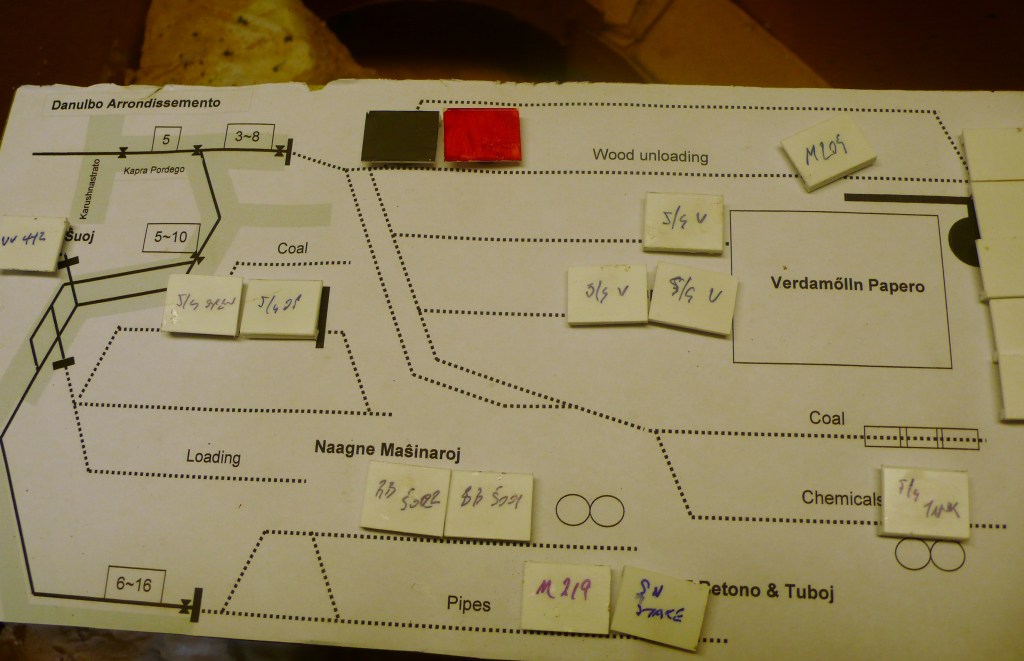
14-01. This area shows the Danulbo arrondissmento at Lacono representing the sidings in the industrial estate served by the “new cassette” accessed through the “door” across the road from the main station. The red and black markers represent locos. Locos and wagons disappeared into this area, arriving back “as convenient”, without any real idea of where they had been or what they had been doing. This board will give a much clearer idea of what should appear on the layout and when. It is noticeable, in the bottom left hand corner, that it will now take 16 minutes to reach the cement silos and the pipe factory and that is before any shunting begins. The factory currently holds 2 silos, an open and a SG stake wagon. These are held in drawers close to the cassette.The sharp eyed will note that a shoe factory has been added to the mix.
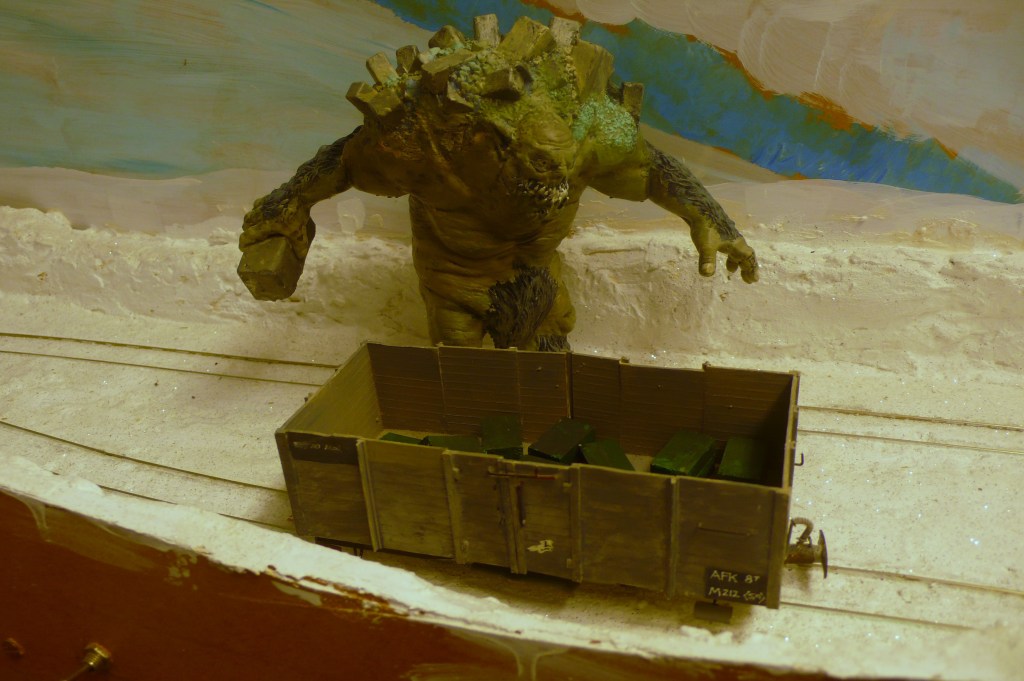
14-02 Some of you might remember that Steinkastir, the absconding troll, was apprehended by the Narnian legate at Caladonno, during the last session (13). The relevant photos were not posted on this thread (but could be shown if there is sufficient demand!) It was all a bit of fun and I do not intend to make a major feature of the strange goings on in Narnia. Steinkastir, now resident in his deluxe troll hole in the snow, is employed to quarry Narnite. Narnite is rumoured to be fossilised Marmite which metamorphosis has turned into a heavy greenish black stone that can be polished to resemble marble. As far as the AFK is concerned this is an excellent development because it provides an additional revenue stream. The quarrying and loading is, of course, a nocturnal activity because trolls turn to stone in daylight. The AFK simply leaves an open wagon overnight which is magically loaded with stone the next day. Perhaps someone is losing their marbles and it might not be Steinkastir!
The summer sees numerous fairs in the mountain villages and the AFK makes arrangements to serve them. Today it is Ithilarak fair.
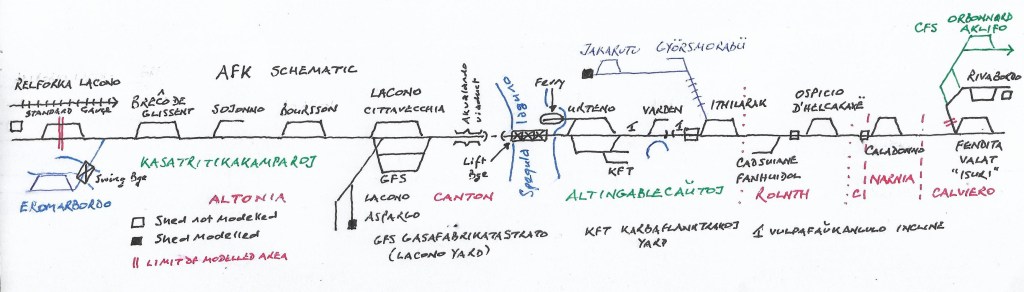
This is the system map for the AFK. It should help to locate where the various photos were taken.
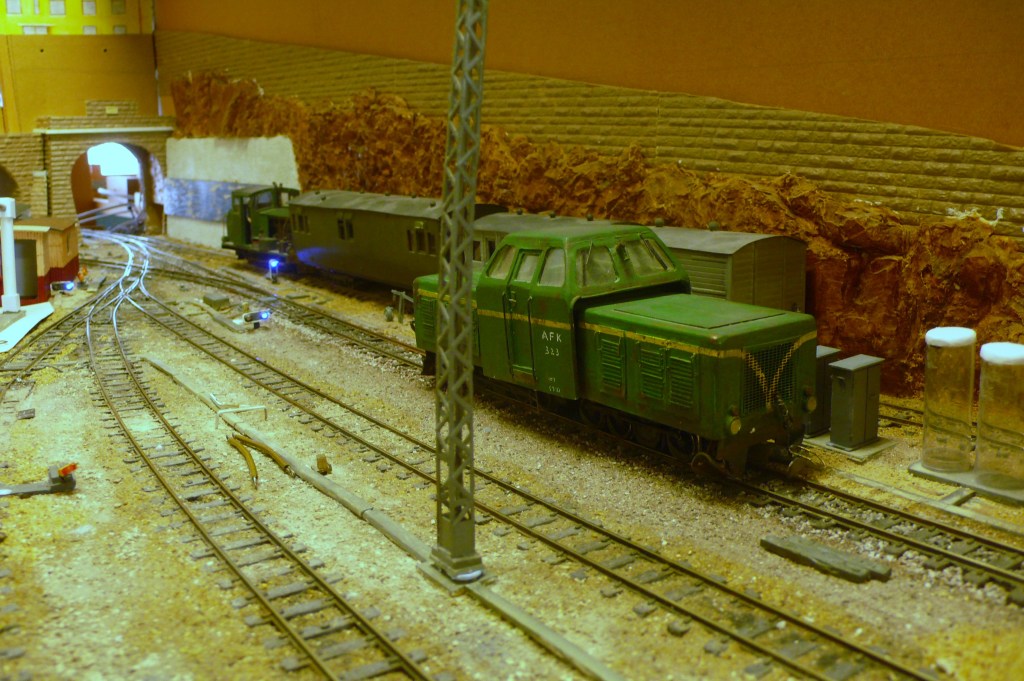
14-03. At 00.30 Lacono Cittavecchia is a busy place, much to the chagrin of those trying to sleep in the nearby tenement housing. The pilot, the diesel shunter in the background, propels empty horse boxes into the spare siding. These were brought in on the rear of the cement empties, which is standing in the yard waiting for a crew. The paper train loco, the crocodile seen here, has come off Aspargo shed to begin piecing its train together. The first cut of wagons has been brought in by the fireless, which is waiting for the pilot to finish its moves before retreating under the box.
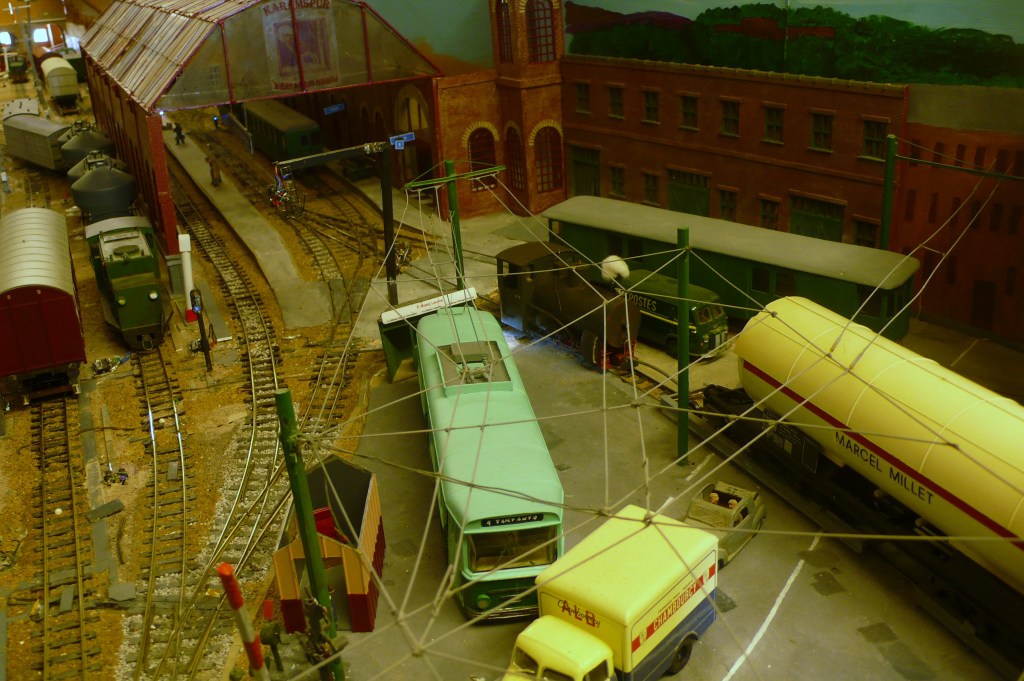
14-04. A cataclysmic failure of the point crossing microswitches necessitated an emergency stop shortly after the session began. The activator fingers became detached from the tie rod operating No 20 points, the set beside the bus shelter, which lead to the diamonds across the route into platform 1. This had happened before and was supposed to have been fixed. The remedy calls for a large Watt iron whilst trying to view proceedings via a mirror placed on the track at Eromarbordo. This circus act was a major fiddle last time around and this time was no different. It was not possible to get sufficient heat onto the point rod to secure the activators. In the end I took the drastic decision to run the operating rod along the surface and place the switches there as well. One is visible beside the loco in the yard. I suppose that I should have done this previously but you know how it is! Large chunks of the recently installed cabling runs came away as a result of these strongarm tactics so they will gradually have to be replaced. I never have been a great fan of underboard mechanisms. Some seem to be able to get them to work reliably but I never can. In fairness they have worked okay for probably twenty years but they are showing their age, just like their creator! At 01.30 the fireless returns with a second cut of wagons including an empty chlorine tanker on the transporters. The recently completed fireless runs in over the offending crossings, which are now behaving themselves. The white light from the signal authorising the move reflects on the loco cab. This is the inverted signal where the white and blue aspects were inadvertently crossed. As this sometimes happened on continental railways it has been left alone. Obviously there would be little road traffic around at this time of night but I prefer to leave the vehicles as they are
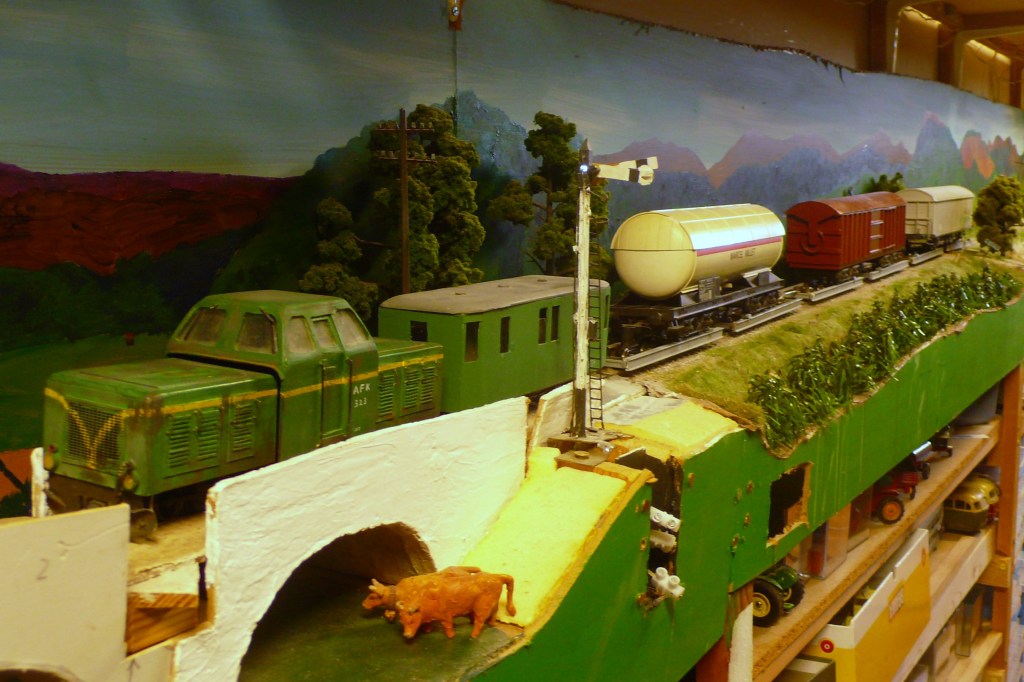
14-05. The paper train was let out of Lacono early, as is often the case. It is running on the down cement train’s path which is used every other day but that train is running north today. It stops at Breĉo de Glissent enirasignalo as it is required to, because the station is not open at 03.00. The loco sounds the horn, as per regulations, passes the signal at danger and runs “prepared to stop on sight”. The crew will then clear the signals for the Urteno goods to pass. The train “weighs in” at 240 tons, which is above the 220 tons general limit, because it is specifically exempted from the limit, providing that the consist is solely composed of transporters. There still are not enough of these available to meet demand so the crossing up train will be formed using transporters scrounged from elsewhere. Once this train arrives at Relforka the issue will be resolved as the six transporters will immediately, and unrealistically, become available.
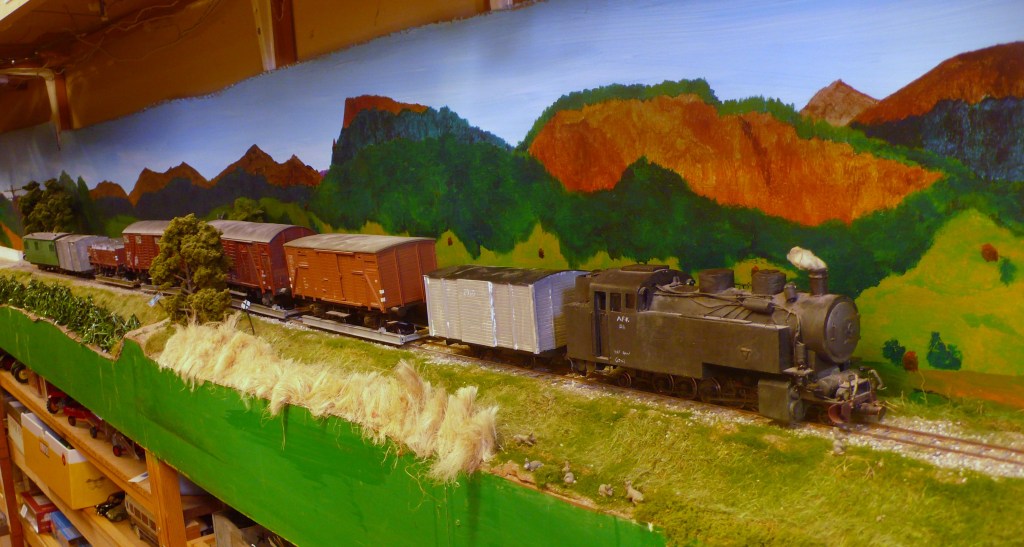
14-06. The AFK is awakening from its slumbers as the Urteno goods crosses the Kasatritikakamparoj behind the 2-10-2T. Even allowing for the approach to the solstice it would still be running in darkness. The train serves Lacono, the modern day provincial capital and largest settlement in Marronĝaco, although it only runs to 12,000 population. As per usual the train is loaded to the maximum 200 tons and contains four SG wagons on transporters. Only the front NG van and SG van will run through to Urteno.
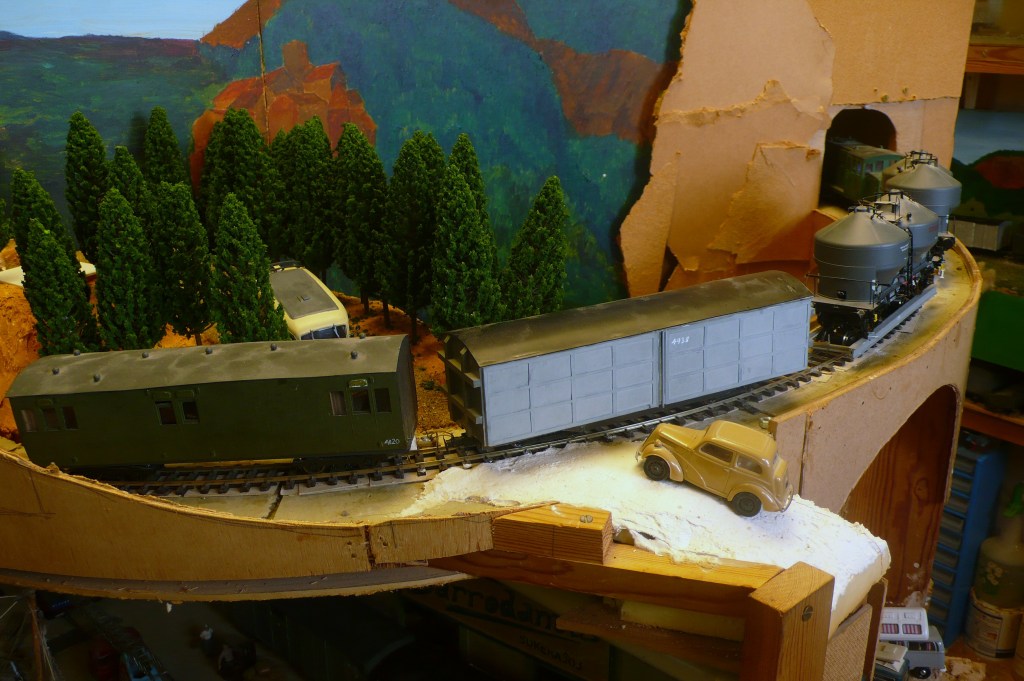
14-07. The northbound cement train is also underway, running slightly early. It is seen here crossing Akvalando viaduct, a cheap rip off of Landwasser. The slidewall van is returning to the dairy at Fenditavalat from the chocolate factory. This normally returns on the afternoon mixto but the consist is altered to carry the observation carriage in summer and alternative arrangements are made. I always wondered why I built three of these vehicles, other than that there was space on the styrene sheets to mark out six sides. Now I know why as all three are needed in summer.

14-08. The incessant shunting continues at Gasafabrikatastrato yard. The Sisyphus nickname is bestowed upon whichever loco is the shunter rather than being specifically allocated to the 0-6-2T which normally does the job. Ironically the steam loco received repairs between sessions and is now running well but I like to ring the changes hence the 0-6-0 diesel taking the role today. The KTT goods is being formed on the middle road and the SG van is in the process of being transferred to the chocolate factory. There seem to be more NG vans than normal in the yard today.

14-09. The Altingablecaŭtoj goods follows the Urteno train, as the skies begin to lighten. There is not usually too much traffic for the ‘High Reaches’, a desolate, thinly populated area, with the exception of Fenditavalat, the former Roman provincial capital. The train is usually made out to the full tonnage allowance by including goods for Urteno or Lacono which cannot be accommodated on the dedicated service. The empty tank wagon is returning to the Győrsmorabŭ on the Jakarutu branch where a couple of loads already await and the bulldozer is going to the quarry at Ospicio. This thing is a bit of a nuisance in that it is out of gauge and has already clouted a bridge abutment. A careful eye will need to be kept on it. I had intended to finish the loco before the session began but there was insufficient time to do this so it remains sketched in.

14-10. At 04.30 the RFK-FDV goods runs under clear signals through Boursson courtesy of the trajnaĉefo working the local KTT goods. This train ran into the loop leaving just enough time for the “guard” to work the frame. This is standard “out of hours” practice on the AFK because the station does not officially open until 06.00 when the staciaĉefino, or more likely her husband, the local track walker, comes on duty. This would not be necessary on most NG railways but the AFK has become a de facto surrogate for the mainline SG system and now works 24/7.
The local goods is booked to shunt for almost three hours because it has to cross three trains and frequently needs to remarshal its train which is often sent out “rough” due to time pressure in the yard. It also consolidates the up wagons into a block for easy pick up by its counterpart up KTT local goods and moves wagons around the station as needed. The Fenditavalat train is booked to stop for 25 minutes if necessary to drop urgent wagons for Sojonno. As per usual this is not needed today so the train is running north almost half an hour early.
The bulldozer and the flat have already caused a derailment and, following a subsequent repeat performance, the wagon was replaced. It has the fine flange profile (RP45?) common on US models which is generally incompatible with the AFK’s rustic track.
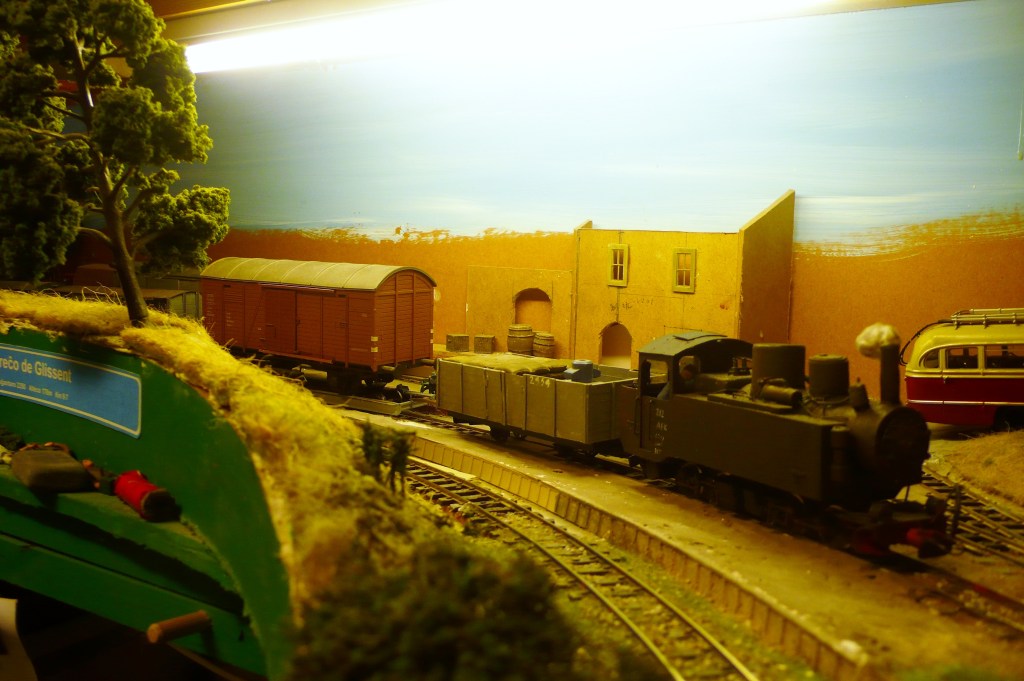
14-11. The morning goods train for Eromarbordo, on the branch, arrives slightly early at Breĉo de Glissent. Normally it is only booked sufficient time to run round and depart but, because the paper train ran early, there is time for shunting today. The consist of the train has changed markedly from the previous sessions in that there are no SG refrigerator vans attached because the fish shoals have moved away and the traffic has dropped back to normal levels. There are enough SG vans at the port to cope with any demand today. The SG van behind the loco represents the railway’s response to another seasonal traffic in that it has been ordered by the BdeG staciaĉefino to take away the strawberry traffic which is now prevalent. On a small model railway system this is but a token nod to the changing seasons but transient traffic has been a feature of AFK operating seasons for around forty years.
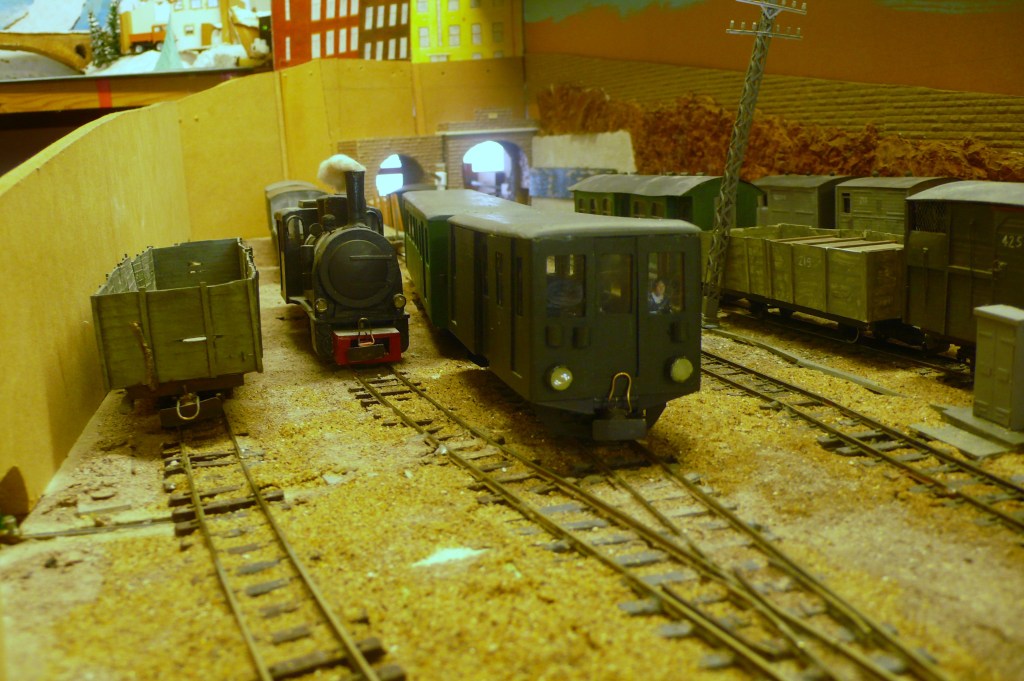
14-12. The limited capacity of model railway station layouts means that the AFK is often only a couple of steps away from disaster. The early arrival of the Fenditavalat goods at 05.05 (seen in photo 10) blocks the goods yard at Gasafabrkatastrato. Unfortunately the ABC schools’ railcar departs from the goods yard rather than the platforms. You might remember that this “railcar” adopts multiple personae and only boards school children from Ithilarak onwards. On this leg of its journey it tends to load with the hospital workers going onto early shifts at the regional hospital in Urteno. They are used to wandering across the platform road to reach the train standing on the goods loop. To reach the north end of the goods loop the railcar runs through the yard which necessitates the FDV goods loco backing into a convenient siding. The “railcar” has become a powered luggage van and driving coach to cope with the increased tail traffic in the summer months. Neither is finished but they both received roofs during the interregnum to at least make them look respectable.
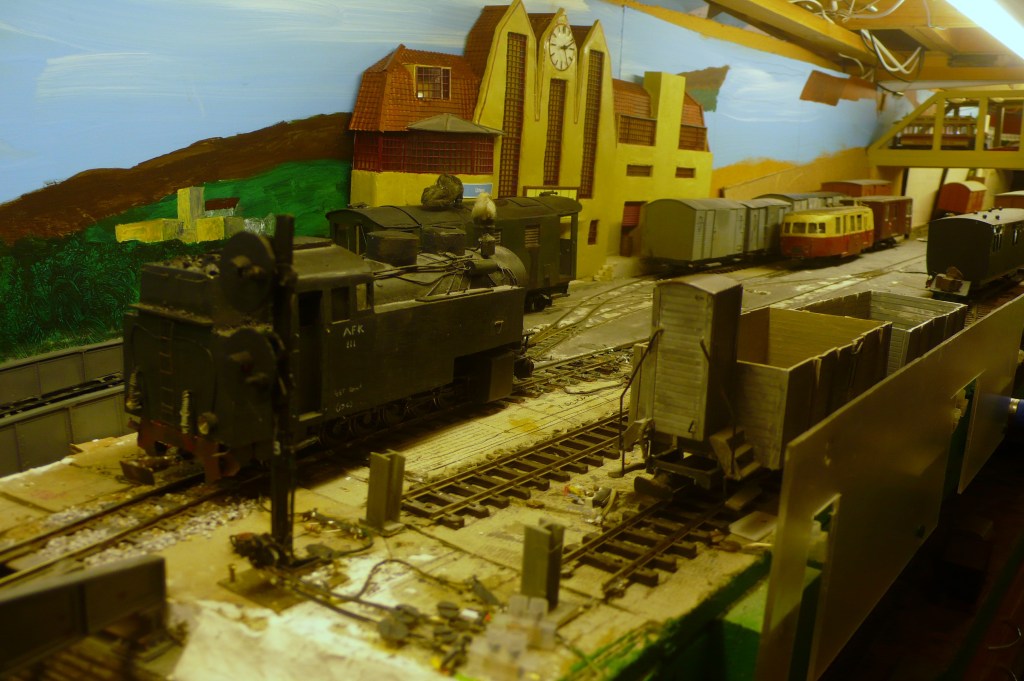
14-13. Urteno is a busy place at 05.15. The 2-10-2T which brought in the terminating goods train is running round its train whilst the pilot has moved across to the ferry slip to remove the wagons that came in on the 04.15 sailing from Karamspur. The railcar, standing in the passenger loop, is due to depart at 05.17 having made its connections with the ferry. The day starts in the manner in which it is likely to continue. The shunting delays the passenger train which leaves at 05.21. Passengers know that they very much second best, behind freight, in the AFK’s priorities!
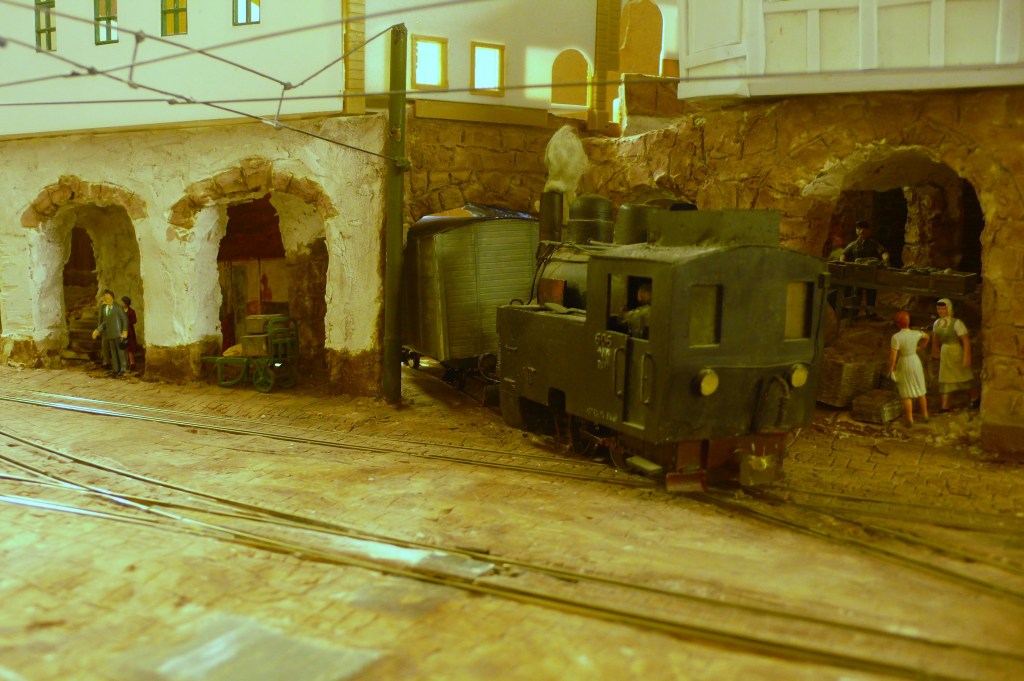
14-14. Isuri’s alarm clock arrives at 04.00 this morning. This is a mountain city and the populace rise early, with the noted exception of the Scolari. These, you might recall are the rather dissolute students of the ancient University dating back to Mediaeval times. The shunter today is the 2-4-0T complete with Brotan boiler and a coal feed chute on the roof. Just for good measure there is an oil bunker on the right hand side tank top pierced by a small peep hole. Certainly not the “plain vanilla” of most NG locos. Might as well get hung for a lamb as a sheep! In another lapse in the sensibility department the loco will not go through the archway leading to the blanket factory. The brakes are released, once the loco is in position, and the wagons roll out by gravity, always assuming that the door is open. In reality they are poked out by a big stick.
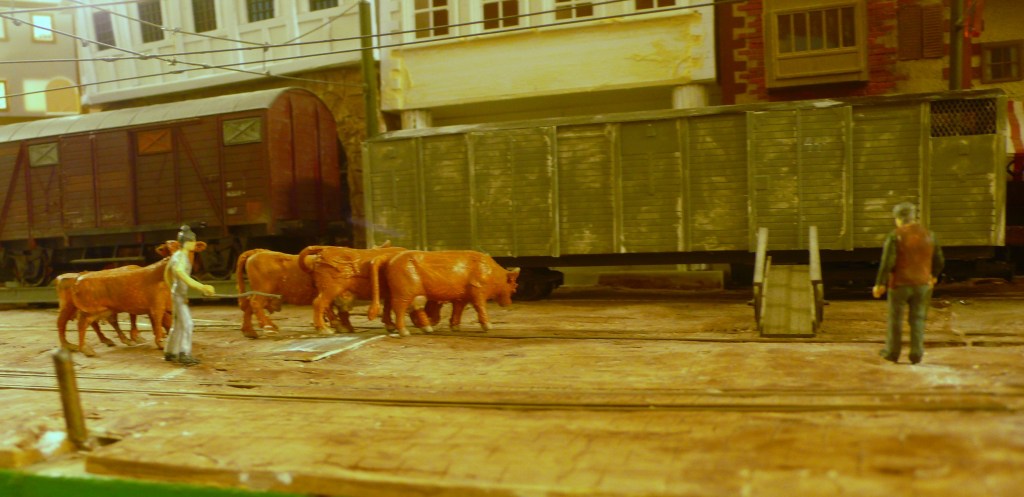
14-15. The AFK provides market day wagons for the transport of stock. The bogie van is being loaded with cattle in the merkatubaxu under the watchful eye of Emmalia, the chief drover. The cattle will only occupy one quarter of the van but it will also be loaded at Ospicio and Cadsuiane-Fanhuidol. There are special market load consignment notes (or waybills if you want to use the American term) for these multiple loadings which are placed in the wagon docket.
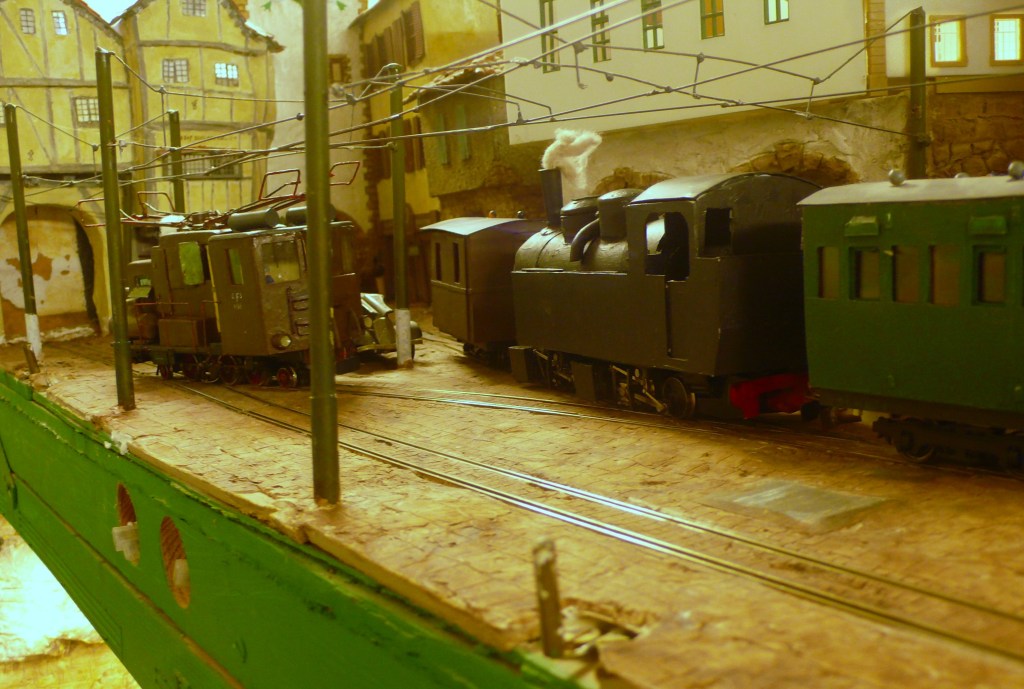
14-16. Fenditavalat square is a busy place by 04.50 because the CFS electric loco has pulled in with its brake van to prepare to take the cement train forward to Lydattyl. The train engine for the Relforka goods has been sent up early from Rivabordo, the Fenditavalat shed, to ensure that the goods gets a prompt start. This loco, an 0-4-4-0T mallet, is pushing the CFS brake up the market square. The three phase electric will then pull the brake 2nd behind the steam loco onto the spur that it is standing on so that both locos will be ready to leave without much further ado.
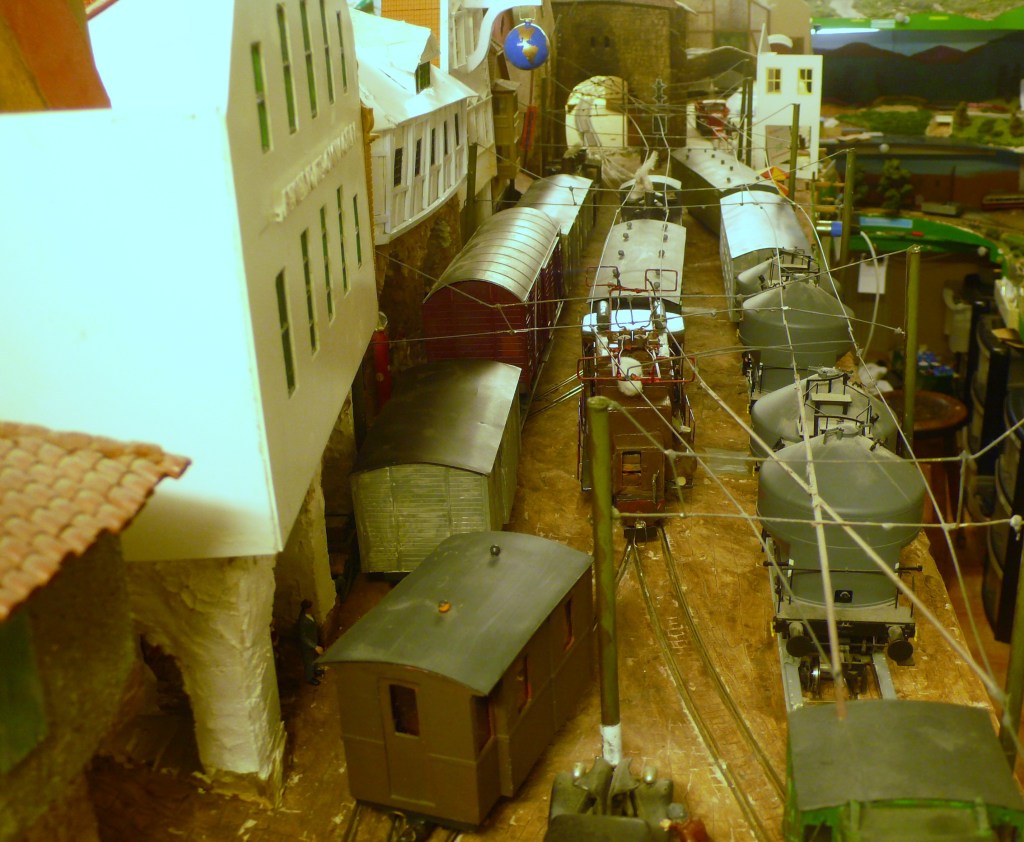
14-17. The merkatubaxu, or Basabazaro, as you might prefer to call it in Thalnian, is unrealistically jam packed with trains at just after 05.00 in the morning. It is rather stretching credibility that such a scene would be played out within the core of a Mediaeval city but such is the nature of the AFK. The local nomenclature preference is for Isuri, but Vallis and occasionally Fenditavalat can be heard in local conversations as well. The southbound goods stands at the left with the pilot beyond it. In the centre the electric waits to clear the points before the brakes on the van are released, allowing it to roll down onto the loco, Beyond it stand the goods train engine and brake, ready to run onto their train once the pilot crosses to deal with the cement train which has pulled in on the right. The buildings on the left are works in progress with the 18th century terra orbis of Y Fako Erdkundo (the Geography department) hanging somewhat threateningly over the scene.
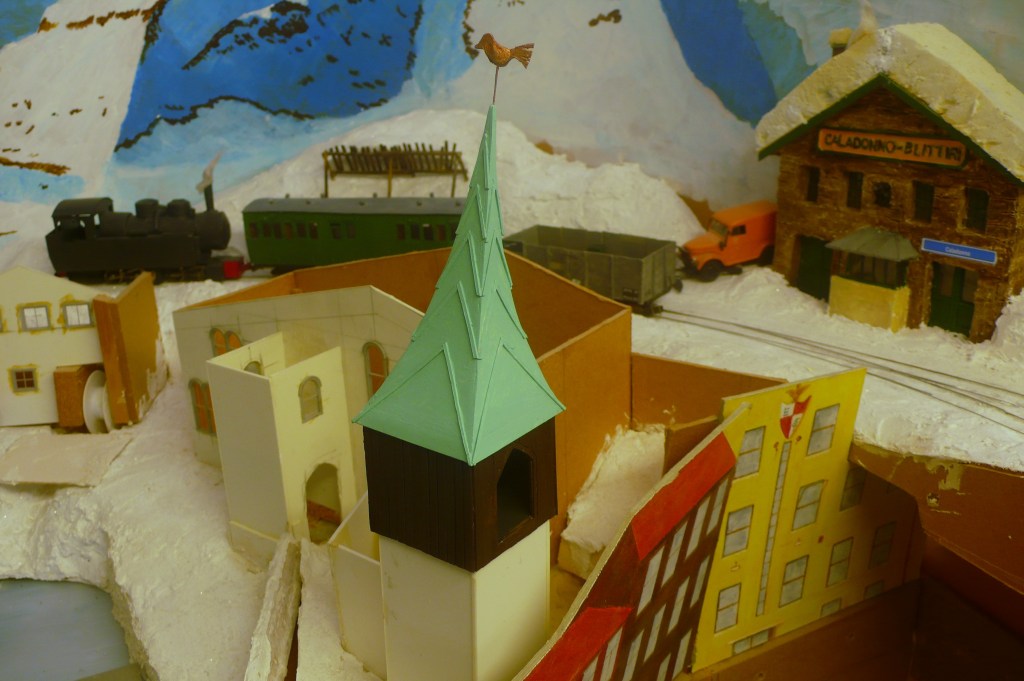
14-18. The FDV-RFK goods pulls the first wagon of Narnite (fossilised Marmite, as found in Narnia) from the loop at Caladonno. Steinkastir the troll has long since left and the somewhat distracted centaur, who is staciaĉefo, is probably still asleep in his stable. The twisted spire and bell tower of St Anaktix have received attention between sessions and I had hoped to finish it but there was not enough time. Like most things on the layout it will develop incrementally. The lack of snow on the spire reflects its steepness of its pitch and the warming of the sun, which makes it a good place for dragons to perch, hence the sharp weather vane. The bell tower was developed to remove the irritating “schoolboy error” of forgetting to leave an overhang on the steeple.
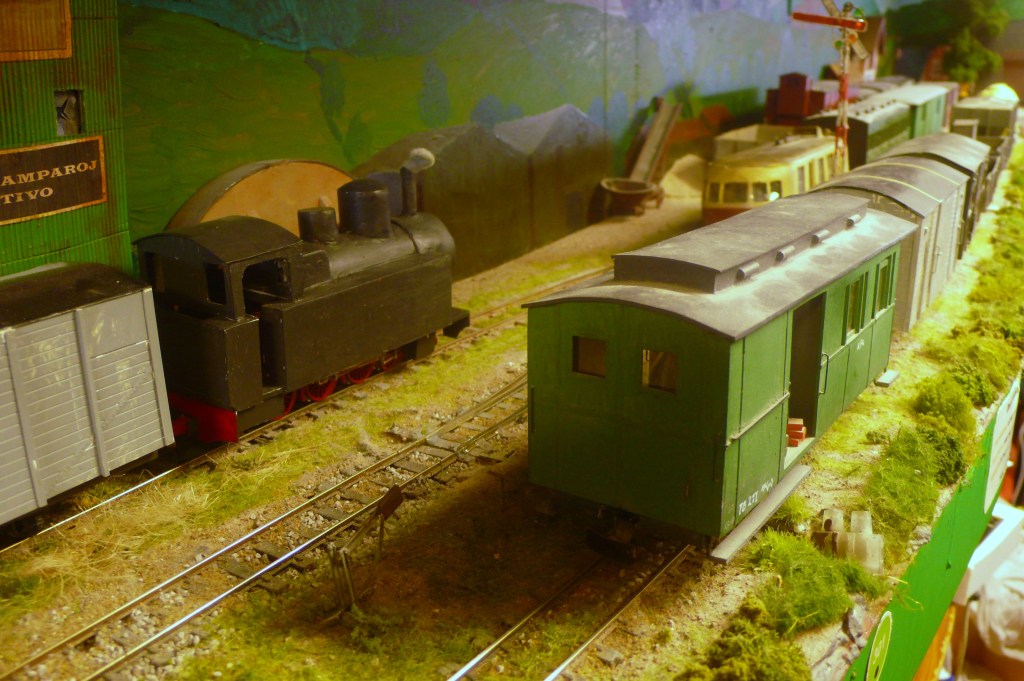
14-19. The early morning railcar pulls into Boursson under clear signals. The 4-6-0T, which is on an extended trial, waits in the Co-op siding where it has gone to fish out a van for the pig traffic booked for this afternoon. The van will be taken to the goods dock where it will be prepared for loading in the afternoon.
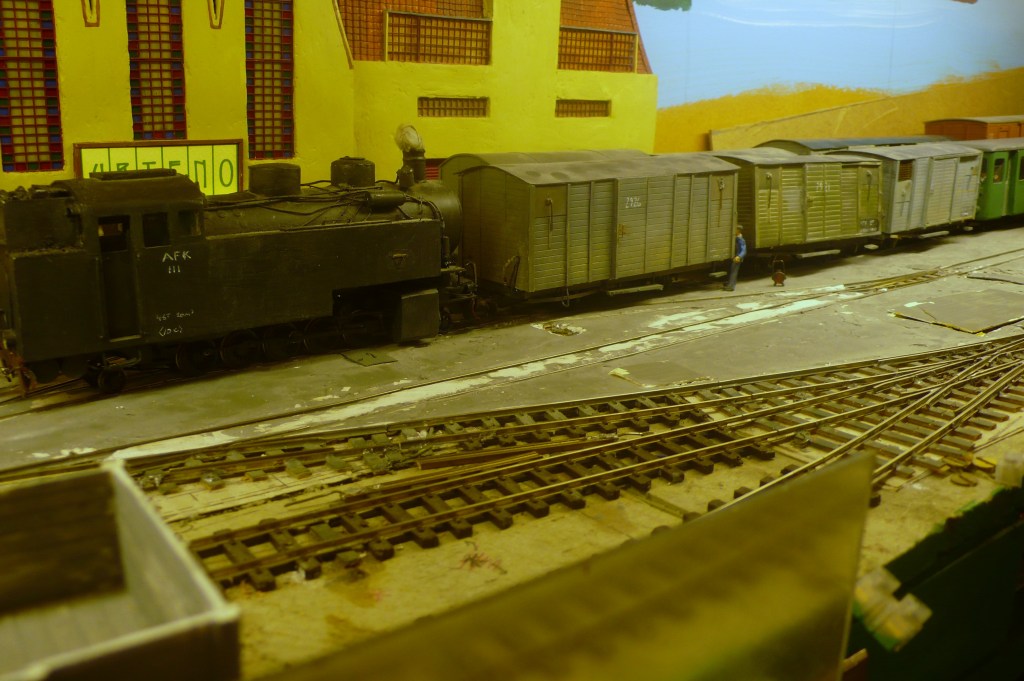
14-20. Things are proceeding smoothly at Urteno for once. The hospital workers have arrived on time and can take a leisurely stroll to work without need for the tram, if they so wish. The freight train loco adds a van of beer to the tail of the “railcar” as Ulfha the shunter hooks it on and removes the tail lamp. This van took priority on the ferry as experience has shown that this is the quickest and easiest way to ensure that the northern loads get up the vulpafaŭkangulo without the overtaxing the train loadings. The two other vans were reserved for market loadings but there was no call for them this morning. They will be left at Ithilarak for the afternoon loadings. The train is packed to capacity with people going to the fair, whereas it usually runs empty over this leg of its journey.

14-21. Jakarutu is awake early this morning. The morning train will leave at 04.45 today, as advised by various posters. What little passenger traffic there is at the normal time will be carried forward by a minibus to make their connections. The basőrn (eagle), as the Győrsmorabŭi (the people of the area) call it, is well patronised this morning for the trip to the fóturaftiganum, or “foot of the stairs” as the locals diffidently call Ithilarak. It is not everyday that there is an easily accessible fair in the locality. There is a van of cattle behind the flat which came in yesterday with a military load.
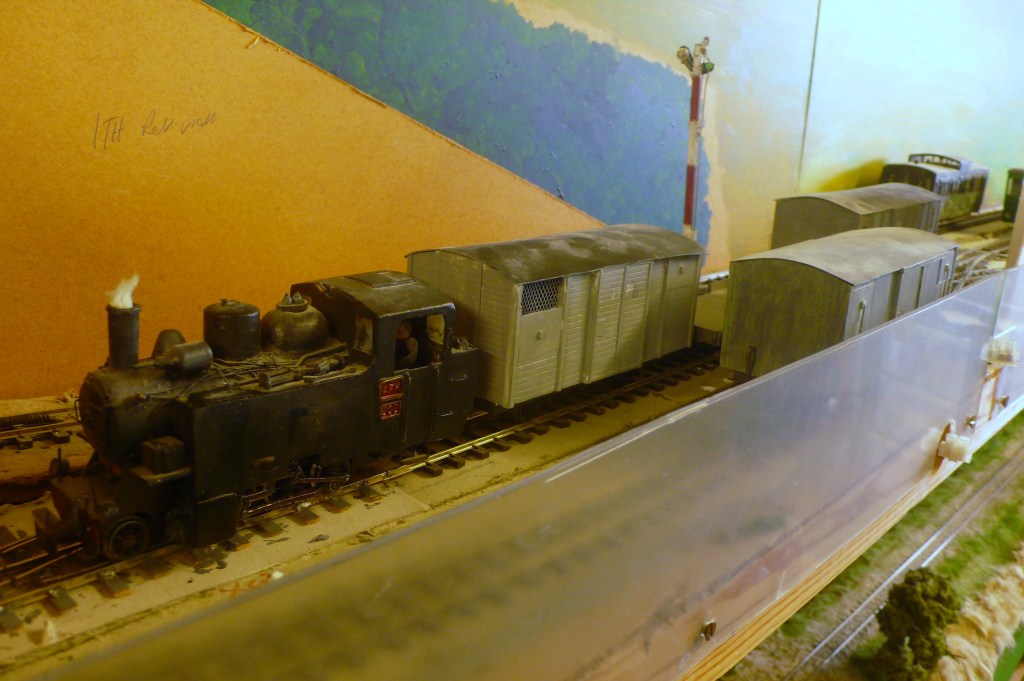
14-22. The rack loco is seconded to act as the Ithilarak pilot between trips along the branch. The schools’ railcar has now arrived and the loco has detached the empty vans earmarked for market use and is seen here shoving the beer van, added at Urteno, onto the rear of the train. The empty vans might be required for various loads once the fair finishes in the early afternoon and, if not, they can be transferred to Fenditavalat for tomorrow’s fair at Ospicio. The Bavarian home signal, behind the first van, is in the “Ruhe” position indicating that the points are released to local control. The loop siding in the foreground serves the goods shed whereas the longer loop, where the empties are, (not seen here) is the exchange siding. This small station could become very crowded today.

14-23. The karbaflantrakoj (coal sidings) are full as the Fenditavalat goods pulls into Urteno, as seen from Ĉefastrato bridge. It would seem that the empty coal hopper will not get a ride up the vulpafaŭkangulo for a while. The photo was really taken to show how the AFK compromises with its Luddite technology. The train could not clear the points at the south end of the station without running onto the electrical section where the banker was standing. It was isolated on the previous section and the banker backed down before the pair then pulled forward again. All totally unrealistic, of course, and easily solved with DCC. The AFK often turns a blind eye to such dodges which are treated as “uncharged time outs” as far as the clock is concerned. At the bottom line I can understand and fix faults with straight DC. I cannot do this with a micro-processor. The banker will pilot the train because there is a SG van on a transporter in the consist. This will derail if banked from the rear, as I know from experience gained the hard way.
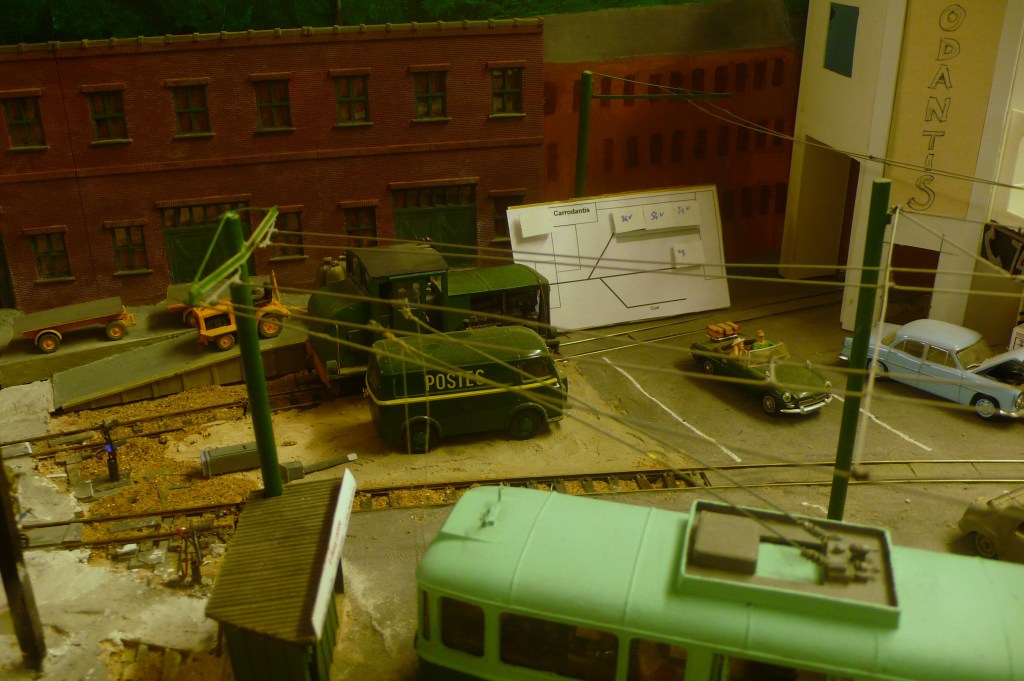
14-24. The first “magnetic” shunt of the Carrodantis factory, the Lacono confectioners, takes place. This will remove loaded SG vans and the empty slide-walled van which needs to return to the dairy. Obviously, under normal circumstances, the magnetic board is not placed onto the scenery but it is posed here for reference. The actual wagons represented by the magnetic tabs are residing on a nearby shelf. Once the shunt is completed the time is appropriately pushed on and the wagons are placed onto the layout. The spur in front of the factory is at about the limit of arm’s reach behind and underneath the trolleybus wiring rendering it an awkward job. There is no room here to extend the siding beyond the backscene, as was done retrospectively with the Danulbo area.
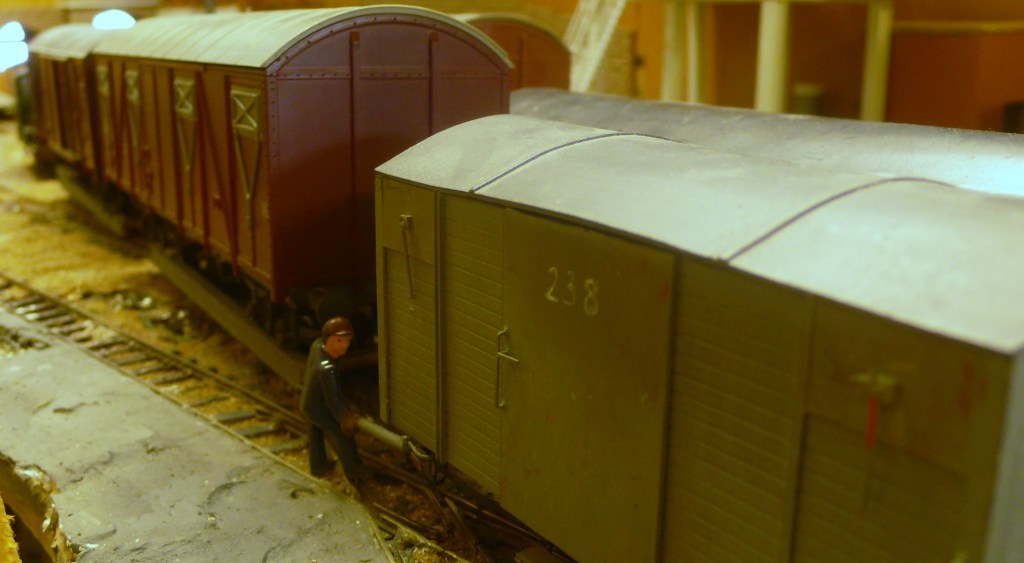
14-25. Working as a shunter was a hazardous occupation with many men being maimed or killed, especially before the Safety Elf became involved. As a signalman, having handed the train staff up to the drivers crewing a Class 66 pulling 30 odd loaded sand wagons I can testify to this, especially when a passenger train was signalled along the adjacent line. These trains were not standing still for the exchange, as is usually the case on preserved railways, and you were very aware of your mortality! Uncoupling transporter wagons using a heavy pole to make the connection would be in a similar category of danger I would imagine. The loco crew waits for the signal to move before a cut of empty SG wagons is transferred to the chocolate factory.
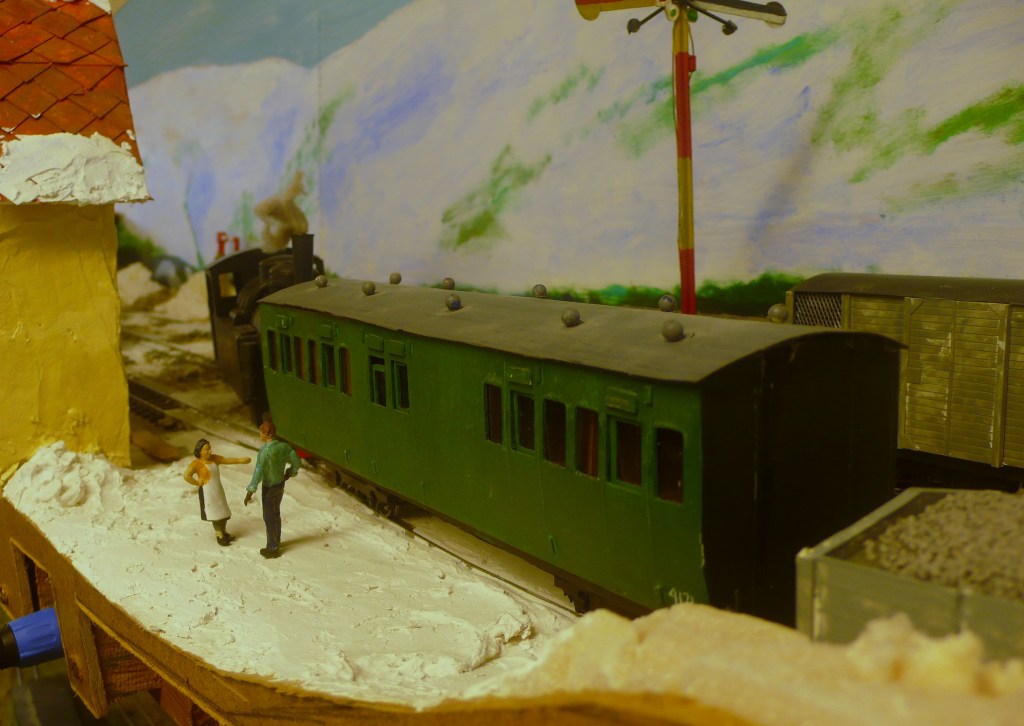
14-26. Quionamaresta, the Ospicio staciaĉefino comes out into the melting snow to discuss the shunting moves with Linsuig the trajnaĉefo. As both are fluent Marronĝacan speakers it will be a little less one sided than it usually is from the train crew’s point of view, although Quiona is known for holding strong opinions. The 0-4-4-0T has backed into the siding alongside the quarry loading bank to pick up a couple of gravel hoppers. The bank, in the foreground, is served by a tramway from the quarry at Fogejvë. The quarry is a seasonal affair and only sends loads out in the summer, this being the first load of the season. Rumours that some of Steinkastir’s friends might be interested making it an all year round operation have been dismissed by the Aŭkeratuo, the Prince-Bishop, as Narnian fairy tales. Cattle are meanwhile being loaded into the van going to the fair.
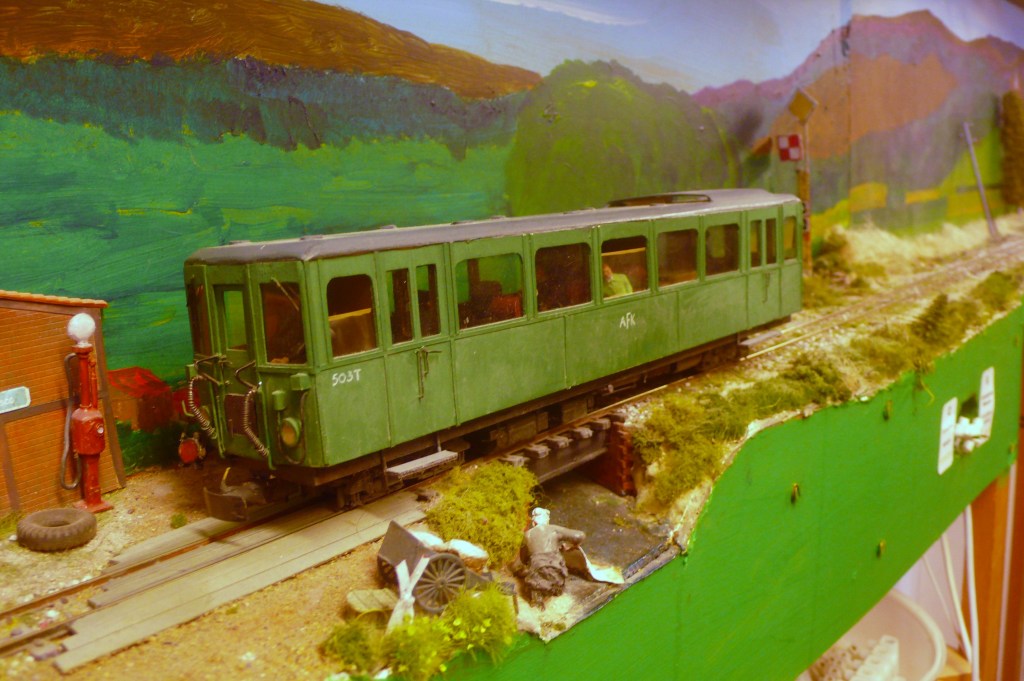
14-27. The up morning railcar is briefly halted at Boursson enirasignalo because of shunting, a not uncommon state of affairs. Medine, the staciaĉefino, has already informed Control that if they want the pig traffic to leave this afternoon they will have to put up with a short delay. In actuality the railcar has only just cleared Lamassco halt but foreshortening is always a problem on model railways. Radacca, one of the local peasants, is washing bed clothes in the stream, unconcerned by the railway’s problems. This was a common practice in rural Europe, into the 1960s, before piped water and electricity arrived.
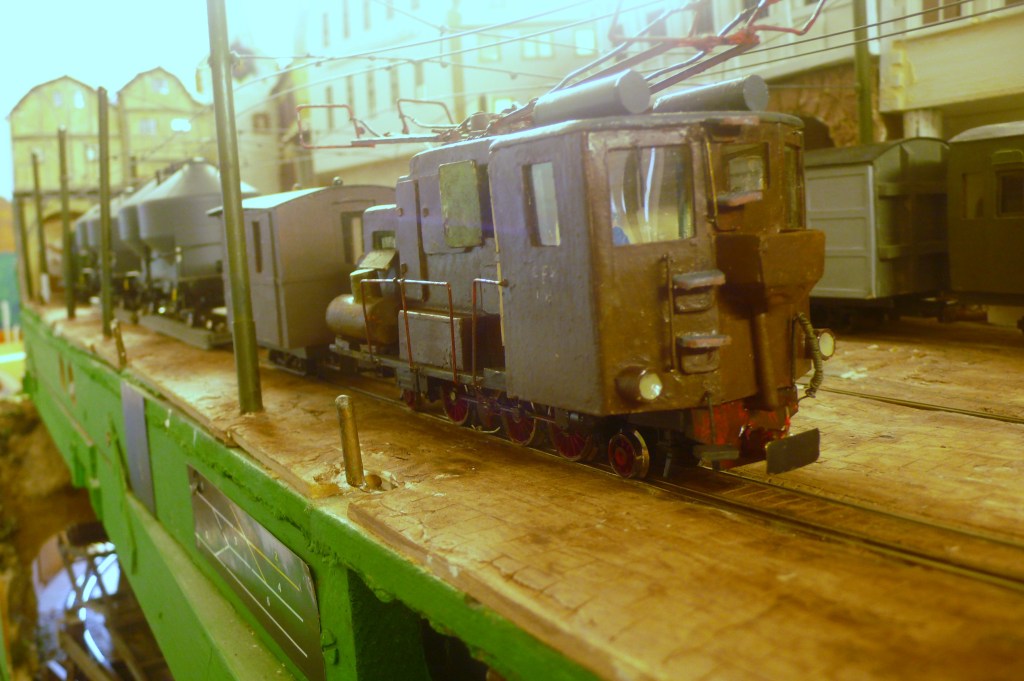
14-28. The unlovely face of CFS 103 backs down onto the SG cement wagons in the merkatubxu. The loco has finally received access steps, although quite why one would wish to climb onto the roof, in close proximity to industrial strength electrical supply is open to question! They are needed when the loco pulls up to a water column to replenish supplies for the liquid resistances.
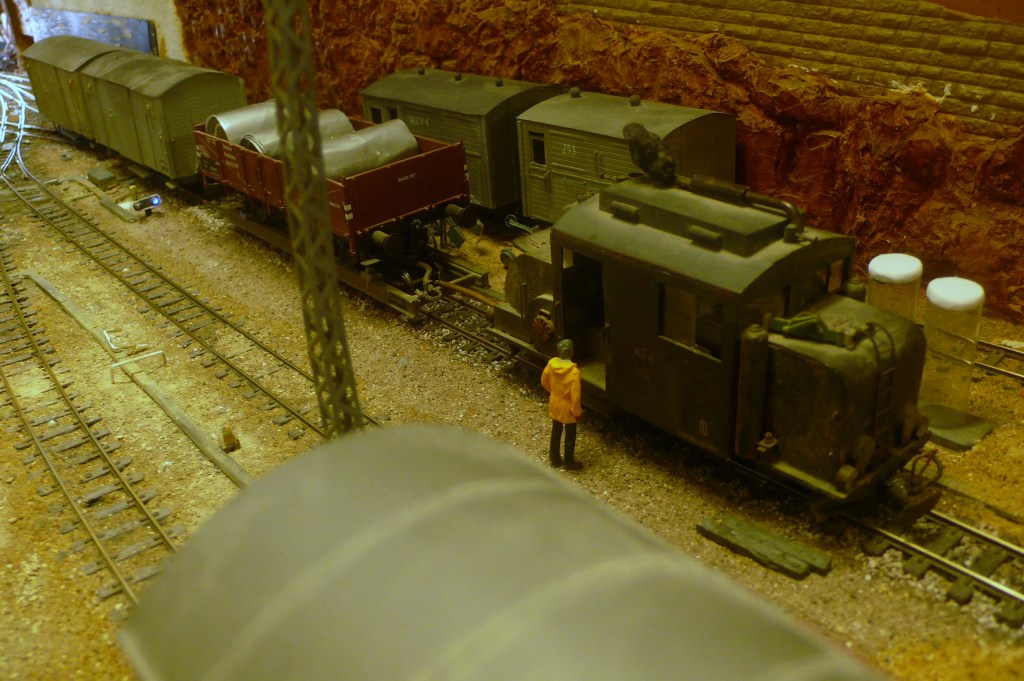
14-29. Whereas previous sessions have somewhat nebulously assumed that the Danulbo shunting would be completed to the convenience of the pilot, today is different. Those with long memories will remember that La Besto was well known for her bad habits, including jumping on the back of unsuspecting wagons. Today she plays a bit part in that she is in charge of the “Danulbo shunt”, aided and abetted by the magnetic tokens. I am not quite sure how long the ‘shunt’ will take but it seems within the bounds of reality that an otherwise ‘spare’ diesel would be manned by a scratch crew of machinists and depot fitters to get the job done. It looks like this will become the normal procedure in the future.
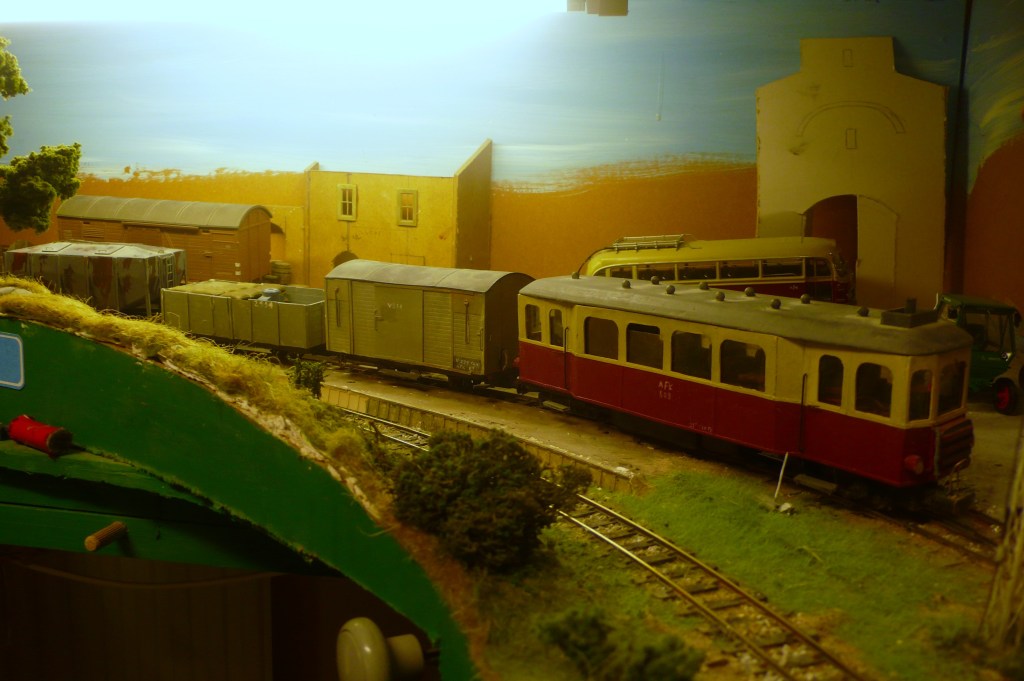
14-30. Not for nothing is the northbound KTT goods known as the plumalito, the featherbed, The Eromarbordo branch railcar shuffles wagons at Breĉo de Glissent to make life easier for the goods train crews. The ancient railcar struggles with the loads, belching out filthy exhaust, but the job gets done. The northbound crew will simply pick up the blocked wagons from the goods loop and set out a block for the railcar to deal with once it returns from the branch terminus.
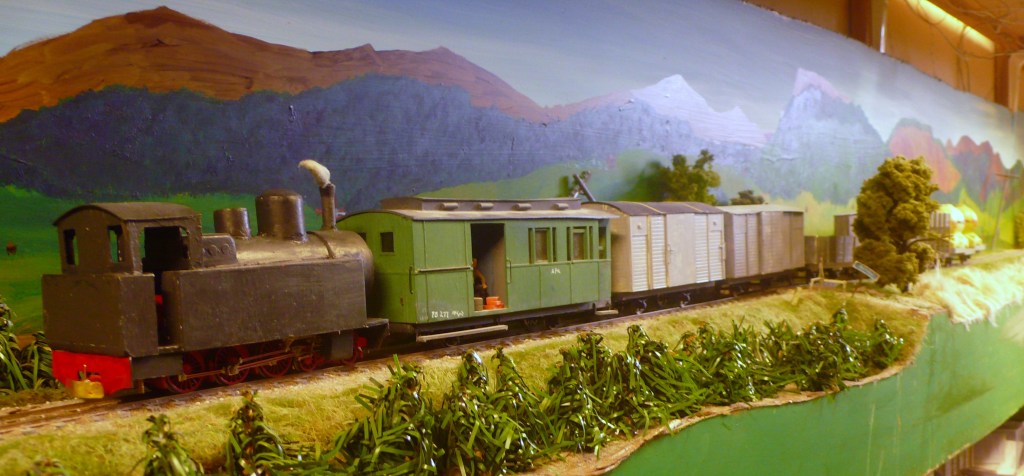
14-31. It became a tradition, on the old website, to take a photo of the down KTT goods as it coasted through the fields of the Kasatritikakamaparoj. I see no reason to abandon this practice so here we have 4-6-0T No 151 running 15 minutes late on the train today. The loco was supposed to have been based upon a Reseau Breton loco but there were problems with the delicate Chinese GWR chassis, which was replaced with a chopped up Fleischmann one, resulting in a misshapen caricature.
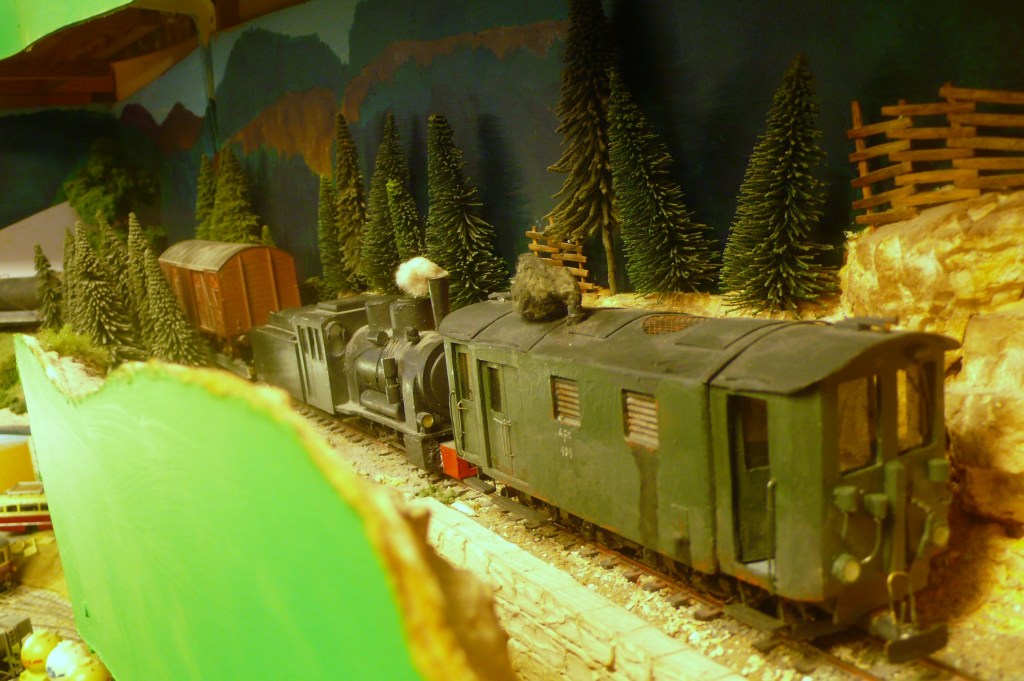
14-32. With the door open, to acknowledge the onset of summer, the Urteno pilot/banker leads the Fenditavalat goods up the gorge of the Aepto, otherwise known as the vulpafaŭkangulo. As noted previously, the SG van on the transporter precludes banking from the rear. It seems as though the steam loco and the dishevelled diesel are in vigorous competition as to which can produce the filthier exhaust. The steam loco would seem to be totally outclassed in this game.
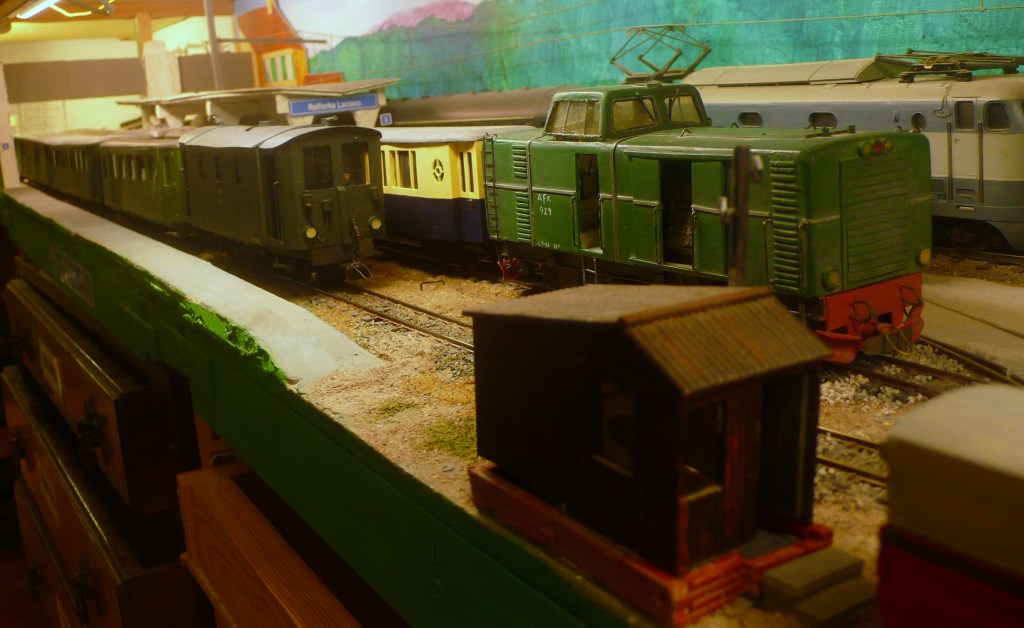
14-33. The line up of the morning express, and the local that follows it, were always traditionally photographed on the old site. Continuing the sequence here is today’s line up. At the right we have the 1-D-1 in charge of the express, the first vehicle of which is the Pullman. This still awaits completion and the roof remains loose. At the nearer platform the local waits to follow. Some of this coaching stock did receive roofs recently. The loco is the 2-C-1 with a wheel arrangement similar to a Pacific. The similarities end there. It has a jackshaft drive which has made the fitting of skate pick ups awkward, both to initially shape and to keep in alignment. These are necessary, as with many other AFK locos, to improve otherwise indifferent running. The PW office in the foreground has been knocked off its moorings. It has deliberately been left loose as it is in a vulnerable position.
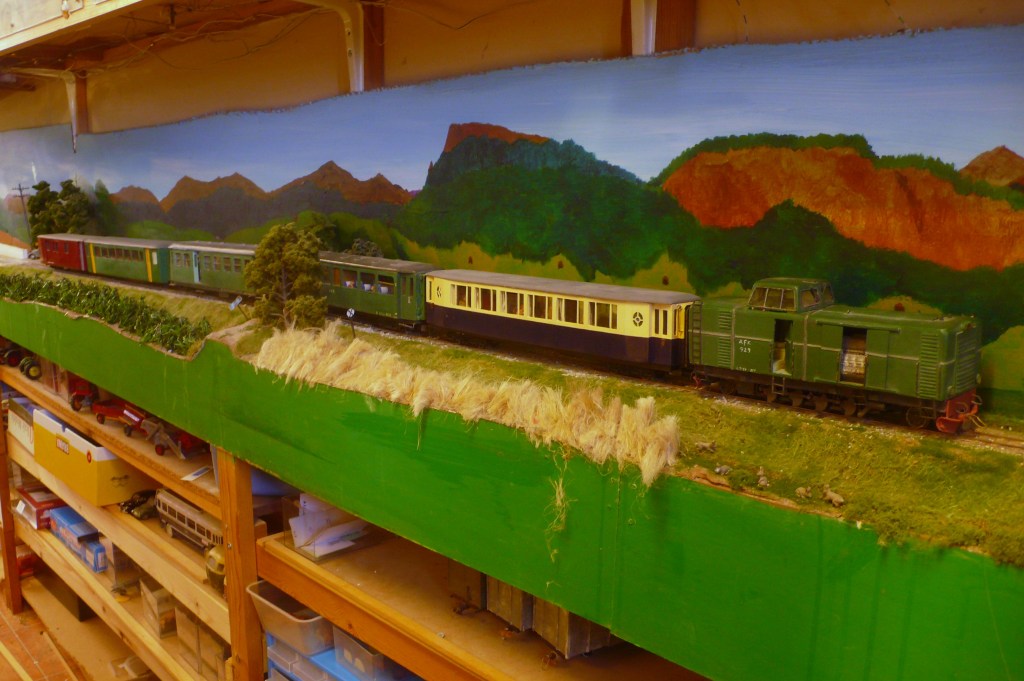
14-34. The express in all its glory, in an uncut scene. This is the longest that the train gets and it is quite heavy. The rear carriage, with the yellow doors, and the mail van will run through to Krelm, on the Ruritanian mainline. The coach, which was built years ago, is the longest on the system and is coupled to the short Post Office vehicle so that they are the same length as their opposite pairing which will be attached at Fenditavalat. The coach was built as a template for AFK stock but it was decided that it was too large, hence it languishes in a drawer for much of its existence. The recently built shelves, below the scene, contain various loads and road vehicles with the lower layers reserved for supplies. The wagons on the top shelf, at the bottom of the photo, are “across the lake” from Urteno at the Karamspur brewery.
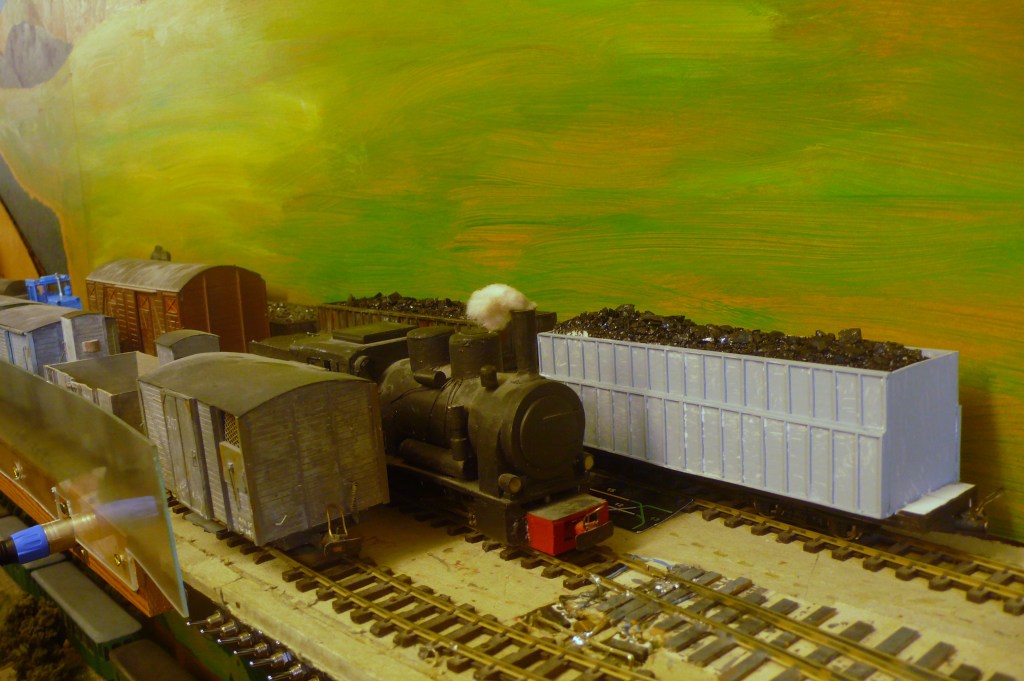
14-35. Shunting at Ithilarak is convoluted by the presence of the branch train which ran early to serve the fair. This has had to pull onto the rack section to provide clearance for the banker to return down the hill pulling the coal hoppers. I would prefer not to carry out such manoeuvres but, as with most modellers, I am short of space for what I would like. The train loco, in the foreground, needs to deliver a couple of loads as well. Unfortunately this location remains as bare bones at the moment.
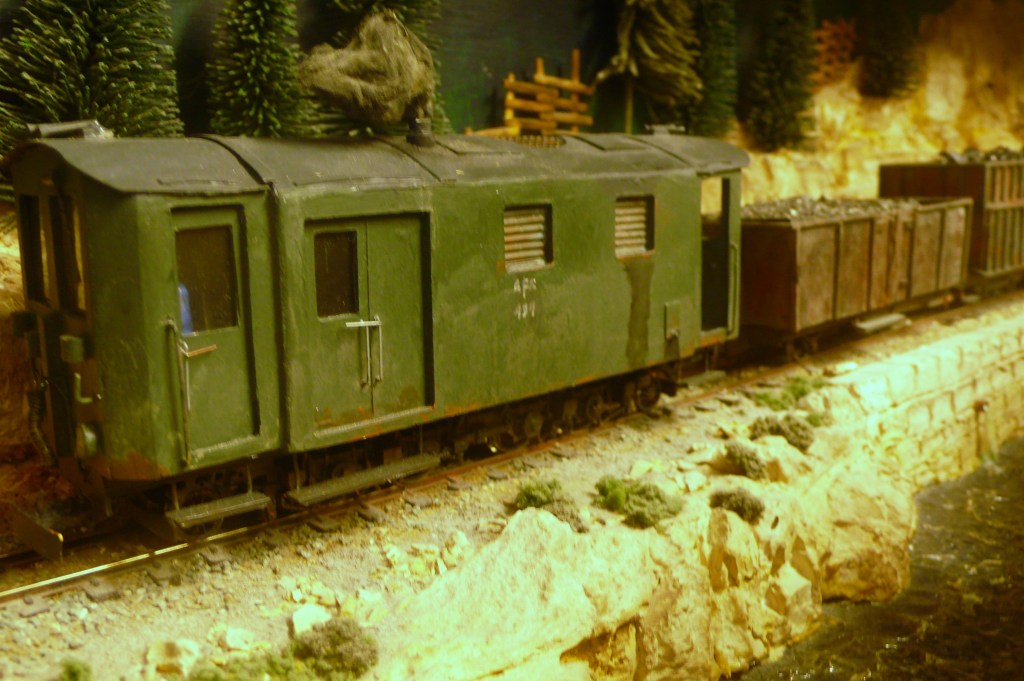
14-36. Just to prove that some parts of the layout have developed beyond swathes of bare boards the banker runs through the lower Aepto Gorge beside the torrent. Even the loco and the rolling stock in shot are completed, although the hopper on the tail isn’t! The banker is authorised to take 80 tons down the bank without a brake. Although there are 10 axles in the train (and hence 100 tons because tonnage is tied to axles) the short wheelbase bogie hoppers are “40 equivalent to 30” because of their short wheelbase. It is common practice for the banker to take loads down the vulpafaŭkangulo because it forms a bottleneck on train loadings.
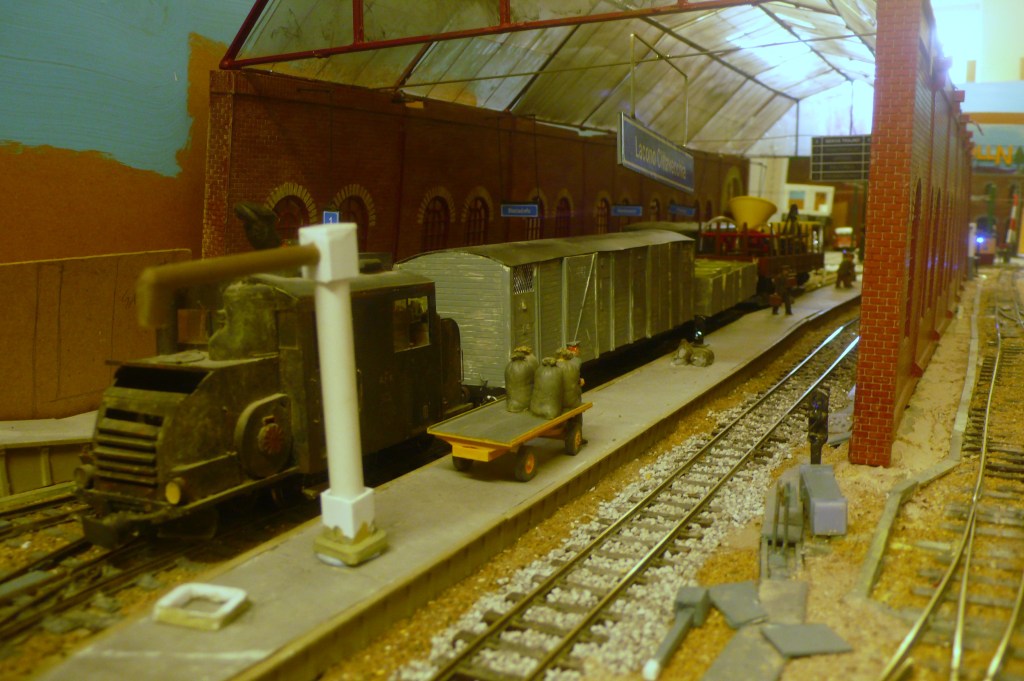
14-37. The Danulbo shunt returns at an inconvenient time after the machinations with the magnets. This in itself justifies the virtual shunting, in my opinion, as previously everything was timed for convenience. The photo shows the interior of the trainshed and reveals that many items still need attention. The water crane needs painting, as do the “wires” suspending the station signboards above the platforms, some groundwork needs attention and the relay cabinets need a final paint of coat. In a short period of time this location is about to become very animated.
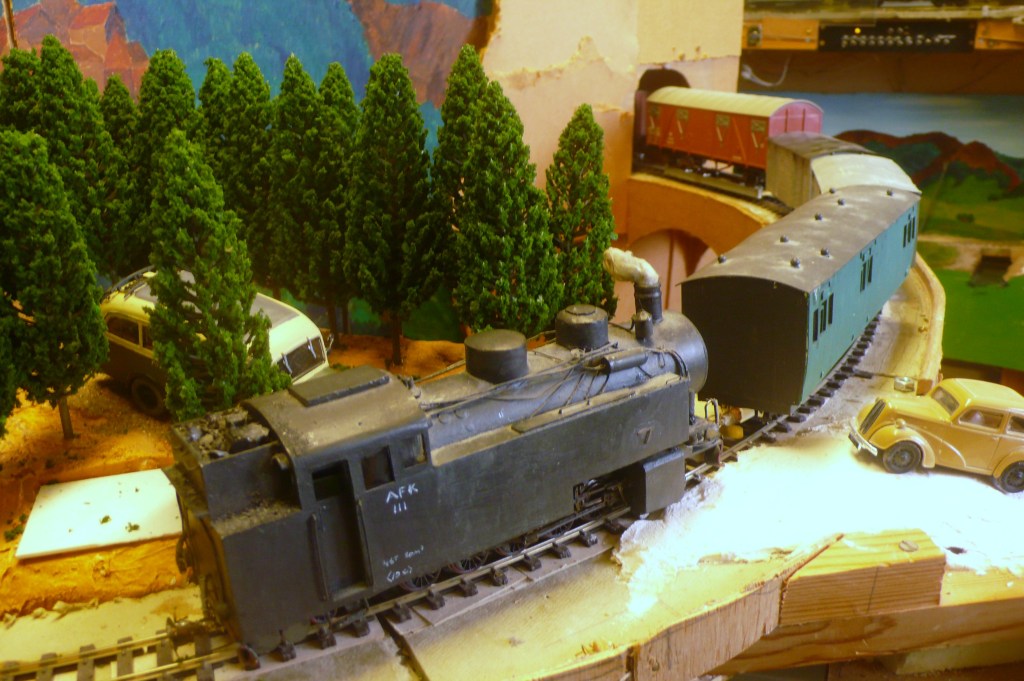
14-38. The URT-RFK goods is bearing down upon Lacono, a couple of minutes early. The train is running at the maximum 220 tons and is probably longer than some layouts. It certainly would not fit onto the 180º curve between Lacono and Urteno. Once it reaches Lacono it will be remarshalled before continuing its journey south. The blank styrene base indicates where the waiting shelter will stand for Ghealdaban halt. The walled village can just be seen on the backscene, above the trees, in the top left corner.
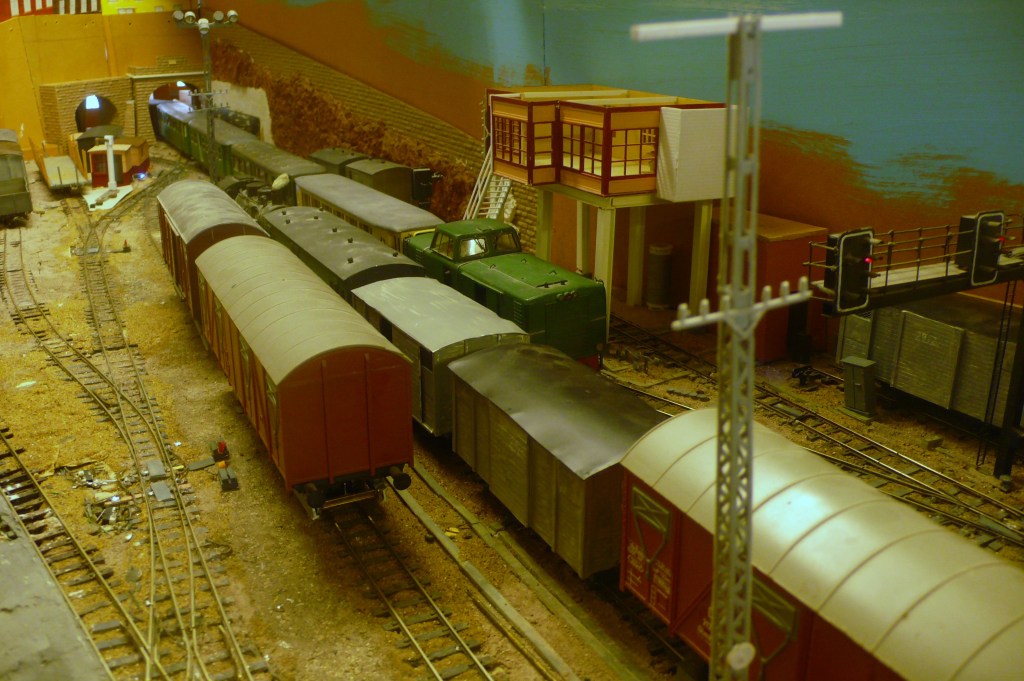
14-39. A view from the top of the floodlights at Lacono, almost. The goods train is now in the reception siding as the express enters the station. “Sisyphus” is working the rear end of the train whilst the loco will pick up the SG vans loaded with confectionery on the next siding over, after taking water. It looks as though the Danulbo shunt will not be able to provide a connection with this train but there is the following FDV-RFK train which should provide onward transit. Anything missing this will have to go forward on the afternoon trains. The signal box awaits completion as do many other aspects of the scene at this end of the station.
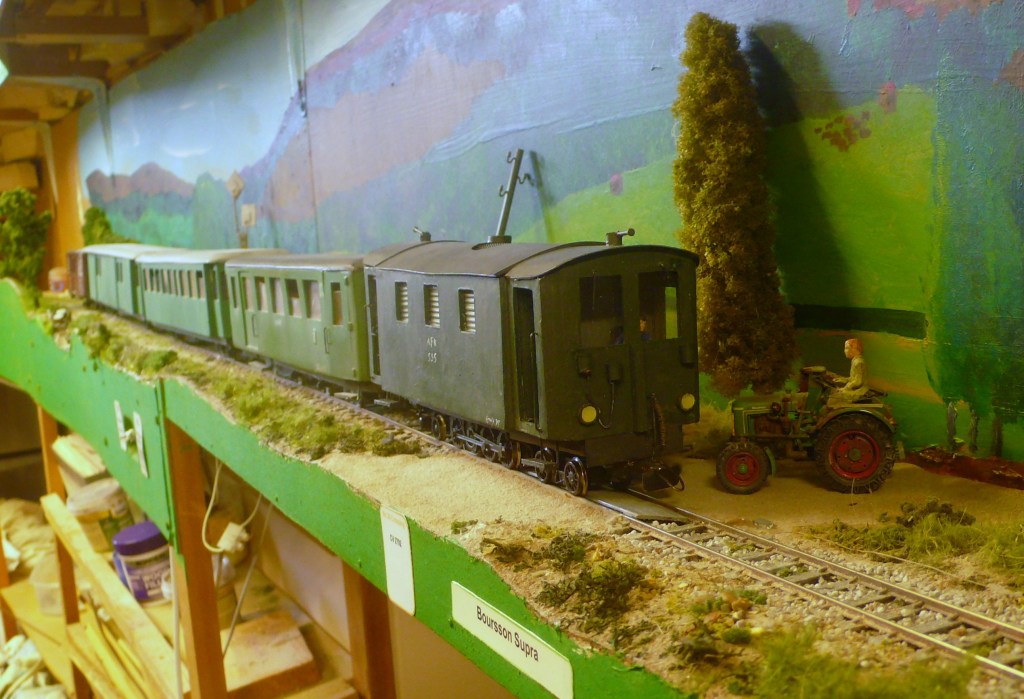
14-40. The local passenger following the express displays a typically heterogeneous collection of stock. The first vehicle is the radial axle brake 2nd usually allocated to this train. The loco narrowly avoids the tractor at the ungated crossing just south of Boursson as it slows for the stop. Contrary to appearances it has not sprouted a telephone pole from its exhaust vent! Despite adjusting the pick ups performance has been indifferent. It seems a little underpowered and the crude addition of the front bogie to the original I-C mechanism results in it lurching and “hunting” quite badly whilst running in this orientation. I would not want to be in the cab if someone really wound it up!
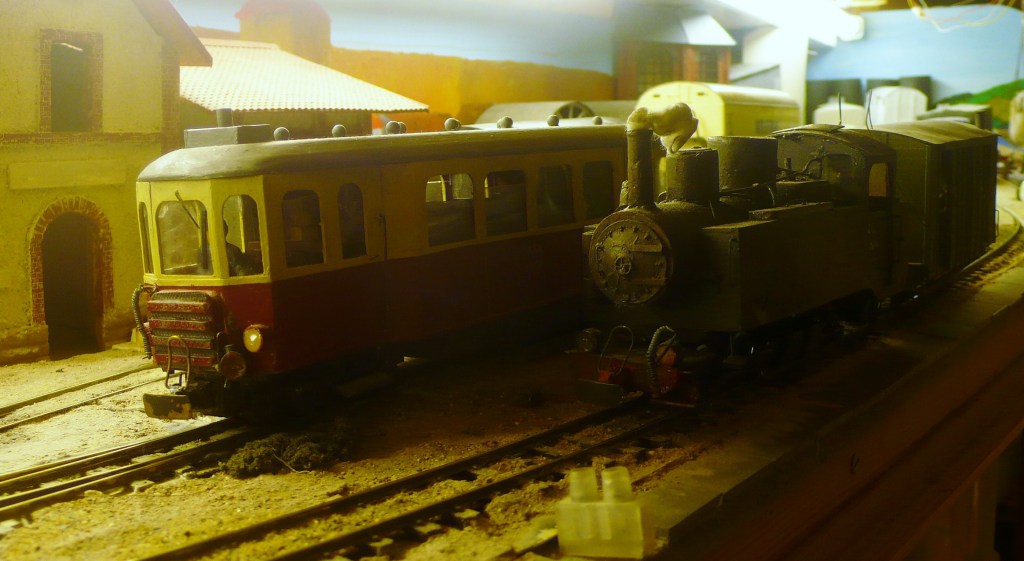
14-41. The branch railcar rolls into Eromarbordo to find the goods train waiting in the siding. Today there has been little activity here and the train will leave as engine and brake. It is a nice little earner for the train crew, who have had three plus hours for breakfast. Such are the vagaries of using a dice based system. A couple of sessions back the place was mown under with traffic and the crew struggled to find time to get a bite. Today there isn’t any traffic. The demand for fish vans, if there is any, will not be known until 12.00, when the fleet returns at high tide. They will be picked up by the afternoon goods as required.
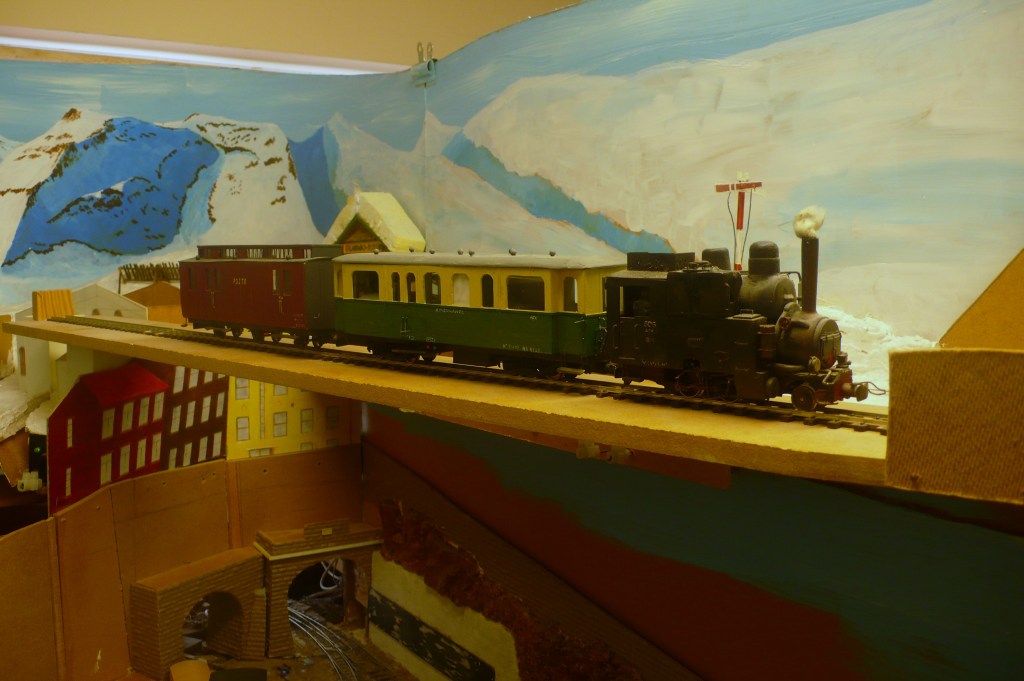
14-42. The original website contained one or two photos of the Fenditavalat cassette, but these have now disappeared into the ether. The 2-4-0T pilot stands ready to leave Rivabordo with the ambulance and the Post van. Use of the cassette is restricted as it is often easier to load directly onto the main line. In this case it is not. The cassette rests on the church tower of St Anaktix at Caladonno, the spire of which has been removed. The cassette is interlinked with the signals at Fenditavalat because, as is obvious here, a wrongly set route could result in a substantial fall onto the middle level. A red in the section signal really does mean “stop”. The train is driven onto the “mainland” from this side of the central peninsula in case of any derailments. There were problems some time back and the rail interfaces received attention.
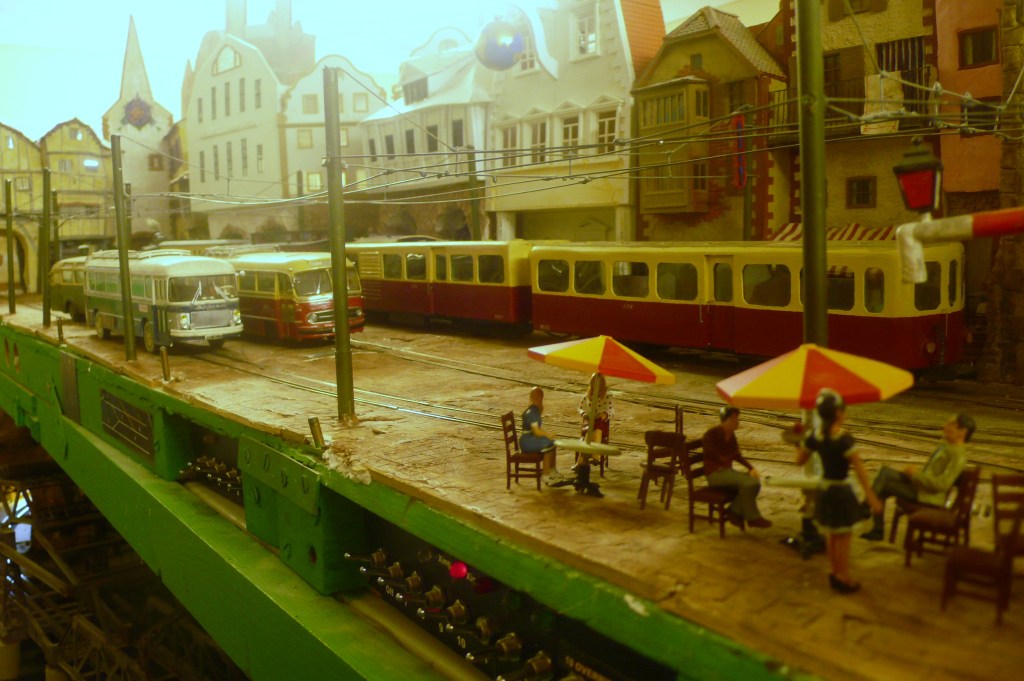
14-43. The internal combustion engine predominates this morning in the Fenditavalat merkatubaxu. The railcar and trailer have followed the (steam) pilot into the square and have coupled onto the trailing vans, seen in the previous photo. The three connecting buses are run by the Post Office, the AFK and the CFS. This is one of the few trains per day to traverse the entire length of the AFK therefore it is important to make connections from the outlying communities. The café’s patrons, most likely the Scolari, or their mentors, take little notice of these mundane every day events as they wake up, drink their coffee and digest important news. There were significant (table) football games played in Scolari Division 4 last night! Not a few Centoj, or even Kronoj, will be wagered on the Division 3 fixtures tonight.
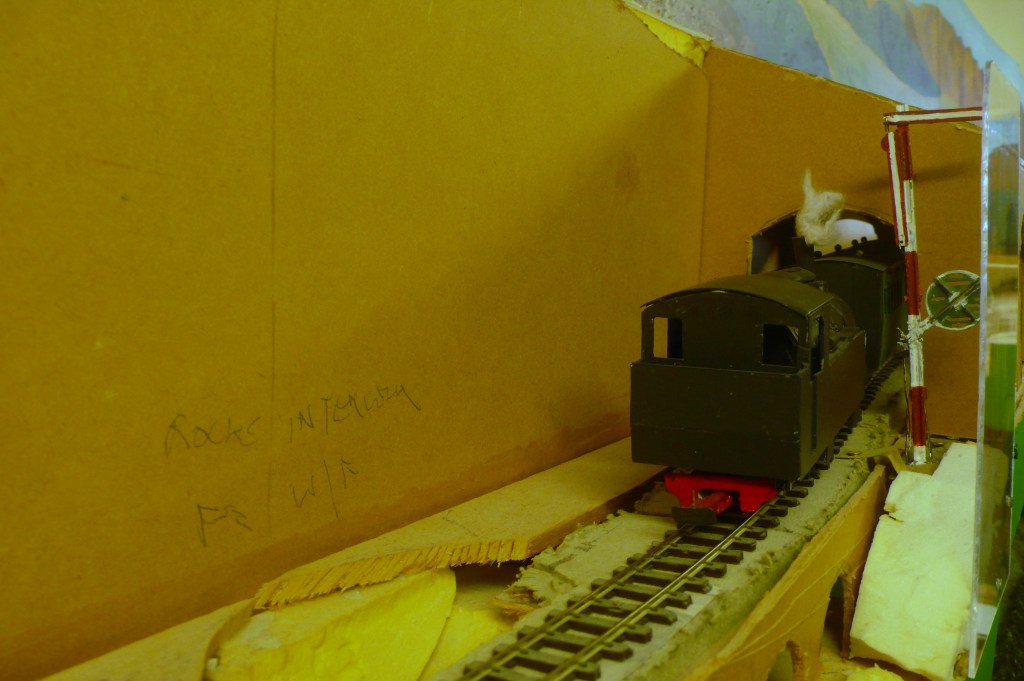
14-44. I made the point earlier about certain layout areas being undeveloped. The southern end of the Ithilarak avalanche shelter is one such area. The down goods pulls out of the, recently affixed, southern portal into a wasteland. As the scribbles on the hardboard note this is supposed to be a rock ledge with a waterfall behind the line. The home and distant for Ithilarak, based upon Bavarian prototypes, have, in the fullness of time received a protecting screen. The mallet tank is beginning the treacherous descent of the vulpafaŭkangulo with the goods.
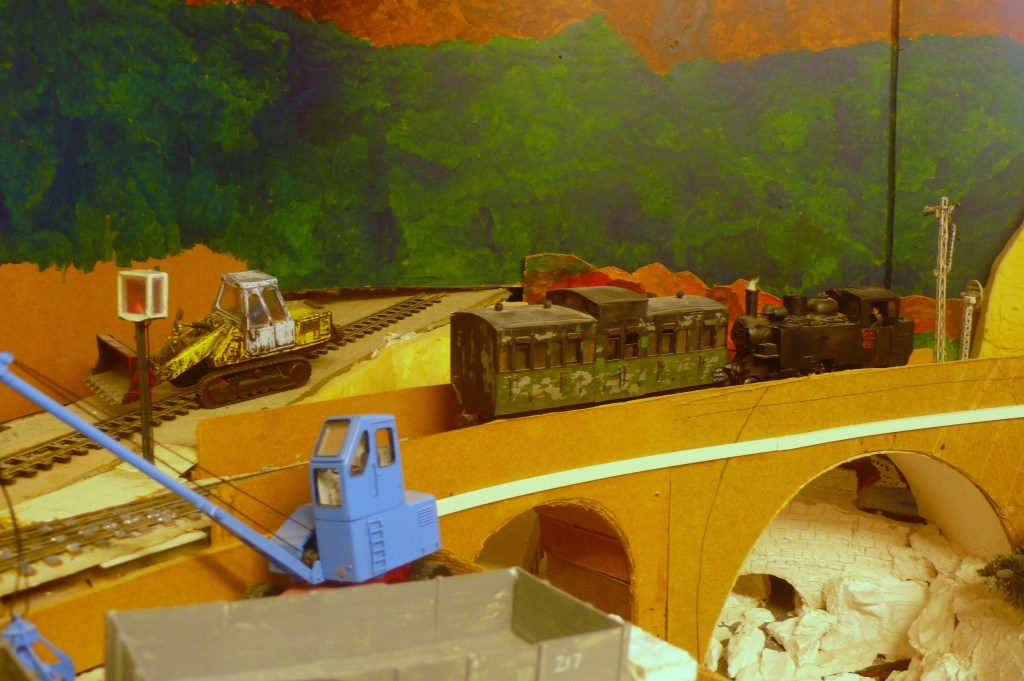
14-45. With both goods trains having left Ithilarak the branch engine gets to pick up the pieces and move hastily jettisoned wagons to where they are really needed. This area of the station has had some scenery sketched in but there is some way to go yet before completion. The home signals here, at the right, have been disconnected for years to allow access behind the viaduct for scenery work.
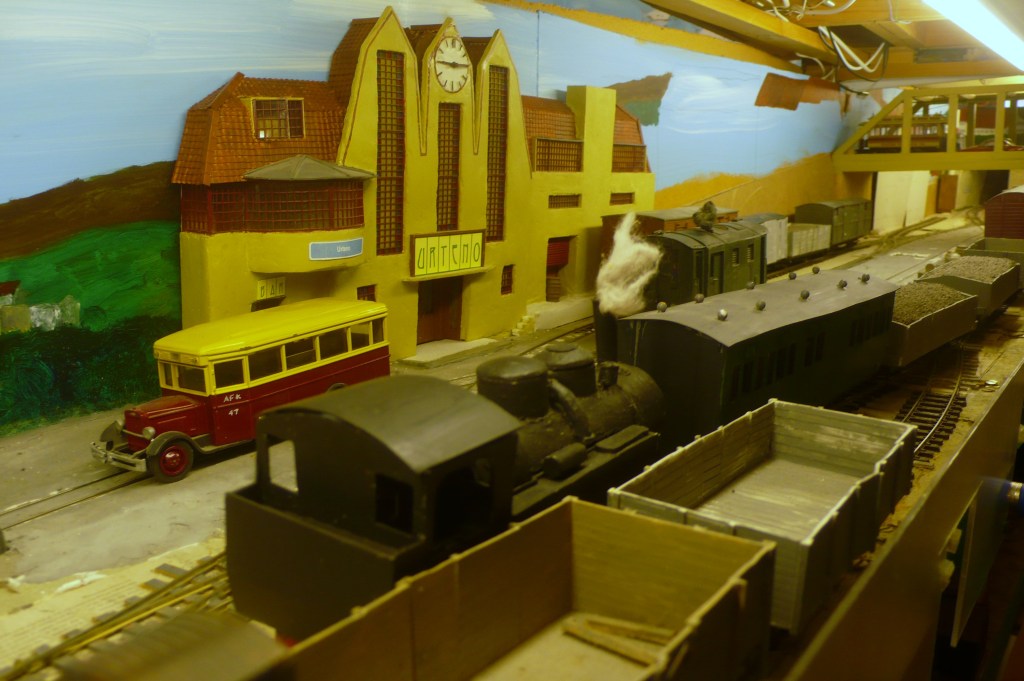
14-46. The 0-4-4-0T has run down the bank and reached Urteno on time. The up express is due shortly and the pilot is waiting, on the loop, to bank it up the incline. The loops here are short, due to the Spegulalaguno occupying one board, restricting the train lengths that can be handled. This was a conscious trade off at the design stage where I decided that I would prefer a lake adjacent to a spa town rather then an expanse of track. The train ferry provides a picturesque fiddleyard in an attempt to have my cake and eat it. The siding, where the loco stands, effectively acts as a headshunt for longer trains, allowing them to overrun the loop. It doubles up as the storage siding for the Pullman in the middle of the day despite its close proximity to the wood siding.
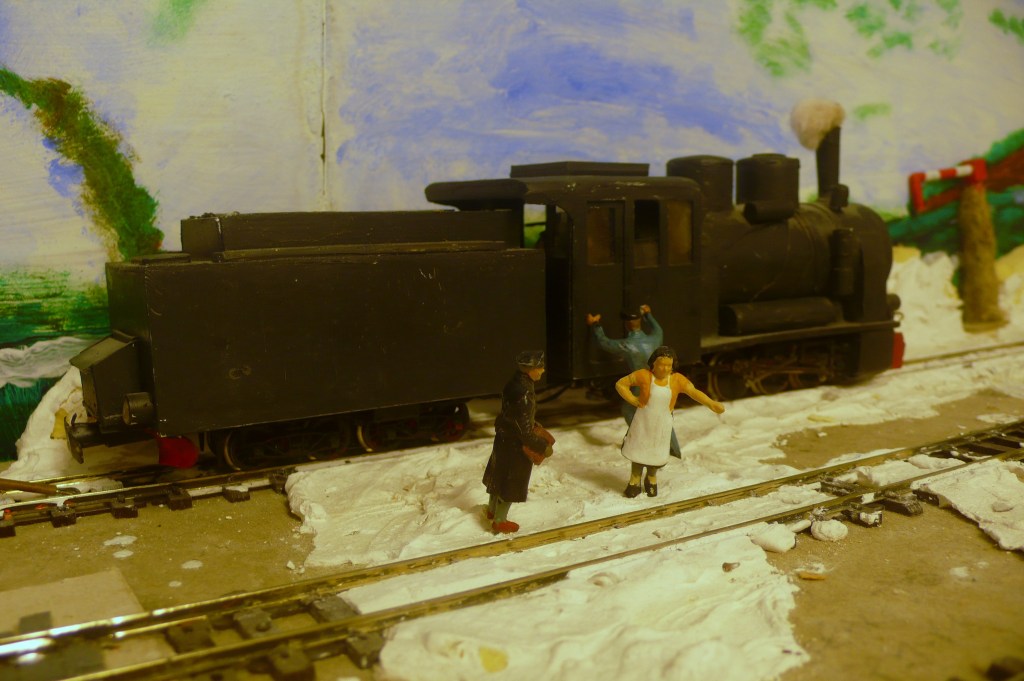
14-47. The up goods has reached Ospicio where it has roughly 30 minutes shunting before the down express railcar arrives. Quiona is discussing the placement of the bulldozer, on the well wagon, with a military wallah. He is one of those officers with his own ideas on the subject but he is not making many inroads with the Marronĝaccan speaker. The fireman gets down from the loco to receive instructions when everything is sorted out.
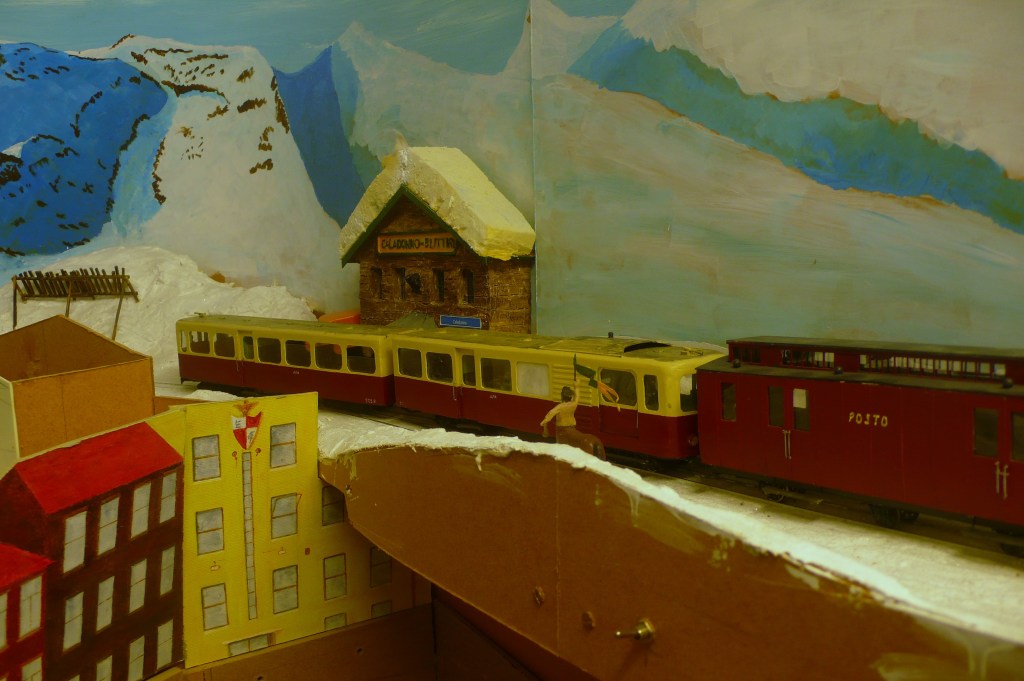
14-48. Urchyllu, half man, half horse, complete fruitcake makes his daily appearance to theatrically wave off the morning express as it leaves Caladonno. I suppose that dealing with trolls regularly is enough to addle anyone’s brains but he has a headstart. Its all NFN (Normal for Norfolk Narnia).
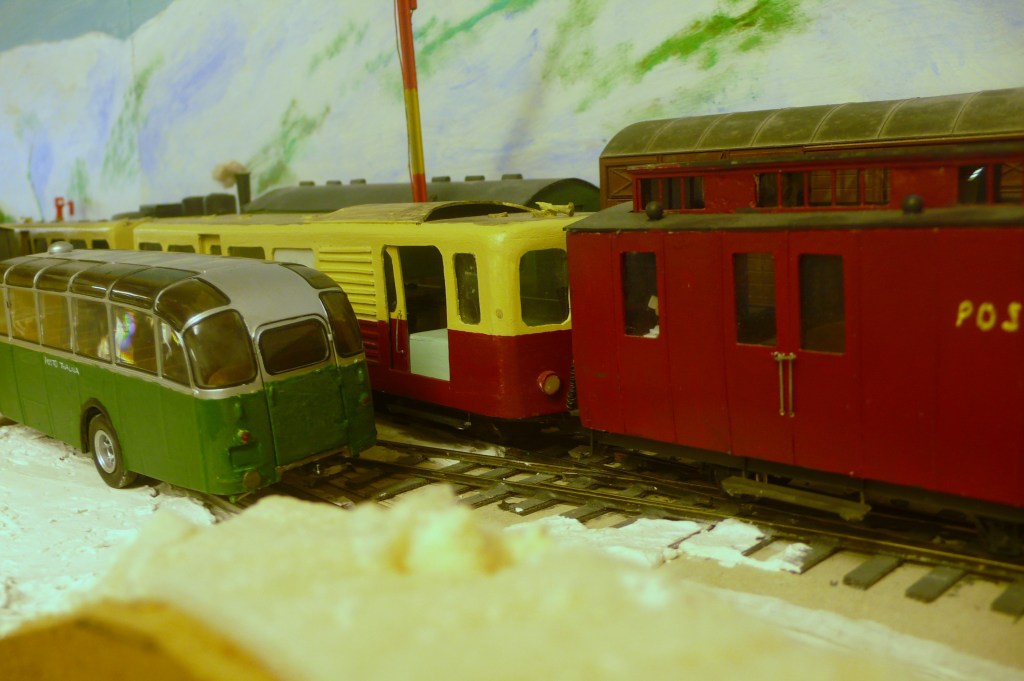
14-49. The Post bus has arrived from the lower valleys to make its connections with the train. These are only made when the roads are clear of snow. The door on the railcar slides open, although the motor cover spoils the impression, but this bus and the Post van do not have opening doors. The bus could really do with the repaint tidying up but that is a low priority job. The Postal worker sorting out letters is just visible through the window.
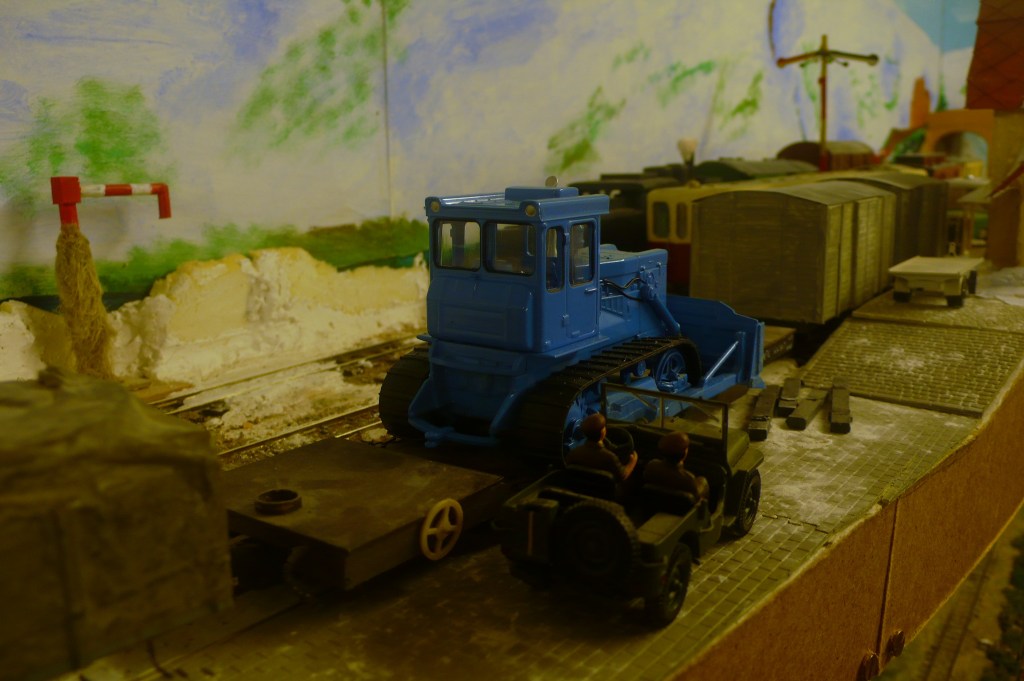
14-50. The usual crew of sappers turn up to deal with the bulldozer. As is often the case the professionals will get the job done with the minimum of fuss, now that the officer has left the scene. The bulldozer has made its first and probably last ride over the AFK. Its blade hit too many lineside fittings and first impressions suggest that it cannot easily be narrowed. The wagon with the tarpaulin was meant to go to Jakarutu but has accidentally been carried past Ithilarak, the junction for the branch. It will have to be taken back at some point. The Fenditavalat goods is already booked to have left but it will have to wait for the railcar’s departure before running round. Quiona has been so busy that she has not yet had time to signal it away.
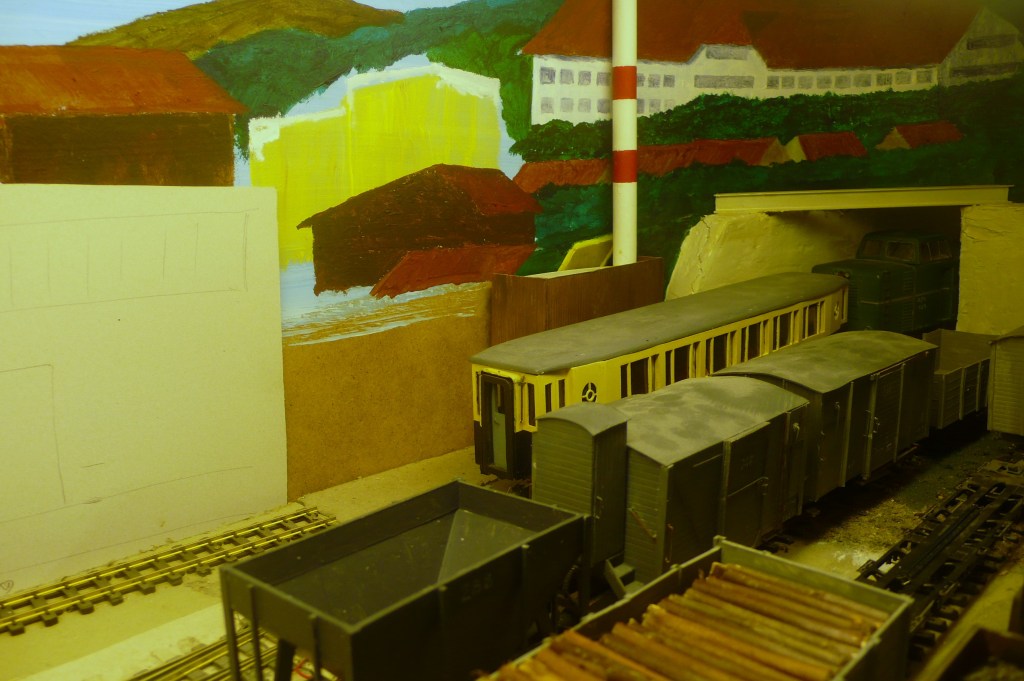
14-51. The arrival of the up express at Urteno prompts a flurry of activity in the summer. The Pullman passengers remain on board their coach which is detached from the front by the train engine. It will be propelled into the adjacent platform to allow them to unload into the fleet of chic courtesy cars sent from the hotels and sanatoria surrounding the town. One of these can be seen behind the trees in the upper part of the town. The striped chimney belongs to the furniture works power plant. The Pullman will be dealt with by the loco of the following local train.
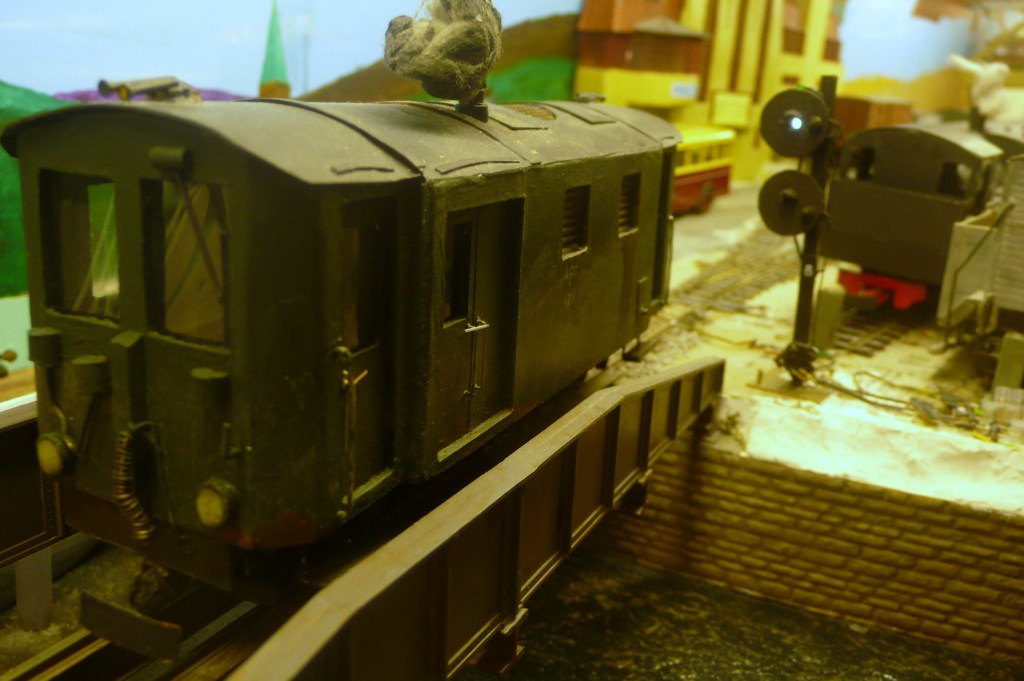
14-52. At the bottom end of the station the disreputable banking loco, belching oily black exhaust, has pulled onto the bridge behind the rest of the train. It receives the white light indicating that the route is set to the RT or through road (rektatrako) so that it can buffer up to the carriages. Perhaps it is a good job that this loco is behind the train rather than piloting. The banker is booked to provide year round rear end assistance over the vulpafaŭkangulo, although this is not always necessary in the less busy times. White in the searchlight signal indicates clear and green indicates caution, you might remember, following French practice into the 1930s.
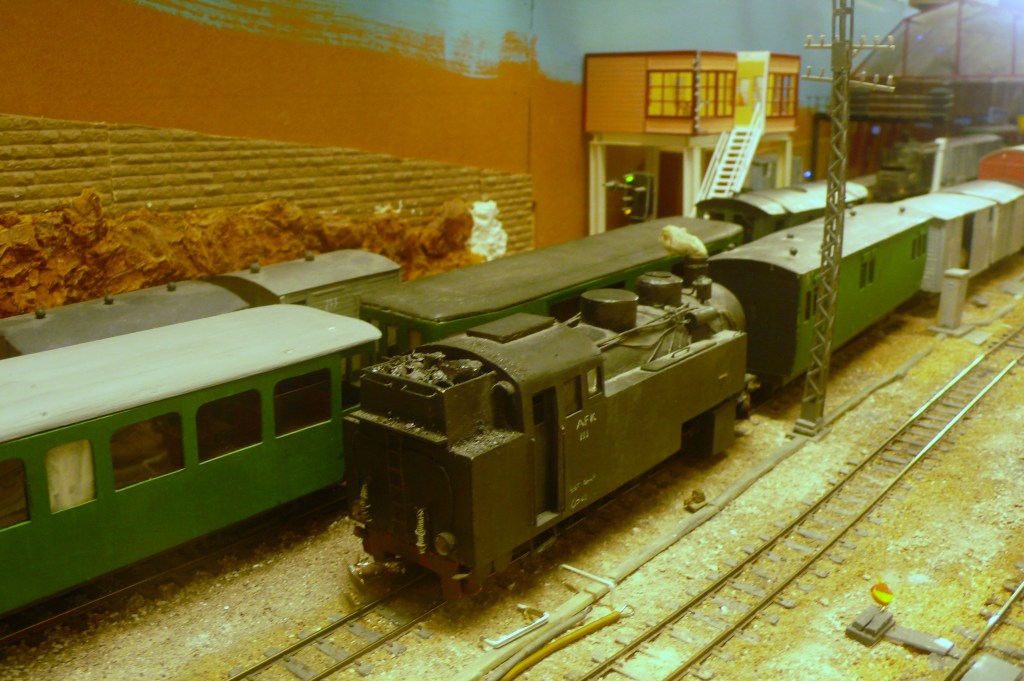
14-53. Once the railways had established standard routines for dealing with traffic they persisted with them as it made life easy. Lacono’s routine has been disturbed today by the arrival of the Danulbo shunt. This is still standing in platform 2 as the local passenger pulls into platform 3. It could not cross to the yard after the express left as the goods train was being remarshalled. The passenger train needs the Postal tender detaching before the TPO is returned to the rear. It might be time to reconsider the marshalling orders for this train which will probably be delayed today.

14-54. The local goods has been let out from Breĉo de Glissent early, as is often the case. The down Urteno goods is standing in the loop at Boursson waiting for it to arrive. The down train is running early and, at this time of day, there is little traffic for it to interfere with on the lower part of the line. The up local goods often has a lot of work to do here which is why the crew look to get an early arrival. The leading wagon contains brine which is going to Sojonno. This is a facing siding for up trains so the standard practice is to run such wagons through to Lacono and drop them off in the afternoon with the down train. As was noted in photo 14-10 there is provision for urgent loads to be dropped off but this is rarely used.
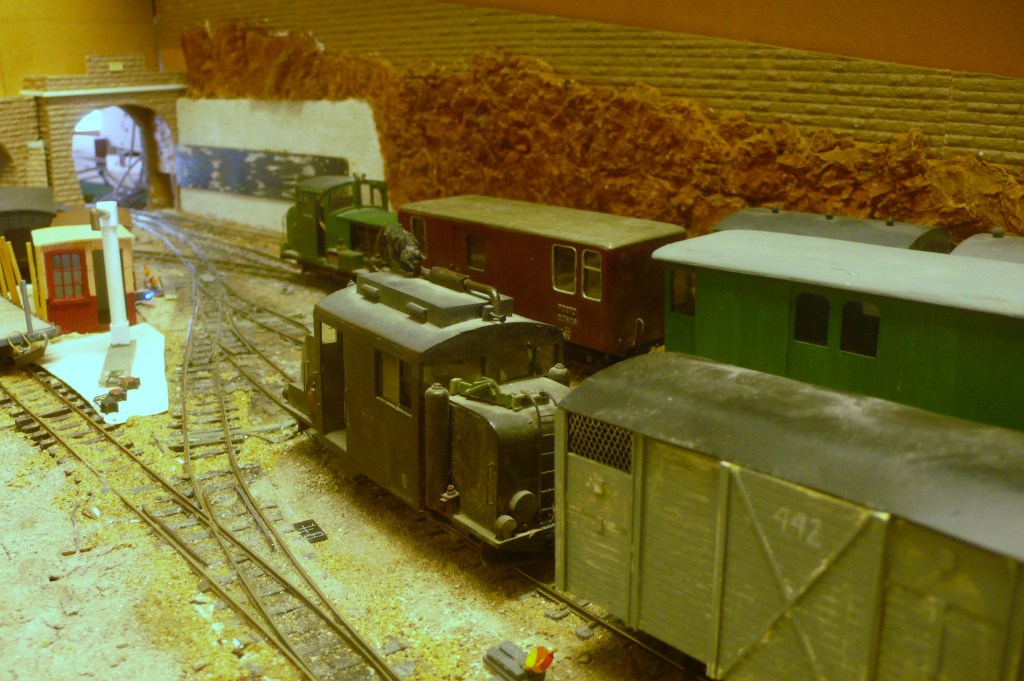
14-55. The “Creature” has retreated into Gasafabrikatastrato yard, along with its cut of wagons, whilst the pilot deals with the postal vans on the passenger train. The long distance FDV-RFK goods is due shortly so the part time crew will be asked to do some marshalling of the pick ups for this train. Some of these were removed from the Urteno train by the pilot to keep it within the tonnage limits and others, such as VV442, which is loaded with shoes, have come from the Danulbo area.
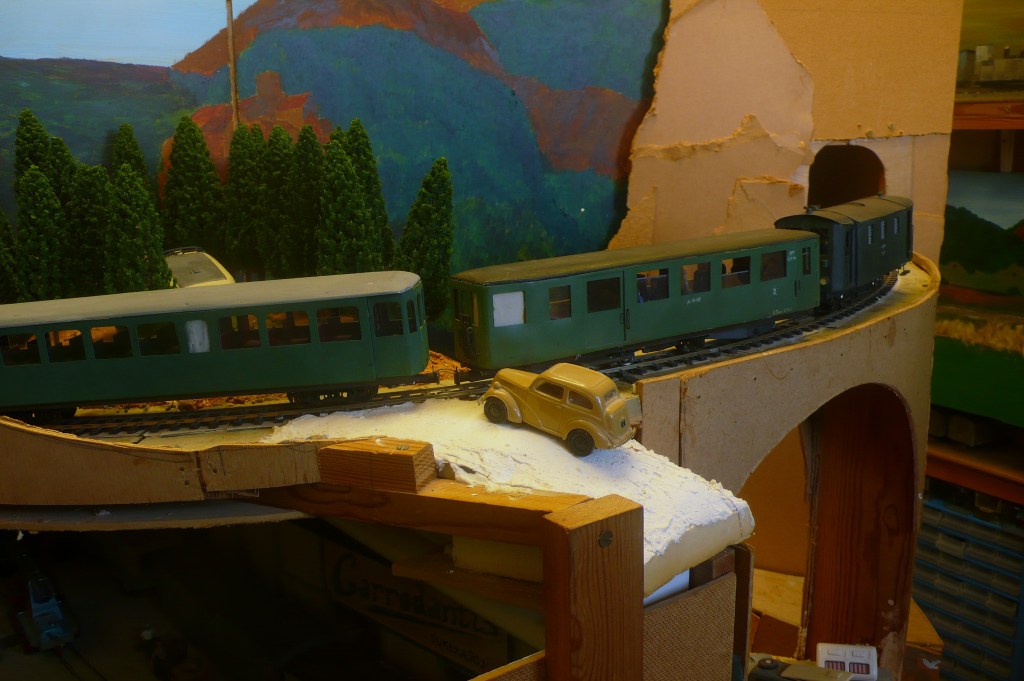
14-56. The RFK-URT local passenger train makes the stop at Ghealdaban, whilst blocking the level crosssing, running twenty minutes late. Rearranging the order of the postal vans will prevent this lateness in future although the pilot was previously able to carry out its job without interference. This train carries out a lot of shunting at Urteno and must cross the down express railcar, although, even allowing for its lateness, it should have plenty of time to do this. Removing the Pullman from the loop will be the priority.

15-57. The “mill train” is ready to leave Fenditavalat slightly before time. This train was added to the timetable recently to carry wood loads to the Verdamőlln paper mill at Lacono. It conveys other goods as required. Today it is leaving with a van of empty beer barrels for Karamspur and the milk containers for the Carrodantis chocolate factory at Lacono. These are usually dealt with by the afternoon mixto for most of the year but this train, or the afternoon goods, are used in summer. The train is limited to 60 tons, as seen here, because it has to fit into the very short loop at Caladonno to cross the RFK-FDV goods.
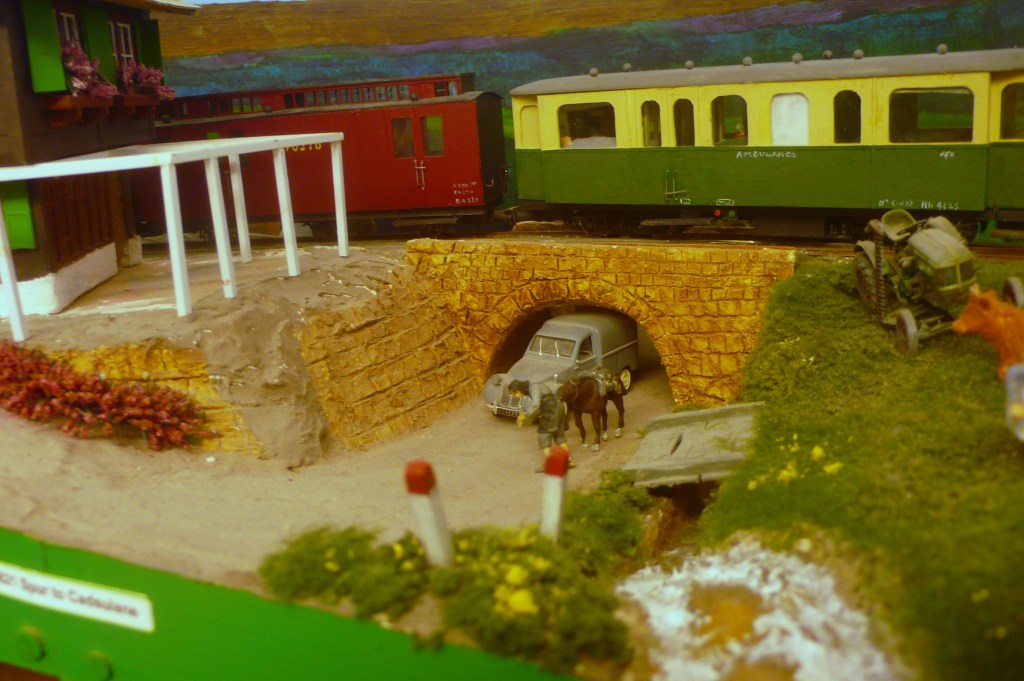
15-58. The Post van and ambulance on the rear of the morning railcar trundle into Cadsuiane-Fanhuidol over the very low bridge that restricts traffic to the mountain village. The “old lass” is pulling a reluctant mule up the road as a Citroen van warily passes by. Many places in the mountains are better accessed by animal power than by mechanical contraptions. Repeated requests to lower the road surface here have been thwarted by the foundations’ proximity to the fast flowing adjacent stream. The scene could really do with finishing at some time.
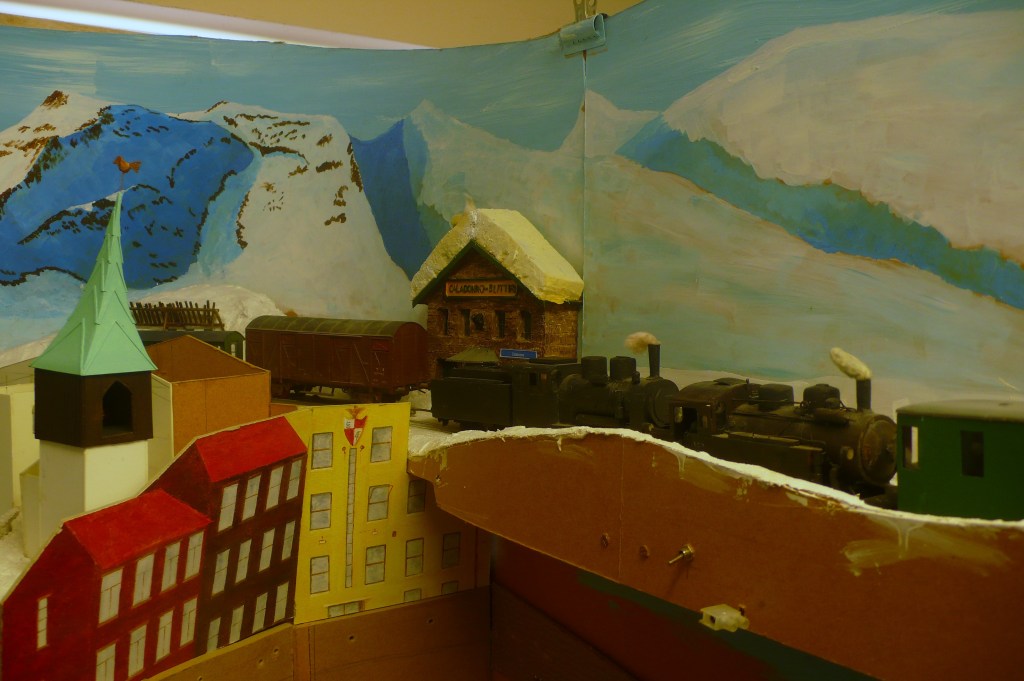
15-59. The late running Fenditavalat goods crosses the mill train in the short Caladonno loop. The fascia could do with tidying up and it would be nice to complete the background. It is fairly obvious where work stopped some years ago! The background buildings for Lacono unfortunately impinge onto the scene but this is one of the problems with a multi-layer layout. The switch to isolate the loop was necessitated by a shortage of centre off 4PDT switches which now seem to be out of production. The chocolate box connector operates the loop’s track brake. I must get around to installing one in the running line to stop trains running away during shunting.
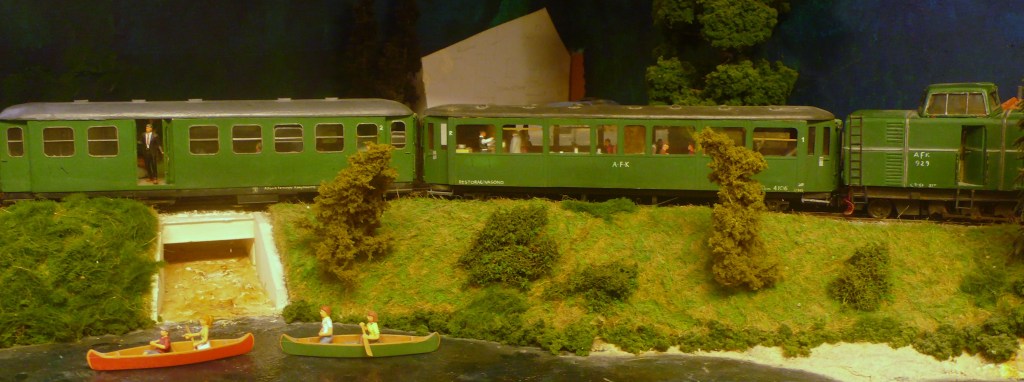
14-60. The express draws to a halt at Varden, the upper suburb of Urteno, a well known recreational area. After some searching around various obscure boxes the summer holiday makers have returned to the lake and the swimming pool. The complex offers swimming, canoeing, boating and golf, alongside pleasant gardens for relaxed strolls. The canoeists are a “straight from the box” Woodland Scenics set. I am not sure whether they are now still available. The ski lift, which is still a place marker, functions in winter when the lake is used for hockey and the bridge forms the end of the toboggan runs. By this stage in its journey the train is effectively an all stations local, stopping everywhere. Patronage is unlikely to be high as the complex is served by the more frequent services of the Urteno tram system. The fuel expenditure of the train loco and banker, in restarting on the grade, probably outweighs any revenue gained.

14-61. Minor problems have far reaching impacts on a “system layout” as the ripples spread. The mis-marshalling of the passenger train, and the presence of the Danulbo shunt, makes the local passenger train twenty minutes late at Urteno which causes a similar delay to the FDV-RFK goods. This is now leaving Urteno at the time that it should be arriving at Lacono. This train will probably need remarshalling as much of the load is low priority raw materials, such as the gravel and Narnite, which would usually travel by later trains. In consequence it will probably lose its path and even more time.
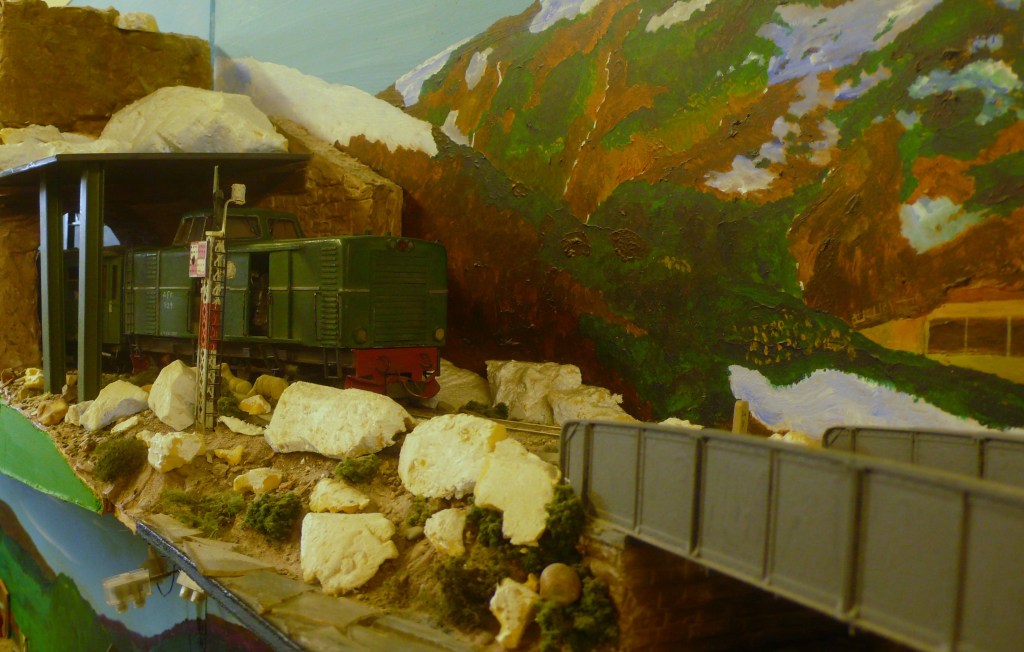
14-62. The up express is momentarily held at the Ospicio “Star” because the local goods was late in arriving and its shunting could not quite clear the mainline in time. Ironically it went across to the siding to retrieve the wrongly delivered wagon (14-50) otherwise there would have been no delay. The enirasignalo has cleared and the powerful loco revs up to restart its heavy train on the steep gradient amidst the melting remnants of the harsh winters. We are now in June and the ice on the Lagunabianco has only just started to melt. For the benefit of new readers, and those who have forgotten, the “Star” is the home signal that marks the end of the vicious climb from Relforka and is named after the Ais Gill distant on the Settle & Carlisle which was known as the ‘Star of Bethlehem’.

14-63. With the goods train gone the loco of the terminating local passenger shunts the Pullman into its siding. This duty is only necessary in high summer and in the skiing seasons. As was noted earlier the Pullman would probably have its windows smashed if it was left so close to the log loading site but compromise rules.
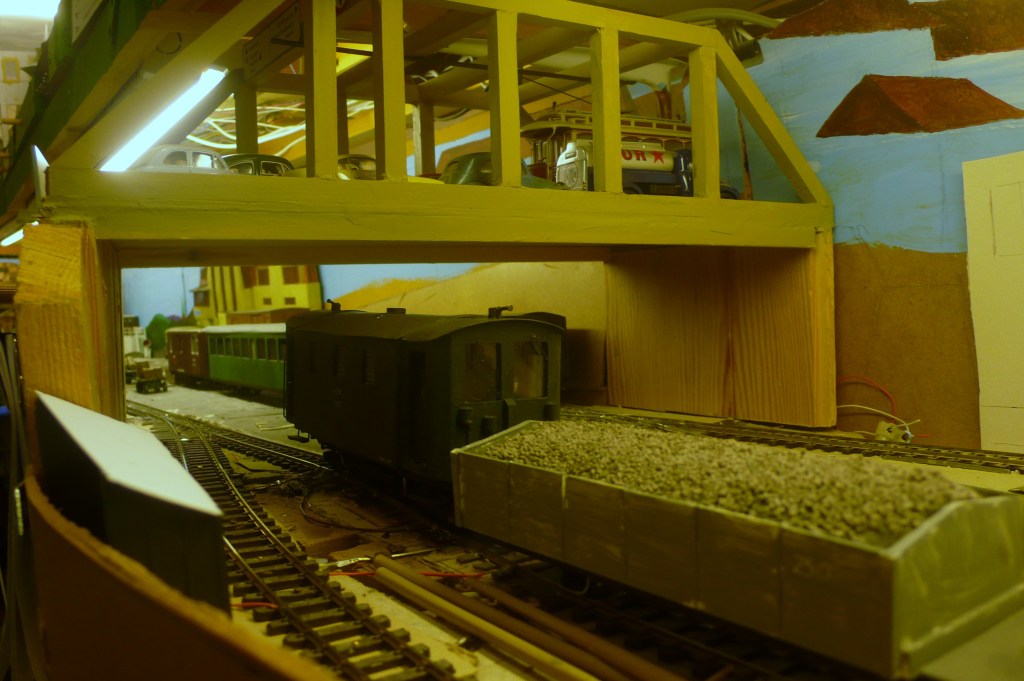
14-64. The train engine is purloined by Ulfha, the shunter, to do a little tidying up at the Karbaflanktrakoj, close to the Ĉefastrato bridge. This is conveniently close to the workbench, from where this view was taken. It is easy to view the loco from “ground level” at this point, and a couple of irritating shorts have occurred during the course of the journey. After pulling the loco off the layout a couple of times to re-align the skates it was realised that the wire holding one of them was shorting against a screw on the chassis. Hopefully all is now cured. The gravel wagon will be tripped out to Varden when the pilot returns.
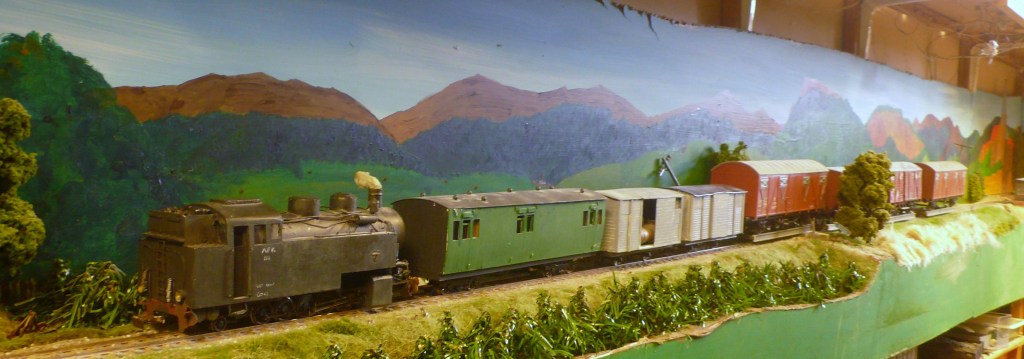
14-65. The down Urteno goods crosses the Kasatritikakamparoj, behind the 2-10-2T, running slightly early. As is often the case this train is characterised by a high proportion of SG wagons in the consist, reflecting the industrial nature of the two settlements that it serves. As I have said before, it would be nice to have longer, more prototypical, trains but the space available prevents this and, in any case, I doubt that this would be good for the models’ mechanisms. The two NG vans, loaded with beer barrels, are going to the coast, providing a relatively rare example of goods interchange between the MFR and the AFK.
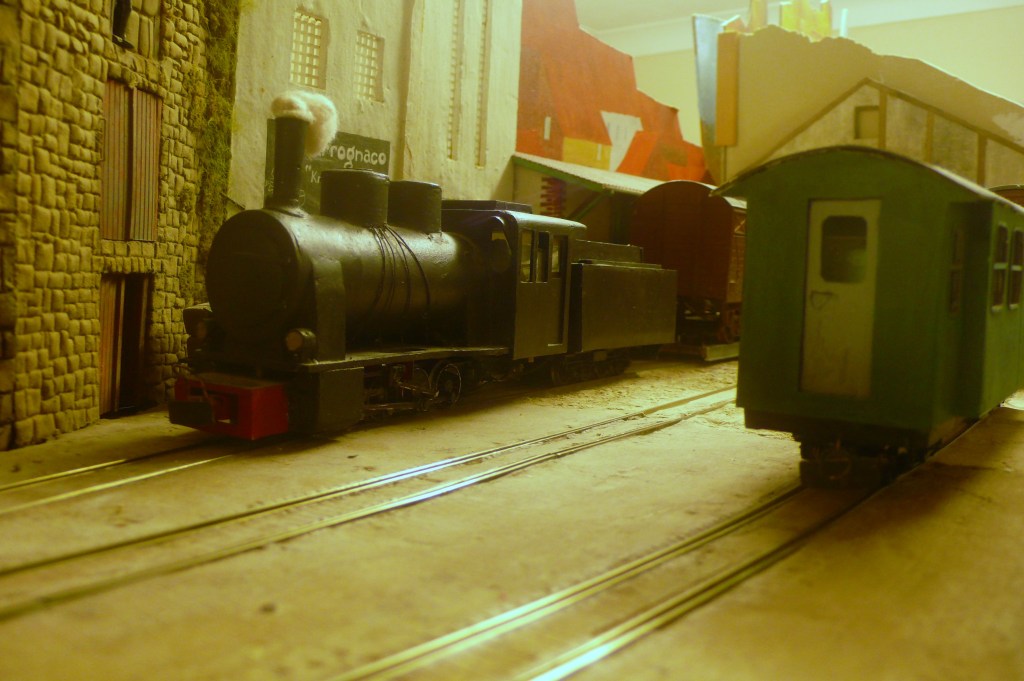
14-66. The final act of the RFK-FDV goods loco is to place the sole remaining wagon, a SG van on a transporter, at Fenditavalat’s goods shed. The crew van has been left on the near siding. The train was first seen in 14-09 when it was running at the load limit. The train effectively acts as a local goods across the Altingablecaŭtoj, once it has left Urteno.
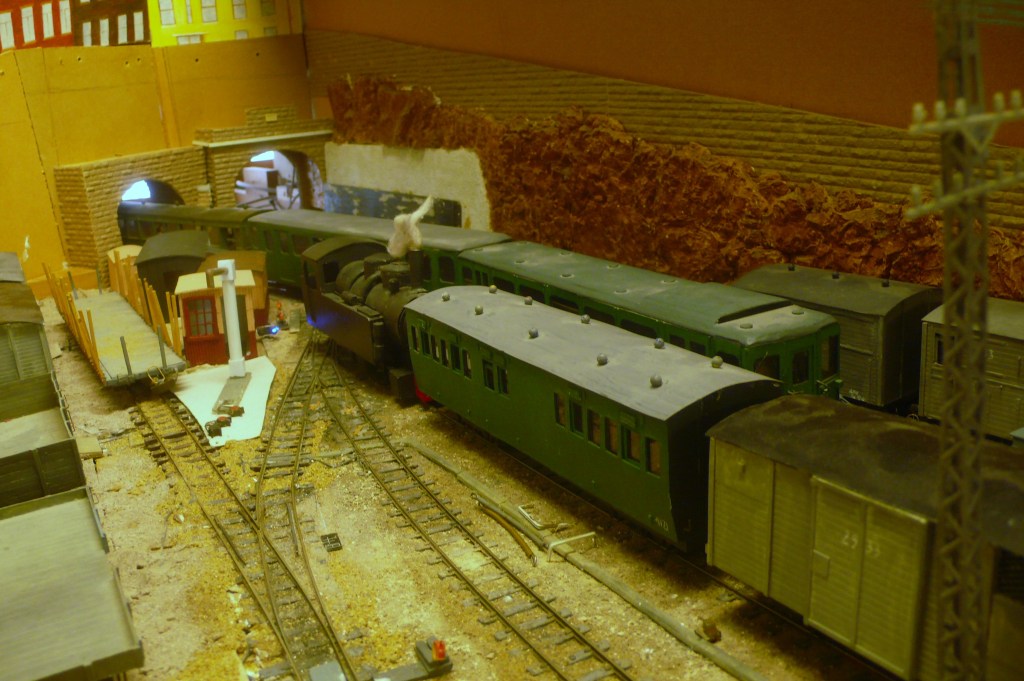
14-67. The FDV-RFK goods stands in the reception loop ready to leave. It will be let out once the late-morning railcar has clattered over the diamond from Aspargo shed. The railcar is augmented by a driving trailer today and will run to Varden rather than Urteno. This allows people from Lacono to spend time at the recreational complex during the summer months. The third coach has been tagged onto the rear to serve as a through coach for the seaside excursions that also begin “today”. The railcar is being brought out early because, if I do not keep a close eye on the timetable, I forget to run it.
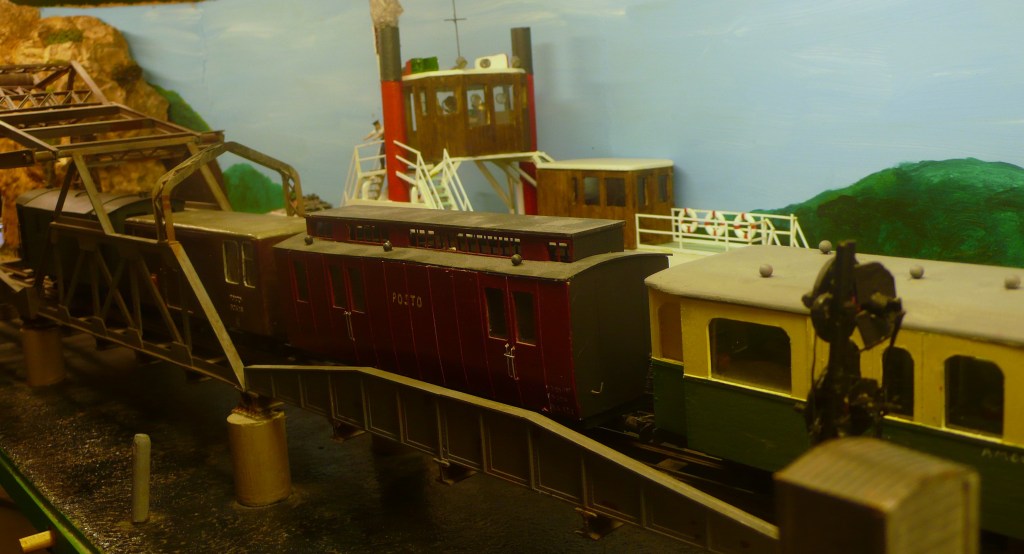
14-68. The railcar in the last photo also connects with the ferry which can provide a nice, lazy, afternoon cruise on the lake for those so inclined. As an inducement both the station restaurant and the brewery café are well regarded eating spots. The elderly boxcab, from the local, has run out onto the bridge to remarshal the vans and ambulance so that they are in the correct positions for loading at Lacono. I must get around to painting the (currently missing) swans!

14-69. The boxcab’s sister, the I-D-I acting as banker today, reverses into the obscure siding at Varden. There really is track in there! Open M203 has stood in the siding unused for some (model) days. This prototypical semi-redundancy was a design objective whereas most models move all stock at least once a day. There is no load today either but one of the self unloading gravel wagons is due to be placed in the siding. It will be easier for this to unload at the top end of the siding. The coupling pole, at the right, is used to secure wagons left in this steep siding to prevent them running away. There are strict regulations about how shunting is carried out to prevent accidents.

14-70. The late running Fenditavalat goods crosses the KTT local goods at Boursson. The lateness was advised by phone to Boursson so that the crew could make the most of the late arrival. The local train is almost ready to go as the loco, with the two vans on the rear, will run round before the railcar arrives in time for a prompt departure. The mallet is obviously a work in progress as is much of the rolling stock. An attempt was made between sessions to paint all the underframe components into black but, with so much stock, it was inevitable that some rogue items would escape, as witnessed by the right hand van and the brake on the express.
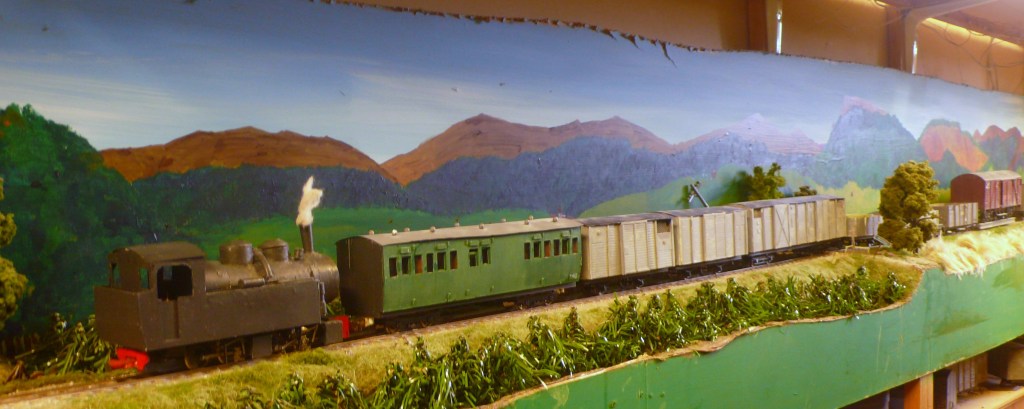
14-71. The contrast between the consist of the Fenditavalat train and the Urteno one (14-65) is often quite marked. With the sole exception of a SG van this train is composed of NG equipment, including a number of opens loaded with primary products. The four compartment brake 2nd is empty now, having served its purpose in transporting the early morning fair goers to Ithilarak. Ithilarak, incidentally, is directly above this scene, the train having traversed the room once, and the peninsula, since departing.
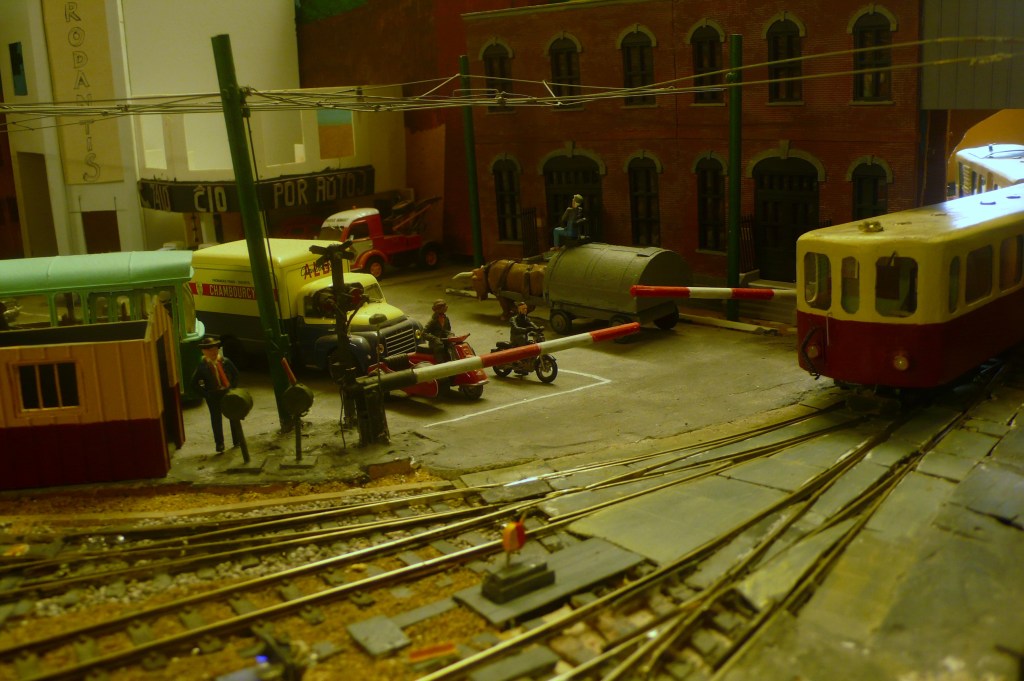
14-72. The FDV-RFK railcar pulls into Lacono Cittavecchia. The Karushnastrato barriers are hand worked from KaS cabin, visible at the left and still awaiting an interior and a roof. The winding mechanisms, based on German prototypes, stand in front of the hut and require Licamo, the crossing keeper, to stand beside people stopped by the barriers. Altonia is a fairly relaxed canton with regard to railways so a blind eye is turned as pedestrians “jump” the barriers providing they check where the train is. In any case Licamo can do little about this as his left leg has been amputated following a shunting accident. The crossing job is an old man’s sinecure reserved for such cases. The box could be phased out, with a little more technology, as it merely releases slots to the main box. The motorbike rider without a helmet is a typical sixties phenomenon, in keeping with ox drawn dustcart. You will note that the scooter-sidecar combination is in the correct orientation for continental roads. I bought it as a “load for a lorry” years ago. It came complete with the lorry and a couple of other scooters. I am half tempted to put a dog in it for a Wallace and Gromit effect.
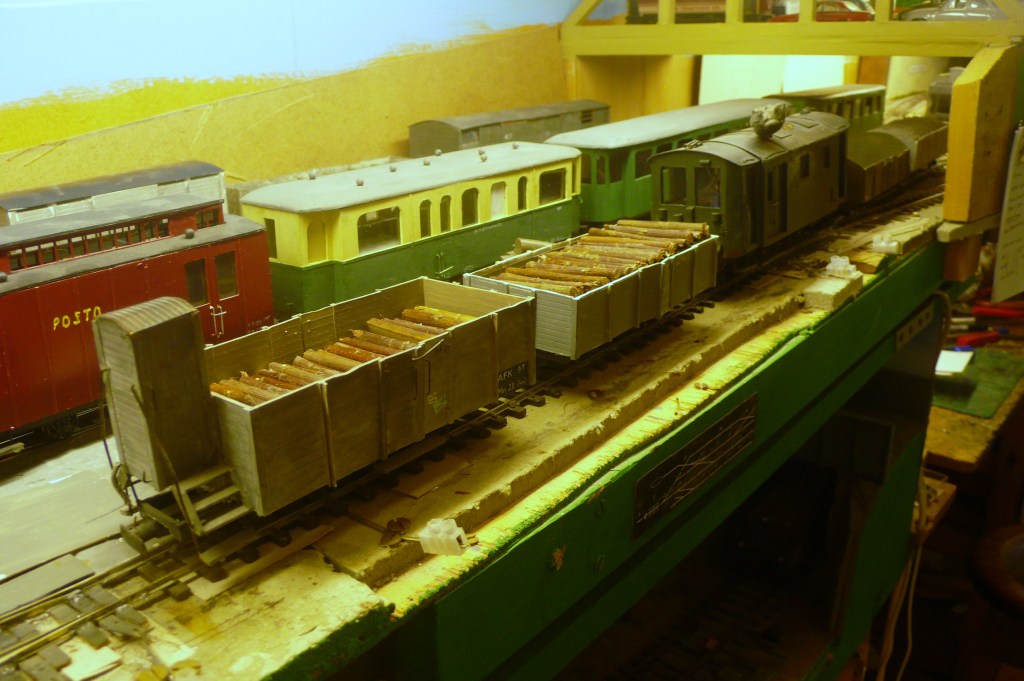
14-73. The main drag at Urteno might be occupied by the local passenger train but this is no excuse for shunting to stop. The pilot pulls two loaded wagons from the wood siding into a more convenient position before propelling the gravel wagon and the empty open back to Varden. The shunt moves were properly “time costed” on a sheet of paper to ensure that no cheating occurred, which revealed that there was plenty of margin for the moves. The log loads were made between sessions, although one or two need more attention, where logs have been knocked off. I rather doubt, however, that they would have been loaded so quickly as implied by photo 14-63.
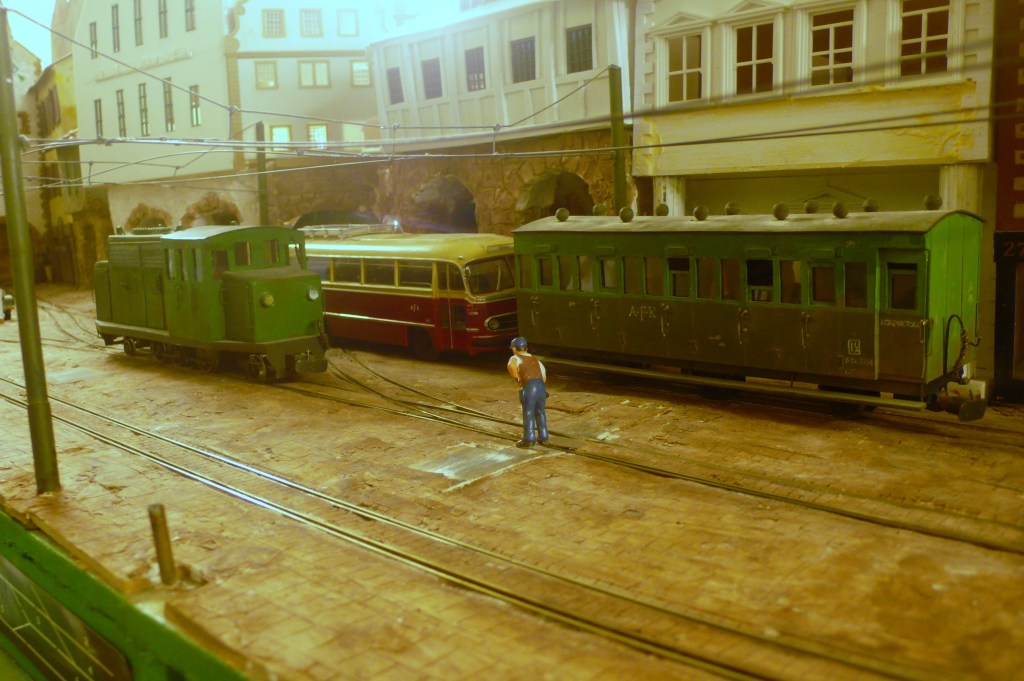
14-74. The calm before the storm. Isuri’s merkatubaxu is quiet in the late morning as Suspasco, the shunter, uses a point iron to align the points for the I-C-I which will supply the power for the return train from Ithilarak fair. An ancient 6 wheeler with a brake compartment will suffice, although it is showing its age. In actuality it is probably doing this by being better built and finished than later models. It dates to the original terminus-fiddleyard model where there was less time pressure to build quickly as it was a small layout. The AFK bus takes a slurp of motion lotion at the CFS petrol pump, perilously sited beside timber framed Mediaeval buildings. The AFK is the “away” team in Calviero and it will be charged by the CFS for the privilege. The place will soon be a hive of activity when the express arrives.

14-75. Running under clear signals the express makes a brief stop at Caladonno as the market special waits in the loop. This loop was added to the scheme at a late date, once it was realised that Fenditavalat could not cope with the longer trains that had become normal on the layout. Initially the loop was regarded as a goods siding but there is little on offer in this snowbound waste and the loop has been incorporated into the timetable as a crossing point to increase flexibility. It is very short so train lengths are limited and it is only used occasionally.
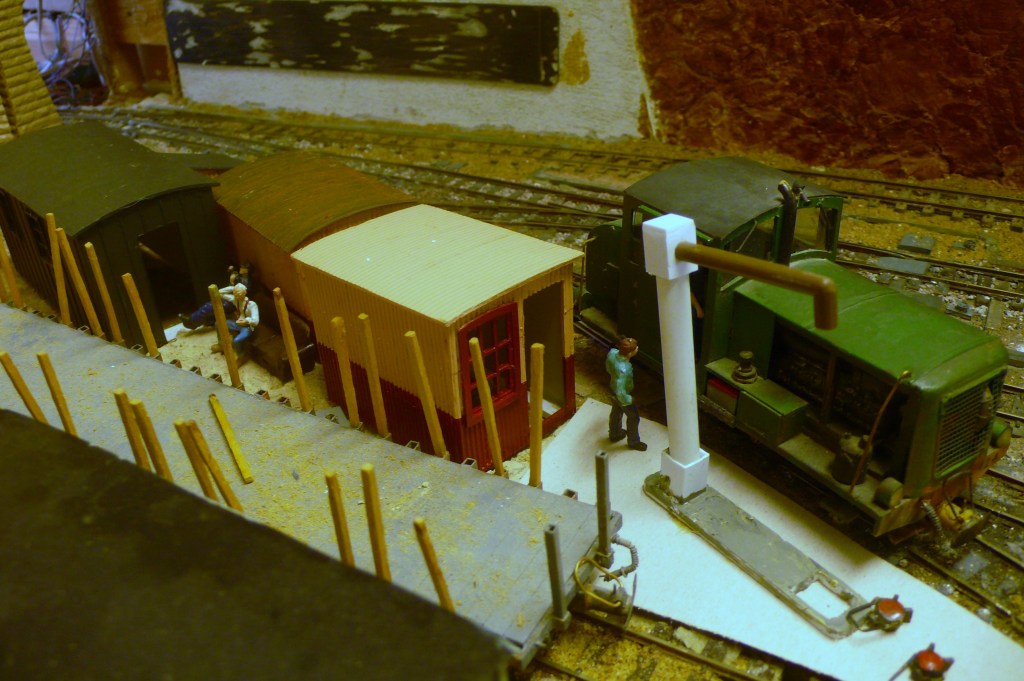
14-76. Sisyphus takes a break alongside the ‘hutted encampment’ of Lacono’s Gasafabrikatastrato facilities. The ramshackle cabins include a mess hut, with dilapidated seats alongside, where staff can lurk between duties. A parked van is the preferred option for screening their activities from pedestrians climbing Gas Works Street but today they have to make do with a log wagon. The assistant chargehand chats with the shunter driver outside the new office. He is a replacement for the similarly painted figure that disappeared during the station rebuild. I still hold hope that he will turn up one day. The other corrugated hut, at the rear, is GaS signal cabin which interacts with the main box to control access to the southern end of the yard.
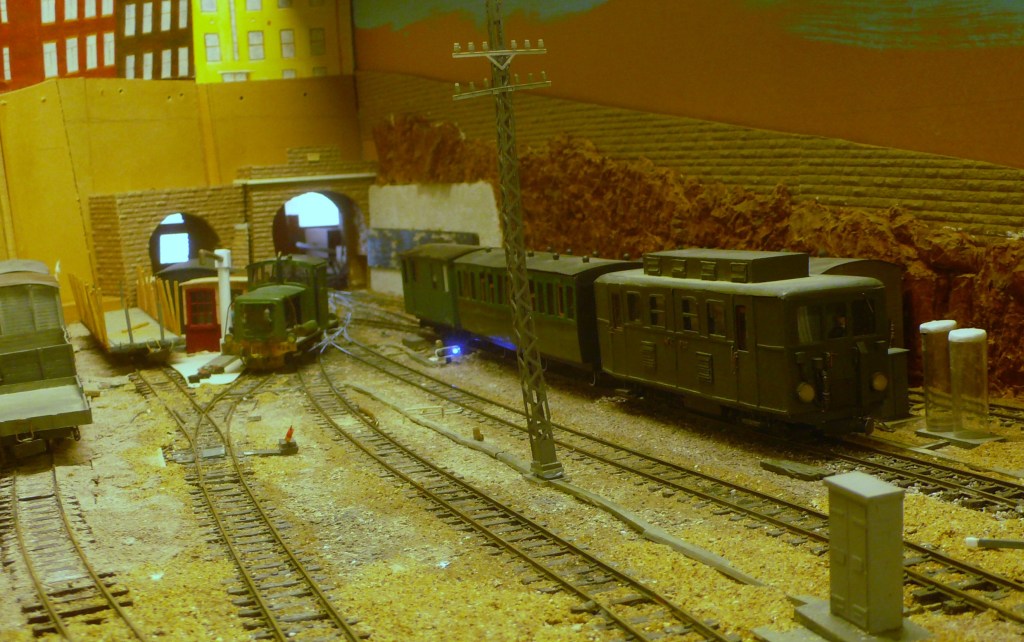
14-77. The up market day special pulls out of Aspargo shed into Cittavecchia. This loco is today’s allocated “spare” so it is be hoped that there are no motive power problems whilst it covers train 6675. The train comprises a six wheel nominal composite with a four wheel brake van attached at the rear. I am certain that there is a six wheel brake 2nd somewhere but a cursory glance at the likely places failed to reveal it! These long six wheelers were rather incongruously based upon GNoSR prototypes.
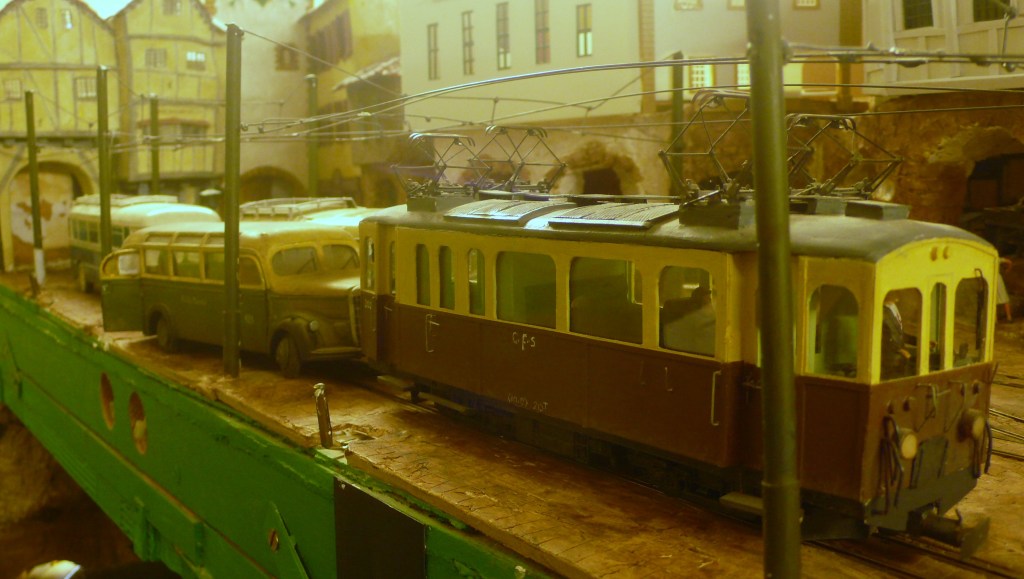
14-78. The Basabazaro at Fenditavalat has filled with connecting road and rail services meeting the express. The ongoing connection via the CFS will be pulled by the railcar. Normally this simply comprises the Post van but today it will include the through coach. There is quite a wait before the train leaves Fenditavalat Orbonaklifo (to use the correct title) so it has become something of a tradition for the able bodied, who are so inclined, to make the “pasealeku”, or passage through the streets, which is a pleasant stroll past the cathedral taking them between the stations. Luggage is left onboard and the walk, of around a mile, passes various food and drink establishments catering to the walkers. There is a warning bell for the tardy or overindulgent and the trek is not advised if the train is too late. It is (or eventually will be) well signed as the trail leaves the square at 180º to the train. (And yes, I have created a skeleton timetable for the CFS mainline based on SG timings at Krelm.)

14-79. Whilst Janetta’s washing stands in the street, just visible at the bottom left, the students have been busy. Hraxo’s ice cream cone stands directing traffic in the middle of the street and indicates where the train should stop. This will actually cause more delay to the slightly late train, if it is not removed, because the train needs to pull right up to the gate to clear the points. The university authorities are not too helpful as they seem to regard it as acceptable undergraduate “high spirits”. The eagle eyed (pun intended) will notice evidence of the Game of the Eagle. Refectory Number 7’s menu board stands outside sister establishment No 3. The game centres around the Eagle of the Ninth which is a much prized trophy. The objective is to liberate as many unwanted but desirable chattels as possible from competing refectories without losing one’s own. The rules, such as they are, prevent items from being secured in any way shape or form to forestall capture. Too much time dissolutely spent on sometimes wild and woolly cricket and rugby tours I suppose, although Post-Grad life throws up some memories! (And I do know of two eagles “disappearing”.)
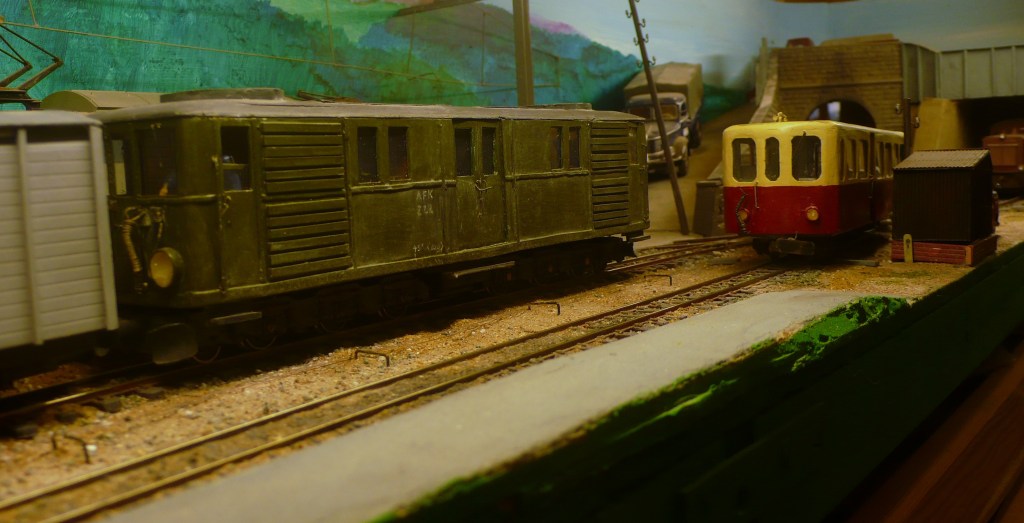
14-80. As the first long distance trains of the day complete their journeys the down railcar reaches its destination at Relforka. It is on time, and the connecting services are also on time, for once. The mixto stands ready to depart on the adjacent platform to begin the second sequence of trains running the whole length of the line. It is carrying the Fenditavalat “reserve stock” which had to be pressed into service “yesterday” due to late running. Although the last session was supposed to have taken place two or three weeks ago this is the next operating session so the stock is returning as though it was the following day. This could cause problems at Fenditavalat. Better hope that the incompetent talking mouse is running Royal Narnian Railways Control office at Beruna!
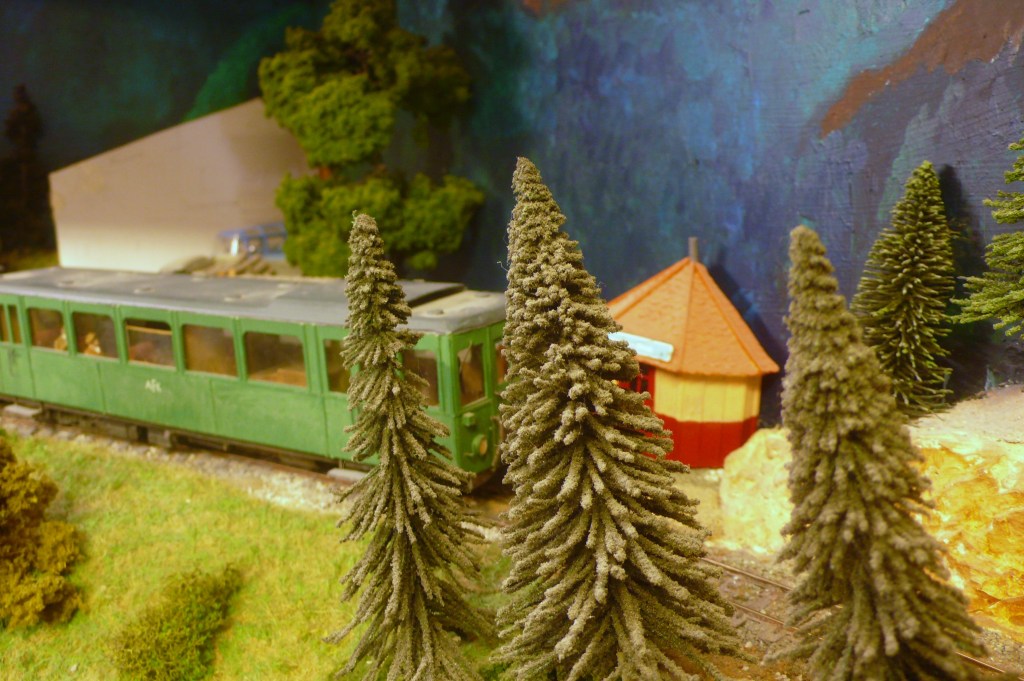
14-81. The railcar from Lacono runs through to Varden in the summer. It pulls to a stop beside the whimsical octagonal station shelter, as seen through the trees. The idiosyncratic building style was chosen as it was thought fit to grace a resort, although I must admit that the influence of the Carrabasset & Dead River played a part in the selection process. I think that it was Taft Lake that had such as structure. The train’s onward progress is stopped by the (currently invisible) searchlight home signal which is just as well because….
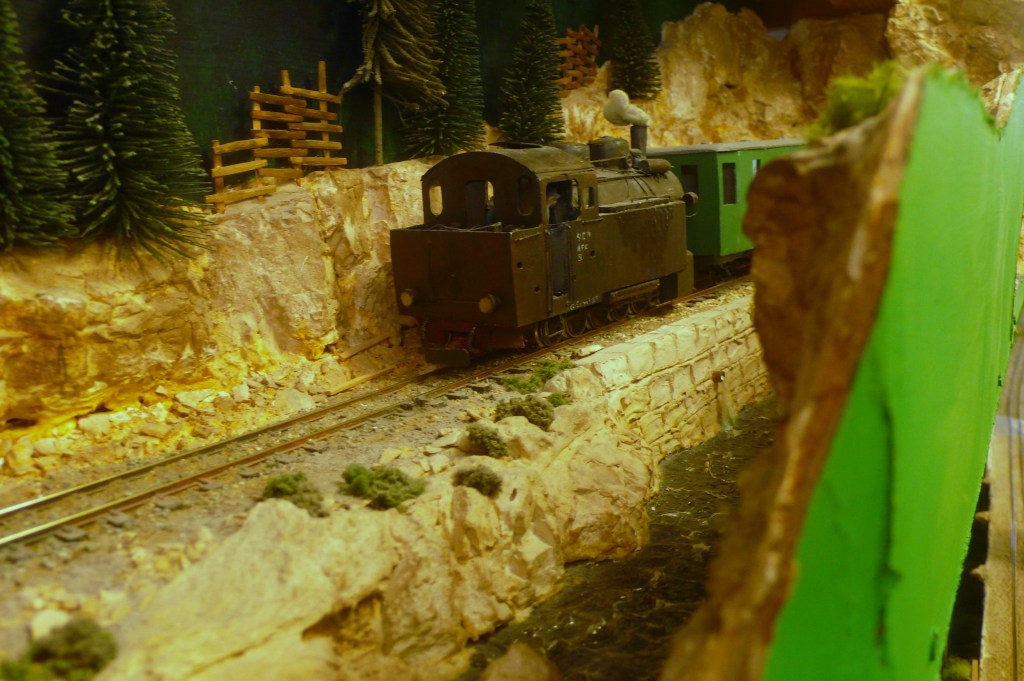
14-83. …. the local ABC goods is bearing down upon it in the lower Aepto Gorge. There are supposed to be three IBS in this section of single line to allow for flexibility. The loco, which is standing across the electrical boundary, has been halted by another invisible signal. In my experience working with a couple of IBS in a semaphore box was a pain in the proverbial because they were easy to “put back” along with the distant, home and section signals unless you concentrated upon what you were doing. I always used the reminder appliances to prevent this. When the railcar left Varden the loco was pushed by hand onto the electrical section in front of it rather than go through the palaver of linking it to the central control.
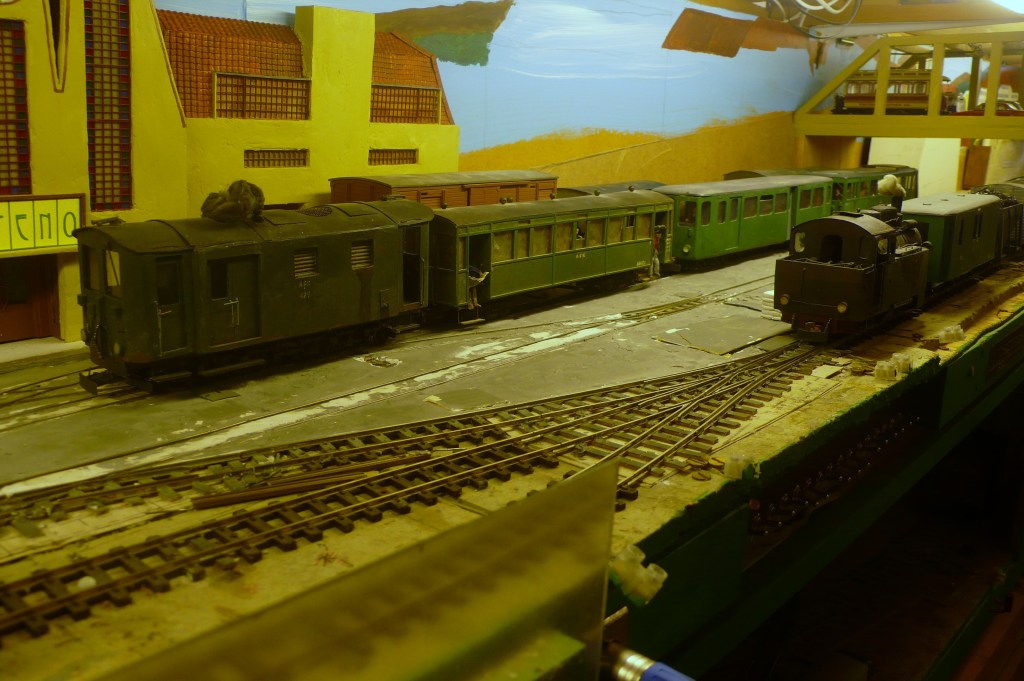
14-84. A little later and the train pulls into Urteno goods loop, having followed the railcar down the hill. The railcar is standing behind the coach that it dropped off earlier to give a through road for the market special. It will be removed by the pilot and the goods train will begin to remarshal its consist. The railcar will connect with a ferry in around half an hour’s time but there is no outward traffic from Varden at this time of day because of the tram service.
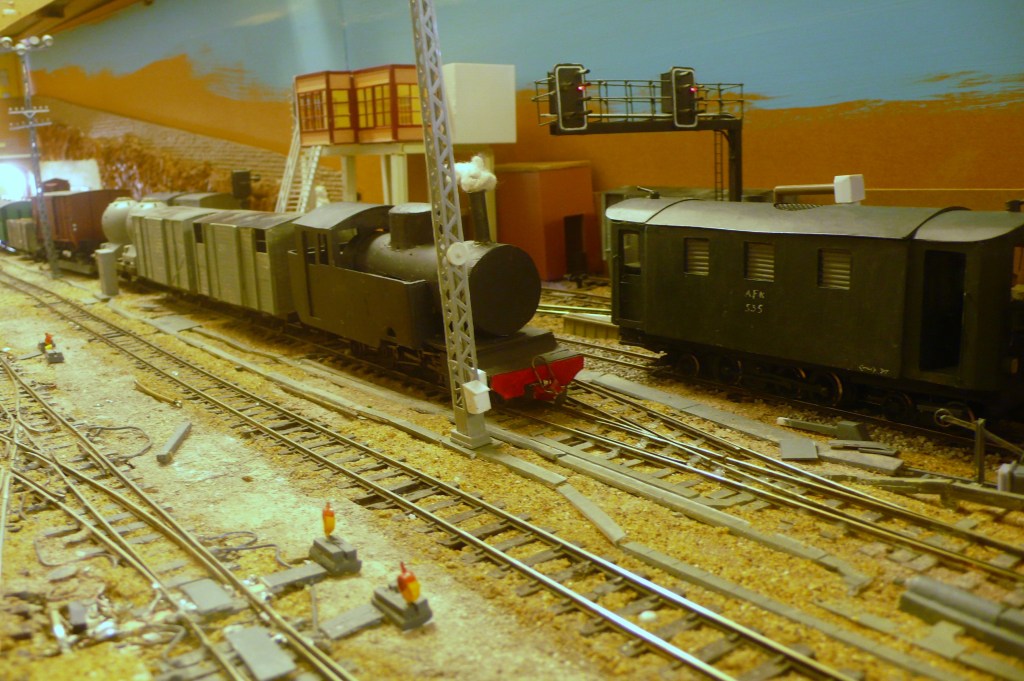
14-85. The morning Kasatritikakamparoj goods pulls into Lacono Gasafabrikatastrato within a couple of minutes of the passenger train arriving from Urteno. The passenger loco has a complex set of shunting manoeuvres to perform to reposition the Post vans and ambulance for their next duties. The goods train crew might or might not be asked to work through to Urteno if the Altingablecaŭtoj goods cannot cope with the traffic. This extension is now written into the timetable as a provisional path.
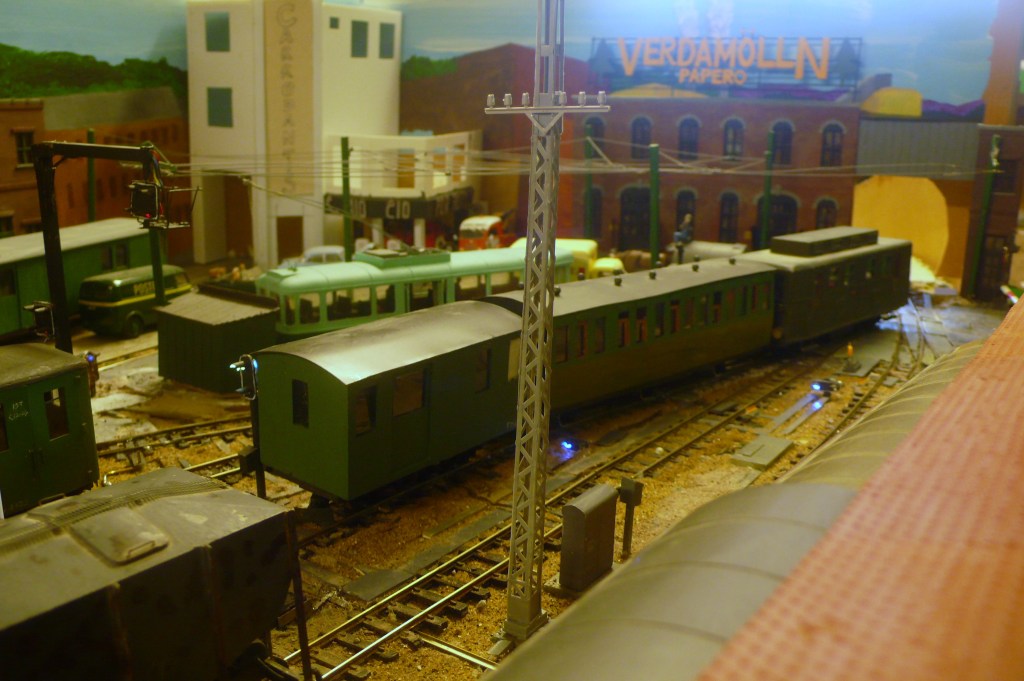
14-86. With the passenger train’s arrival at Lacono the market special can depart for Ithilarak. It would not seem as though much traffic will be on offer but those people who travelled on the early morning school’s railcar will mostly be ready to come home. The Lacono signalman has had a busy ten minutes dealing with these trains and the barrier box. He is not going to get a break either, as the Post van shunts will soon begin.
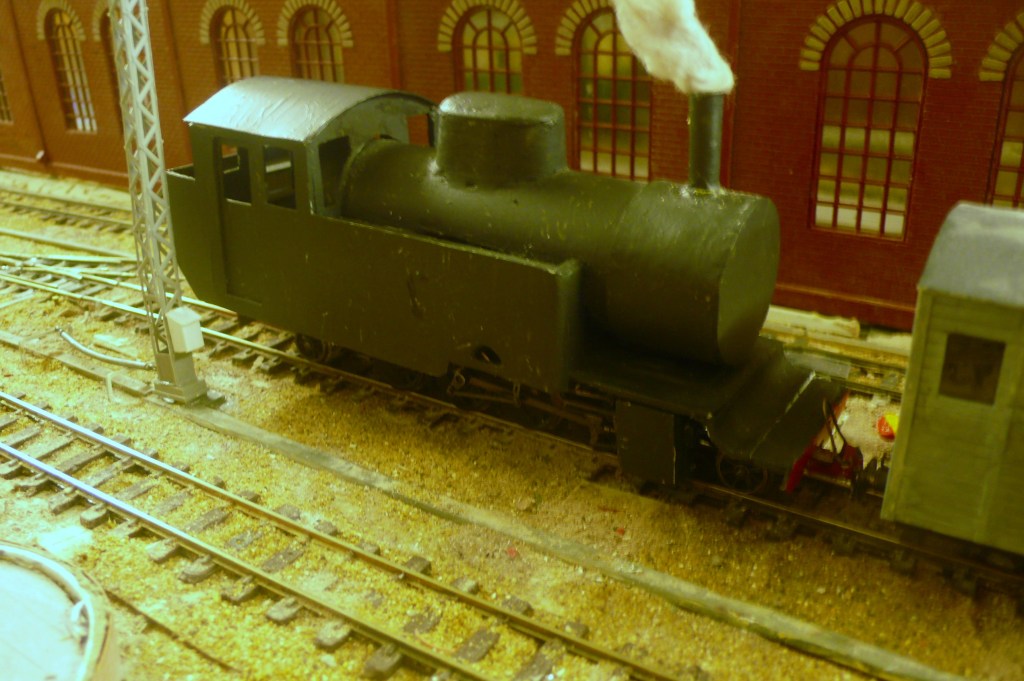
14-86. The 2-8-2T, which is covering the KTT goods diagram today, reflects a mixture of Swedish and Swiss influences. Following standard AFK practice it has been completed to a very basic level and sent out on an extended trial before it gets finished. This procedure has the merit of highlighting any problems. It performed reasonably well as the Urteno banker yesterday and has performed reasonably well on the goods today.
Then it got into Gasafabrikatastrato yard, hardly a paragon of the platelayer’s virtue! It persisted in derailing the leading pony truck over certain pieces of track where other stock had no problems. Pony trucks are always a problem area on AFK locos because they are lengthened to extend the wheelbase to allow a credible representation of the loco being modelled. Getting the wheels exactly parallel with the driving wheels is an issue because if the truck ‘crabs’ the wheels pick the points. Following a number of unsuccessful crude resets with a soldering iron it struck me that there was more to the problem than this.
This loco has a very tight fit for the wheels to clear both the cylinders and the buffer housing. After a whole afternoon of paring back, rebuilding and numerous frustrating derailments, it appears that the problems might have been tamed, although I am not holding my breath. I suppose that it comes with the territory of being a bodger who wants a railway that runs large engines.
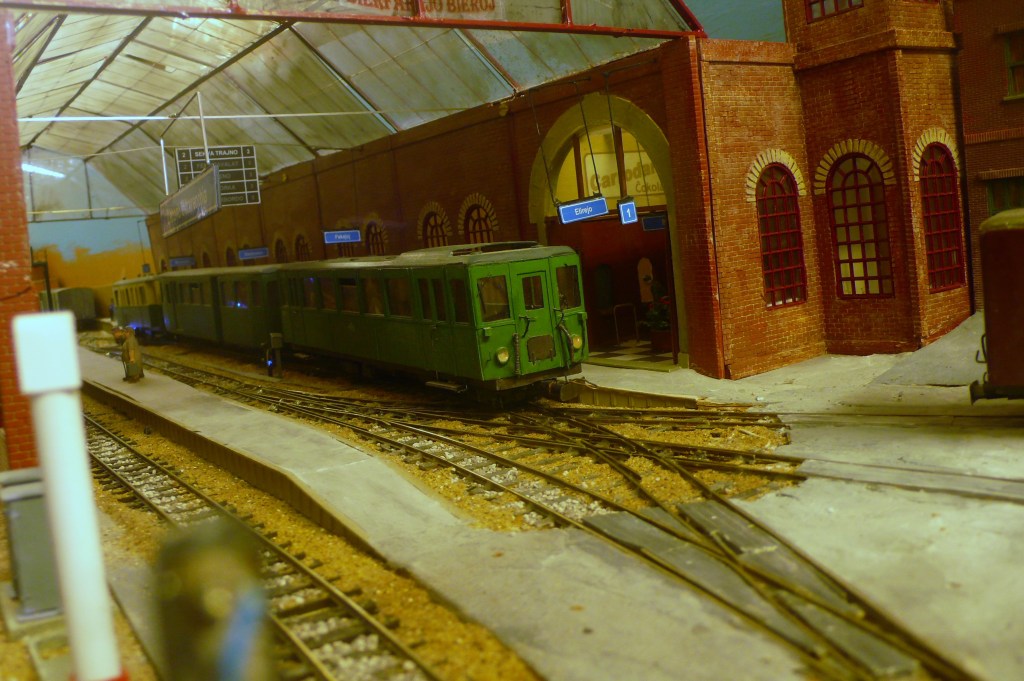
14-87. The shuttle railcar from Urteno arrives at Cittavecchia at 13.00. It is one of the few trains to use platform 1 but it is scheduled to pick up the ambulance which has been conveniently placed there for loading with patients. The recently completed booking hall shows up well as do the diamond crossings. The train indicator is relatively sophisticated and supposedly follows 1950s Underground practice whereby the next train is shown by incandescent bulbs lighting up the indicator cabinet, although it is operated from a switchboard in the station rather than relays. The supporting wires, which are removable along with the curtain wall, could do with a lick of paint. The narrow platform precludes the use of simple indicator boards although I did contemplate a contraption that would have used a windlass. Platform 1 uses boards when needed.
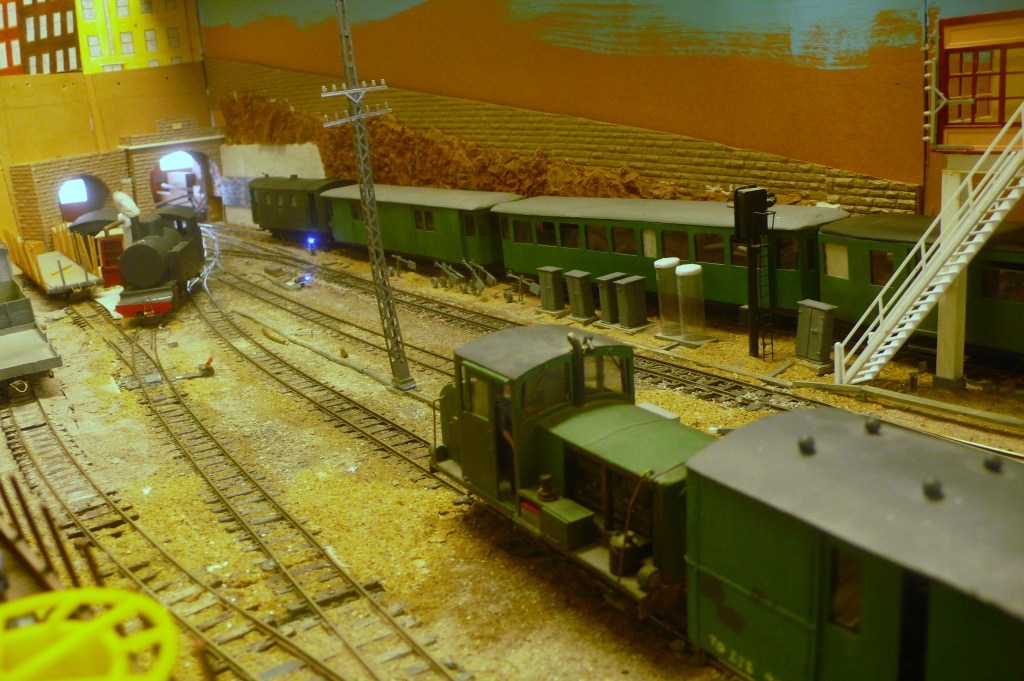
14-88. The southern end of the station is busy at this time of day. It had become the practice to shunt the passenger train into the goods yard when this was a relatively slack time. The introduction of the “mill train” now causes capacity problems even though the yard has been extended. The 2-8-2T was sent to the “spare siding” to collect a couple of horseboxes and leave it clear. The carriage stock is being reversed into the siding by the ponderous diesel, along with the loaded Postal tender. This will leave the goods yard clear. Both train locos need to visit Aspargo shed and Sisyphus needs to pick up a wagon of cordwood which came in earlier.
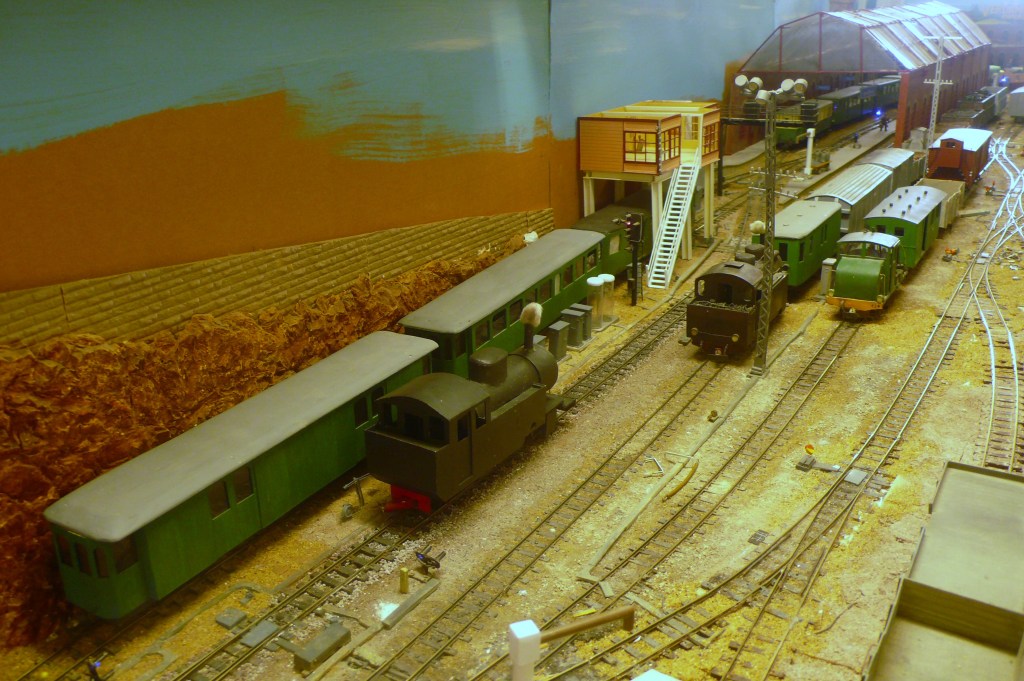
14-89. As the mill train, or the Altingablecaŭtoj (ABC) local rolls in on the reception siding the 2-8-2T is about to follow the diesel onto the shed. It is held at the signal until the goods train comes to a stop to provide an overlap. As can be seen the goods train is long and both northern end loops are occupied by wagons which would have caused difficulties had the passenger stock been left there.
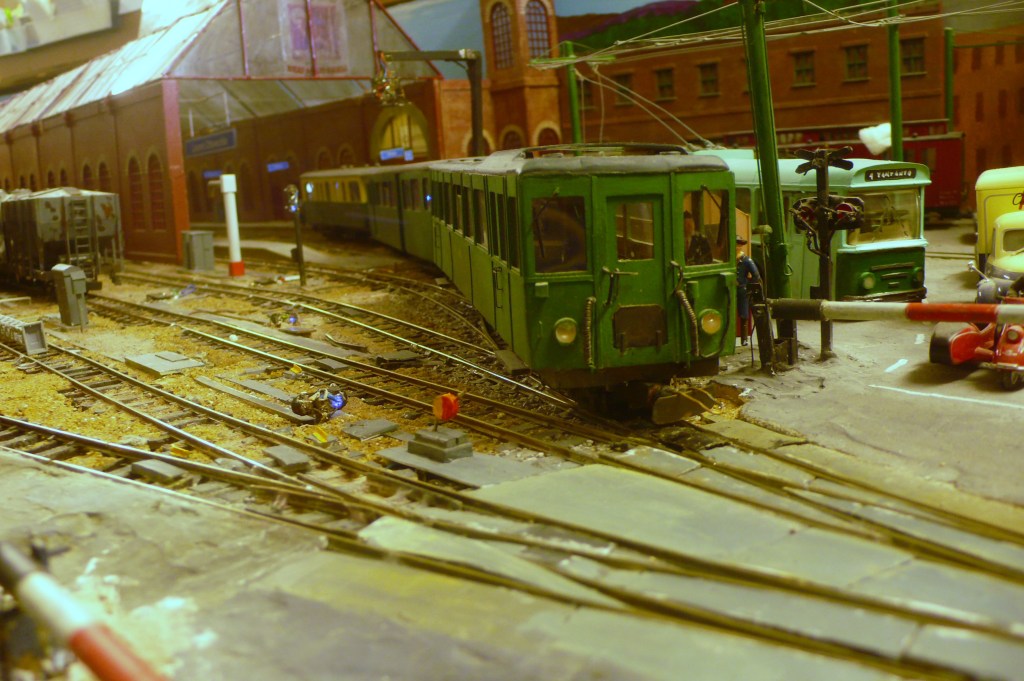
14-90. The railcar leaves immediately after the arrival of the goods. Everything is running smoothly at the moment but late running causes chaos due to the tight timings. The trolleybus will wait for the traffic to clear before heading for Xantanto, out on the Ero plain, well beyond the city limits. The eagle eyed will spot that a floodlight pylon is lying in one of the northern goods loops. They are held in place by Blu-tac so that they will fall without damage when they are inadvertently knocked. The steam emitted by y kolbasajvarmigilo, or ‘sausage warmer’, the fireless loco can be seen behind the bus.
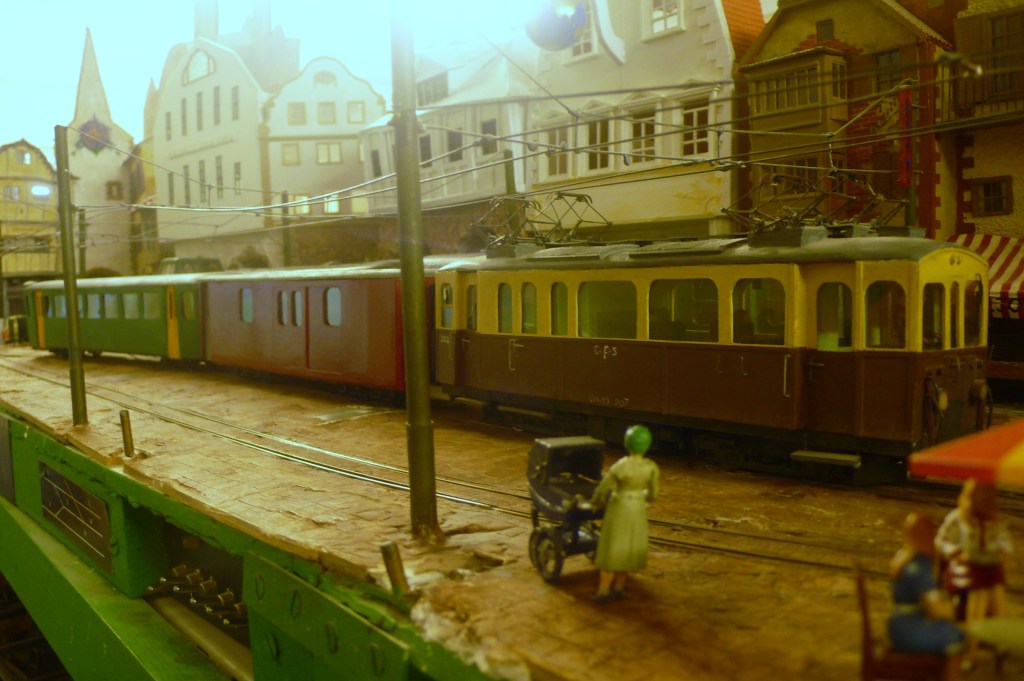
14-91. It is easy to become distracted by working Lacono and to forget the rest of the layout. The time at Fenditavalat is now 90 minutes behind that at Lacono so Lacono is left in abeyance and this is the next place to receive attention. The pilot has removed the through carriage and Post van from the rear of the express, placed them on the middle loop and retreated into the goods yard. The ancient three-phase railcar has backed down onto them and will take them to Nordabordo or Northbank as it is known colloquially. The passage of the long carriage caused some problems as it was built ages ago and did not incorporate the simple three point suspension of the later carriages. In fact, when investigating why it had derailed, I was surprised that it had run as far as it had done without causing problems.
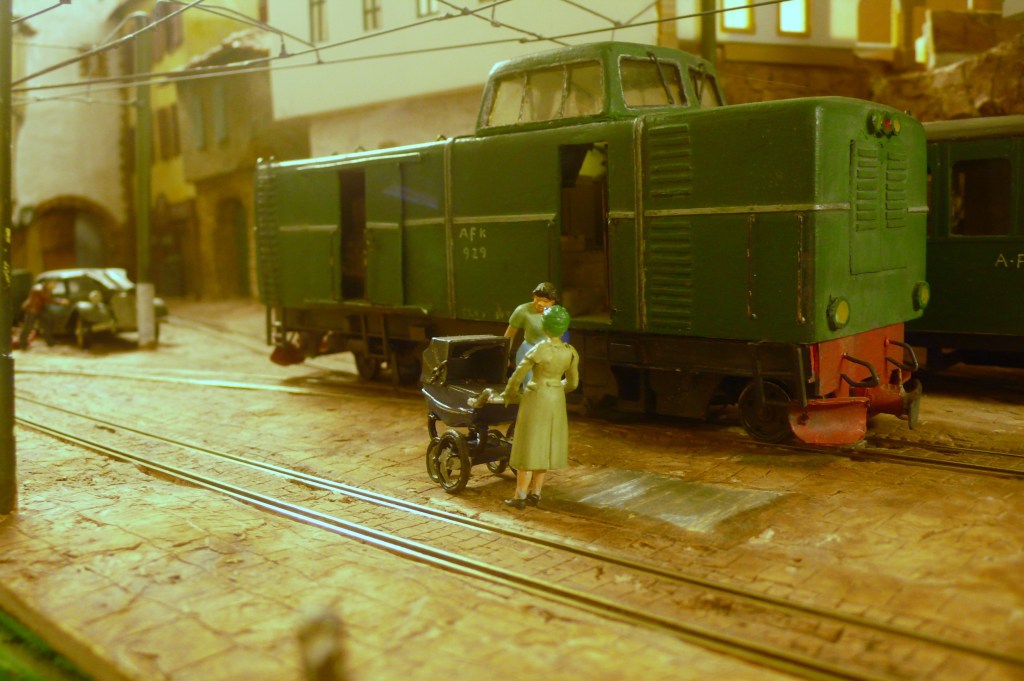
14-92. Photo 146 in session 13 showed a similar situation “yesterday” but as it has now disappeared from the old website I decided to restage a similar one. The hulking great diesel is casually parked in the middle of y merkatubaxu, the main square of ‘Isuri’. The cab door is wide open, the engine is running and anyone could climb in if they so wished, although any one other than a railwayman would receive suitable upbraiding from the resident populace, not that this deters the more high spirited university students! The matron walking across the square looks as though she could rigorously apply admonishment! Following the shenanigans with the ice cream cone she discusses the untoward behaviour and lax disciplinary procedures with a counterpart pushing a pram. The driver is probably partaking of a quick snack in one of the local establishments before the connecting CFS train pulls in.
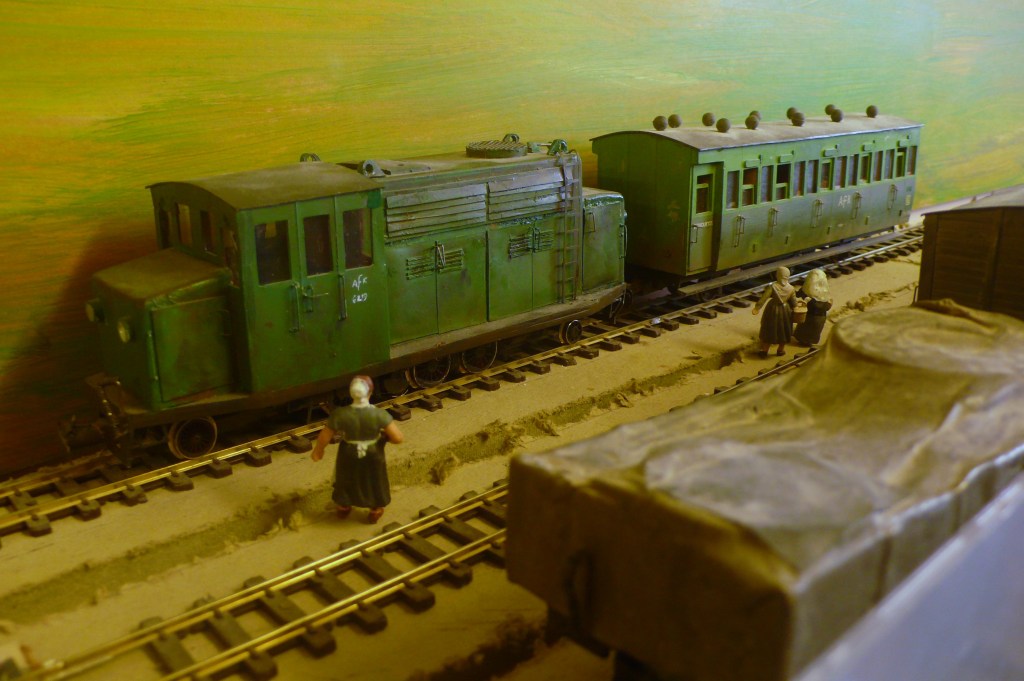
14-93. The market day special rolls into Ithilarak just after midday. It is met by Sacansa, the staciaĉefino, who gives the crew the instructions needed for marshalling the return train. In the background a couple of the peasant women eye the six wheeler, somewhat dubiously, as it has a local reputation for rough riding. They have been busy at the fair, as one carries a goose in her basket. None of the figures are of British provenance. Sacansa is a modified Preiser, the woman with the goose was French made, I forget by whom, and the old woman in the shawl is home made.
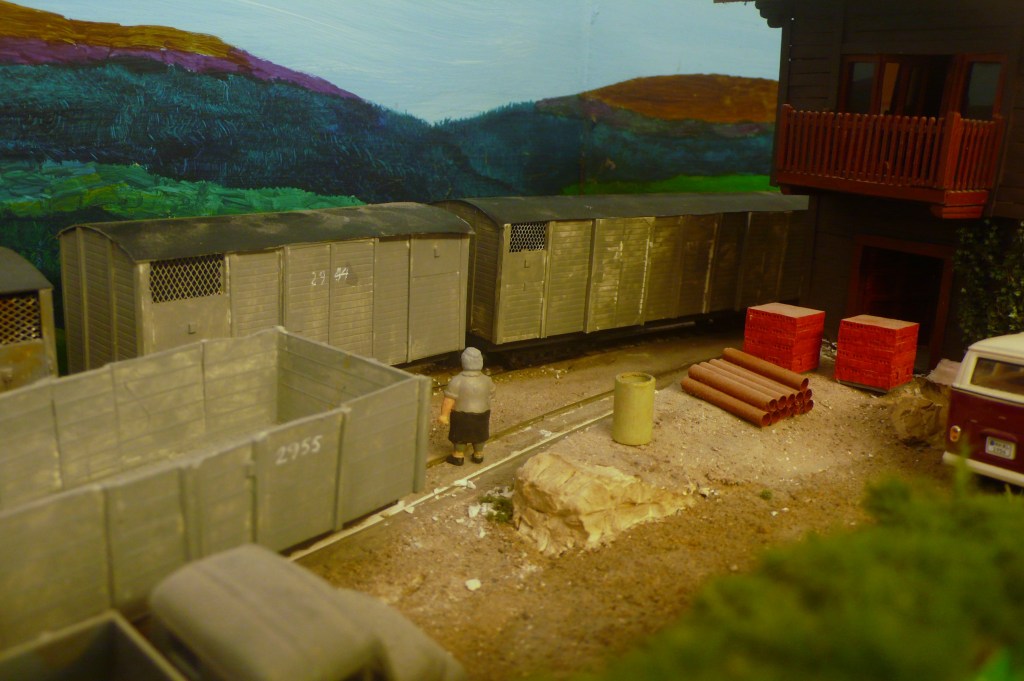
14-94. The fair special rolls into Cadsuiane-Fanhuidol where Dyddfrea, the staciaĉefino casts her eye over it. The last two vans are empty but a couple of cattle need unloading from the bogie van. The drovers and the farmers will see to this but Dyddfrea is a typical AFK appointment in that she comes from peasant stock and is used to handling livestock. Fair days are always the same: most people have a good time, a few overindulge and the same stock often returns as went out, it is just that its ownership is redistributed. Dyddfrea faces a long and lucrative afternoon as the station café-bar will cater to many of those alighting here. It’s a pity that (the few) trains will disrupt business.
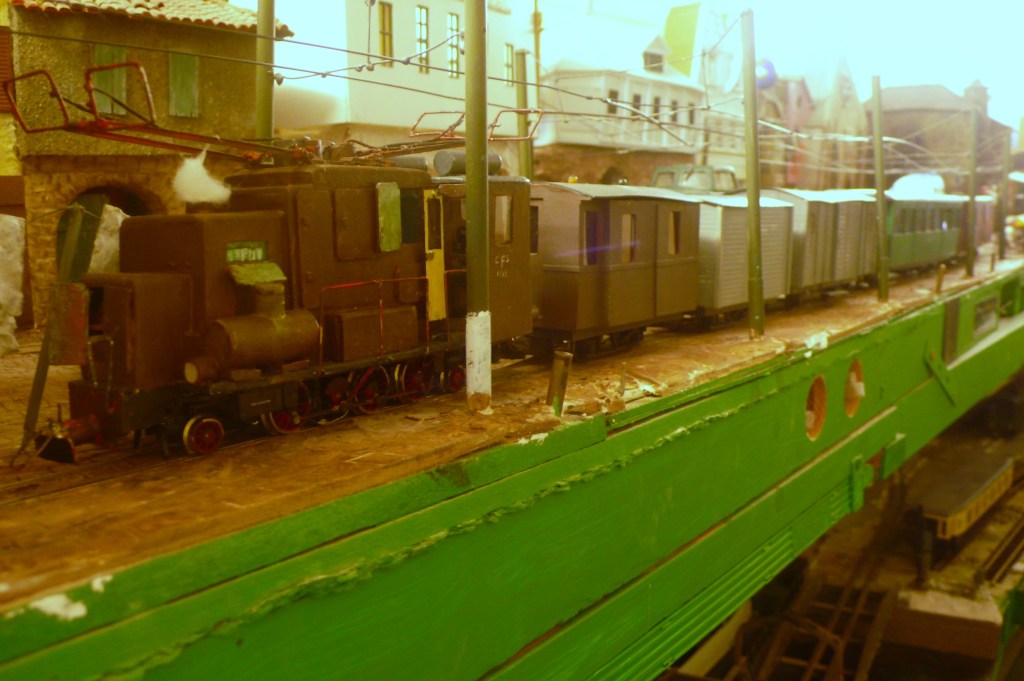
14-95. The CFS train comes to a halt in the merkatubaxu at Isuri. There are two road vans today so the CFS coach was detached at Nordabordo to ensure that the train would fit into the loop. The train loco, the cab of which is visible above the vans, will transfer the through coach and Post van, on the rear, onto the express.
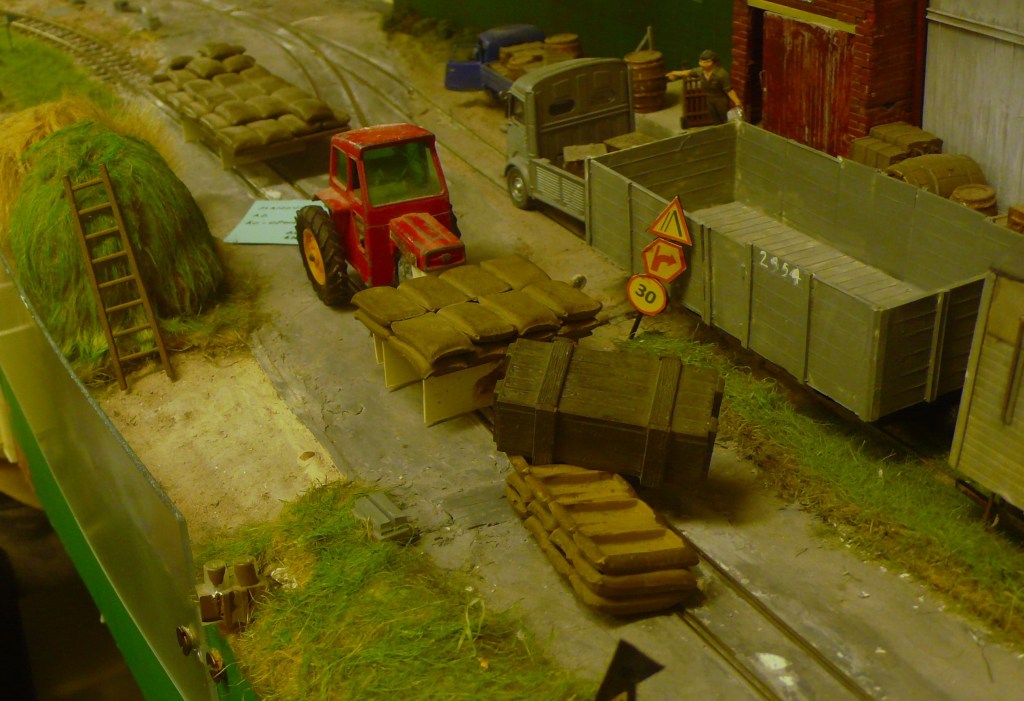
14-96. No there has not been an accident! Running a long session over a number of different stations demands that loads are changed during the session. The contents of wagon 2954, standing at Glissent Co-op, have been unloaded and await transfer to the holding box. The tractor will be placed back onto a shelf located below the mainline through the Kasatritikakamparoj and the full load in the rear will be placed into the open wagon standing in the station loop, to represent the carrots that are going out.
The paperwork, which is the bane of my life, also needs attending to. Unfortunately, with well north of 150 wagons and loads traversing the system today, there is no escaping it and it is more interesting then the stuff that I had to deal with before retirement. My administrative ineptitude was obvious even to the 13 year olds that formed my tutor group before I escaped teaching. I usually delegated as much of it as possible to a couple of reliable girls to take care of. I don’t suppose that you could do that nowadays!
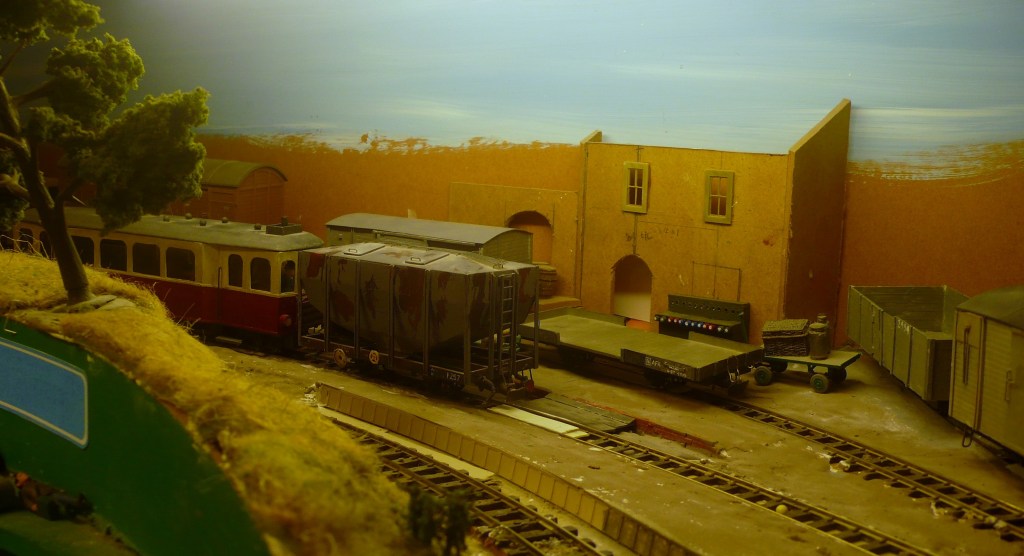
14-97. After 45 minutes shunting at Breĉo de Glissent the Eromarbordo railcar waits for its connection with the mixto. The empty open in the last photo has been pushed onto the glassworks lead along with a van of grain bound for Fenditavalat. That was loaded during the morning and will probably not get to its destination before tomorrow. The tail lamp, on the hopper, shows that the train is complete. These seem to be diminishing in supply to such an extent that I might need to make some more before long.
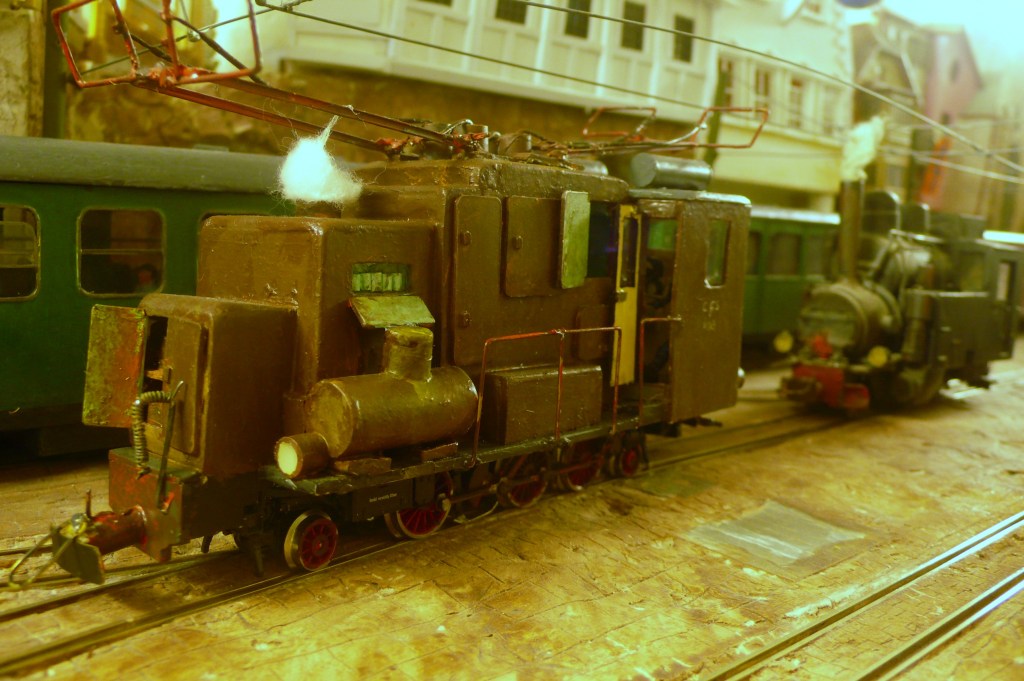
14-98. The CFS loco and the pilot line up on the central road as they wait for the express to depart. They will not win any prizes in a display of locomotive pulchritude. The Italian SG three-phase prototypes usually seemed to run with nearly all their doors open so I followed suit. The Brotan boiler on the pilot was a crude form of superheater common in eastern Europe during the early twentieth century. There was, apparently, a NG fitted loco although, to be honest, I have never seen photos of it. Throw in the rod driven diesel on the express and if you like a meeting of unaesthetic designs of steam, diesel and electric power, in the middle of the street no less, then Isuri merkatubaxu is a mecca. Alternatively I might just be stretching credulity!
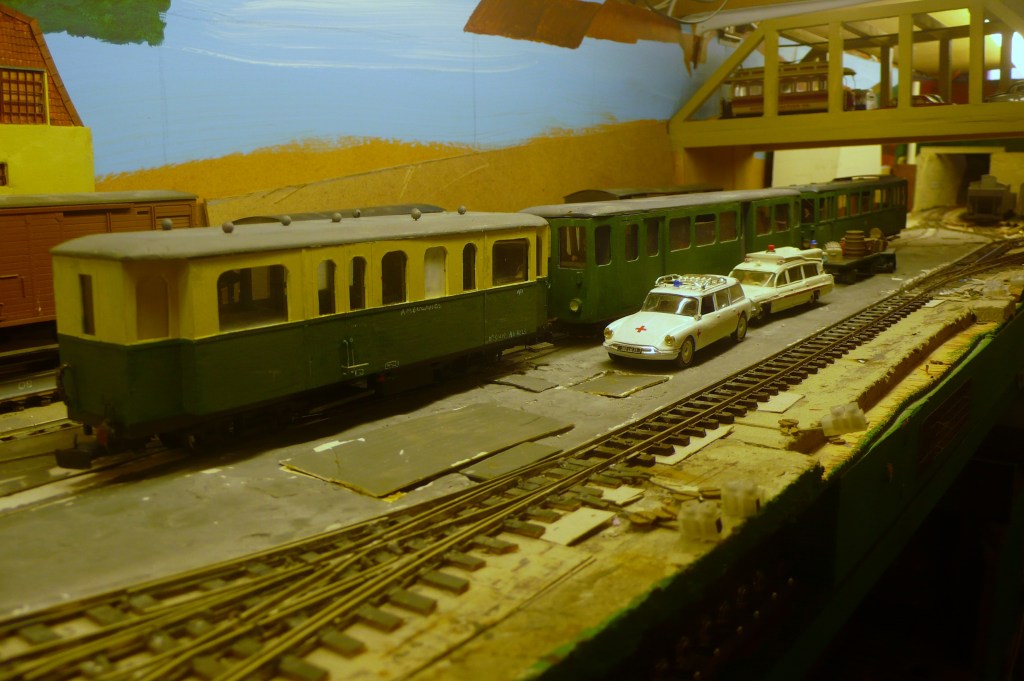
14-99. The road ambulances are waiting as the Varden shuttle arrives at Urteno in early afternoon. The railway ambulance will be uncoupled from the train and the patients will be transferred to the road vehicles and taken to the Regional Hospital, which is the University teaching hospital. Only the most severe cases are transferred from the District Hospitals. The rail ambulance then will be taken to Relforka to cover cases from the Kasatritikakamparoj which need transferring. This is done in the early evening. The circuit was devised after reading about early 20th century Swiss provision and provides an unusual tail traffic working to a complex daily roster.
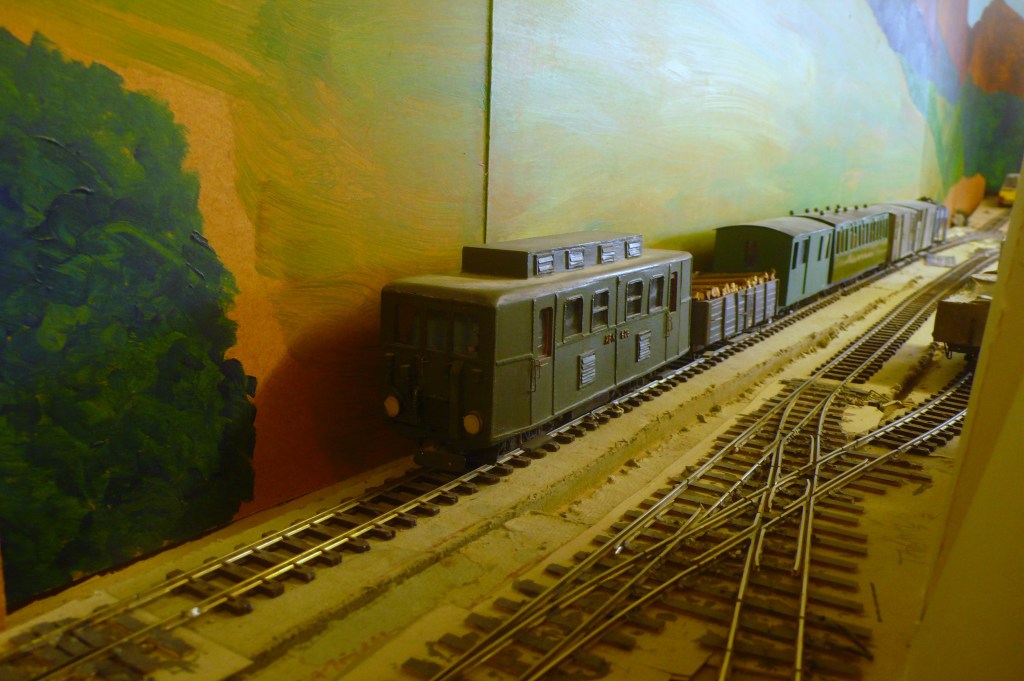
14-100. The market train south from Ithilarak has no market loads with the exception of the passengers. Sacansa has received orders, from Control, that the train must pick up empty vans, as well as coal and timber loads, because there is a chance that the afternoon goods could be heavily loaded. The train is about to leave 13 minutes behind the booked time. It is also technically wrongly marshalled but needs must when the Devil rides.
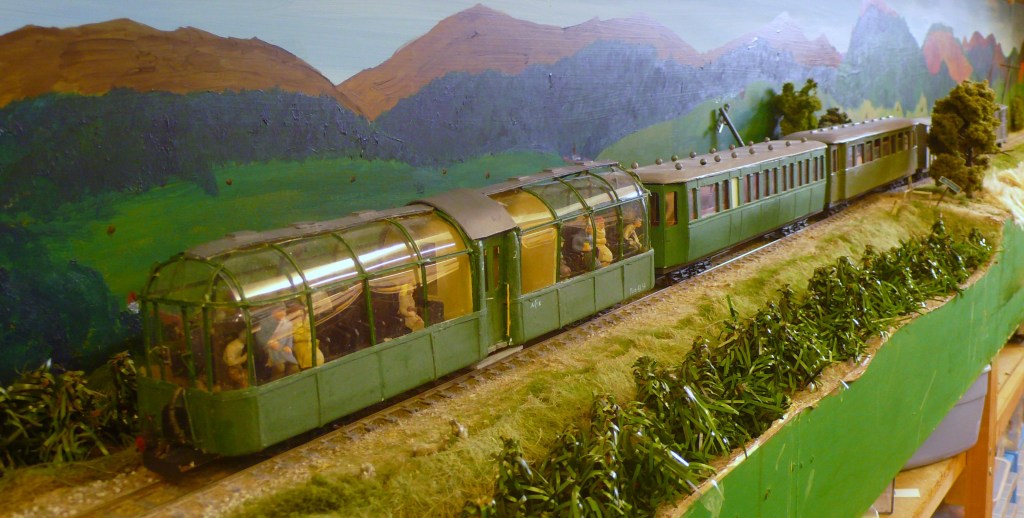
14-101. The afternoon mixto passes the ripening maize in the KTT. The rear vehicle this afternoon is the observakaleŝo, or observation car, which is providing a land cruise through the provincial interior and will be taken through to Krelm by the CFS. It is just possible to do the circular tour from Nerv within the day but it is a long day. The CFS and the AFK offer the option of an overnight stay, in either Krelm or Relforka depending upon which direction the cruise is running in, or another alternative is to curtail the tour at Fenditavalat and retrace one’s steps on the morrow. The milk van is on the front, as usual, as the farmers’ days are based around this train’s timings. With the cattle now in the highlands there will be no loadings until the train crosses the High Reaches.
Here is another copy of the system for those who are mystified by the various locations.

14-102. The afternoon cavalcade continues as the down express crosses the snowy wastes of the Narnian enclave. This section of the backscene is complete, although the bridge awaits railings and the buildings need finishing. The gap between the buildings is the snow covered road leading to the station and on to Blittiri.
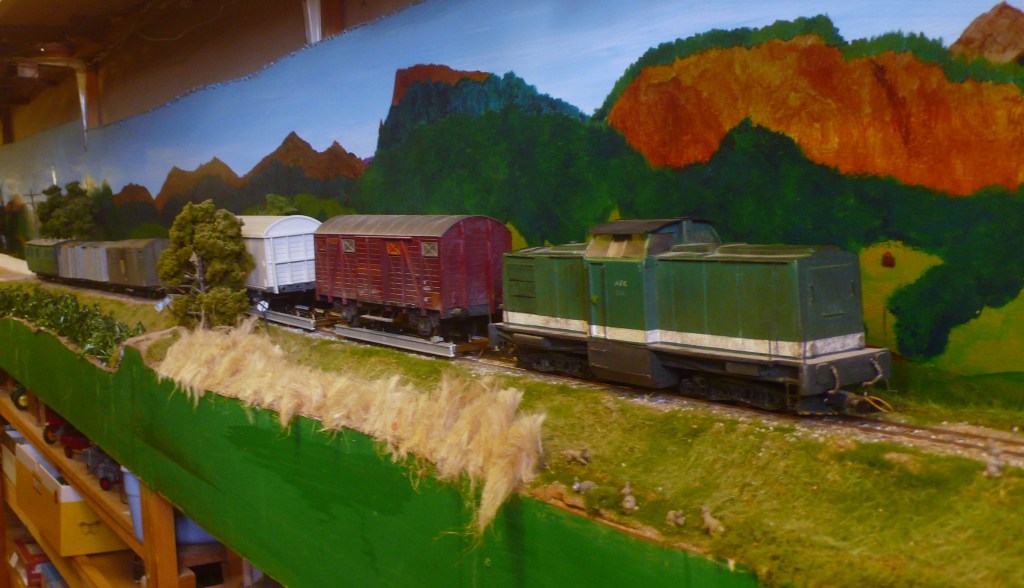
14-103. At the other end of the system the afternoon RFK-FDV goods follows the up mixto across the KTT. The second, incomplete and unpainted Swiss SG van is filling out the tonnage and will go to the paper mill. The six wheel van behind it was held over from yesterday due to tonnage limits. It came from Eromarbordo and is loaded with seaweed for use as fertiliser on the thin mountain soils. The six wheel wagons wreak havoc on the train capacities as they are effectively 1½ wagons. The train is slated for 200 tons but is running at 190 tons. The German kreutztafel, the cross sign, beside the tree, is the fixed distant for the (Italian) home signal. There is a healthy population of rabbits to keep the ganger’s family fed and turn a little profit.
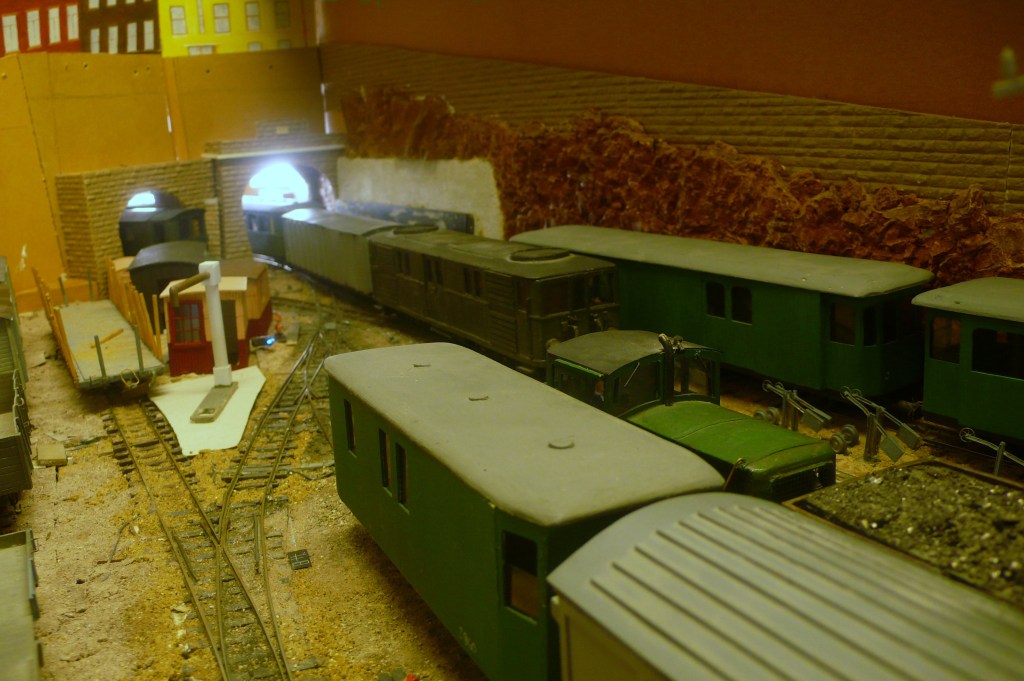
14-104. It is now time to return to Lacono where the mixto arrives to find a busy scene. The pilot is waiting to transfer a wagon of coal to the KTT goods being formed in the yard and the loco for the passenger train waits in the tunnel leading to Aspargo, the local shed. The stock for local passenger train is parked in the spare siding although it is too long to fit into either the siding or platform 2 with the loco attached. The passenger runs in front of the express southwards across the Kasatritikakamparoj. The mixto was replatformed some sessions back so that it could use the whole of platform 3, which is the main platform, rather than having to use platform 2 whilst leaving clearance for the incoming railcar. It will stand for 20 minutes or so as it is booked time to attach and detach vehicles, observation car or not. The French derived mixto designation indicates that it is a passenger train carrying blocks of wagons between specified stopping points rather than shunting every station, as a mixed train would.

14-105. The mixto makes a brief stop on Akvalando viaduct to allow tour passengers time to appreciate the view of the Carramasco Gorge. Should it ever come to completion there will be a raging torrent in the valley beside the camping ground. The Post bus is standing upon the tortuous mountain road as the car passes the archway. The scene is little more than a sketch at the moment.
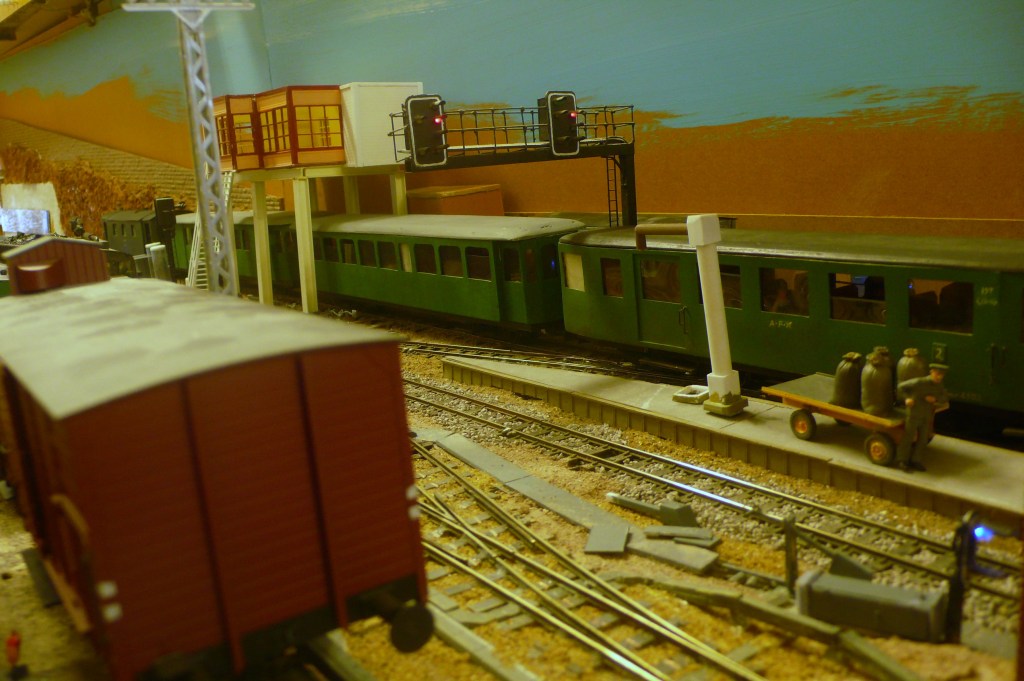
14-106. The local passenger is propelled into platform 2 to couple onto the ambulance which was left by the railcar. In previous times the railcar ran into platform 1 but it was realised that the job would be made easier by it running into platform 2. Platform 1 has become a semi-redundant carriage siding once more.
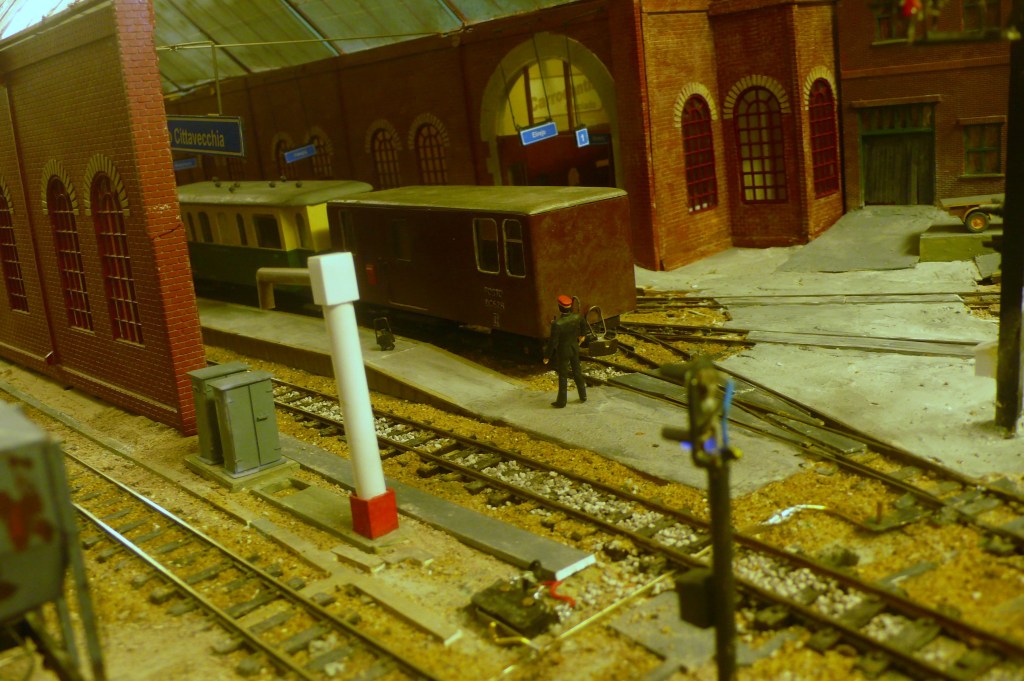
14-107. With the remarshalling now complete and the TPO and the ambulance on the rear, the passenger train backs along platform 2 under the close supervision of the trajnaĉefo. The tail lamp will be placed on the rear van before departure and the crossing is now available to passengers who wish to board.
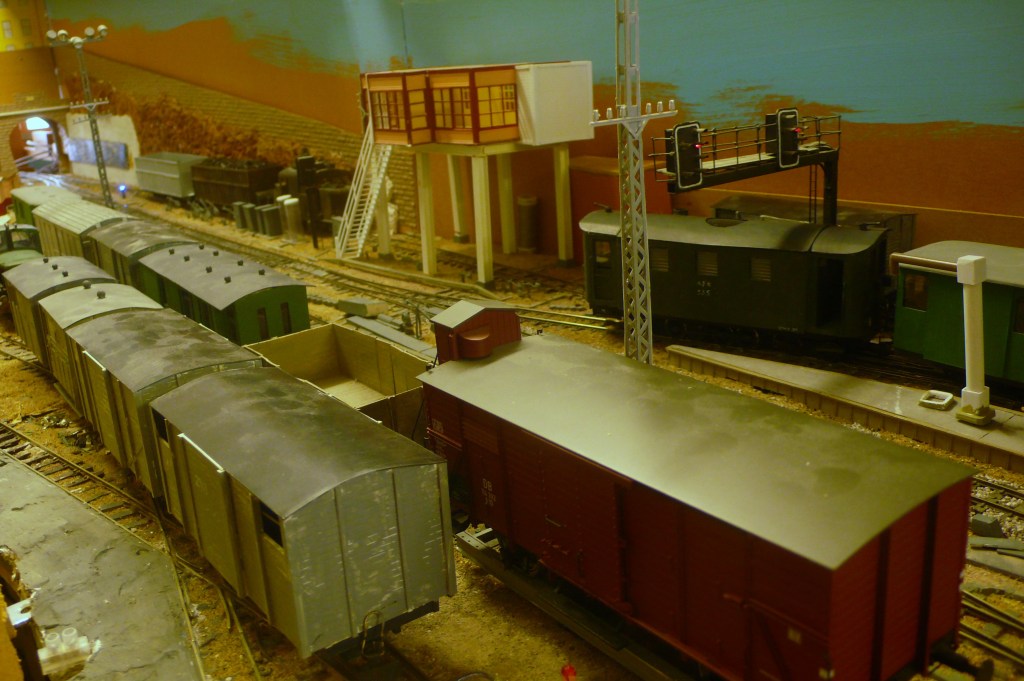
14-108. With the passenger train loco slightly in advance of the platform starters it waits for the arrival of the up goods. La Besto hides in the formerly little used siding to make a quick getaway on the afternoon Danulbo trip once the passenger leaves. This seems to be a more efficient use of the siding rather than using it as a store. I am almost beginning to wish that the single slip accessing it had been built as a double slip. (It will definitely not be rebuilt.)
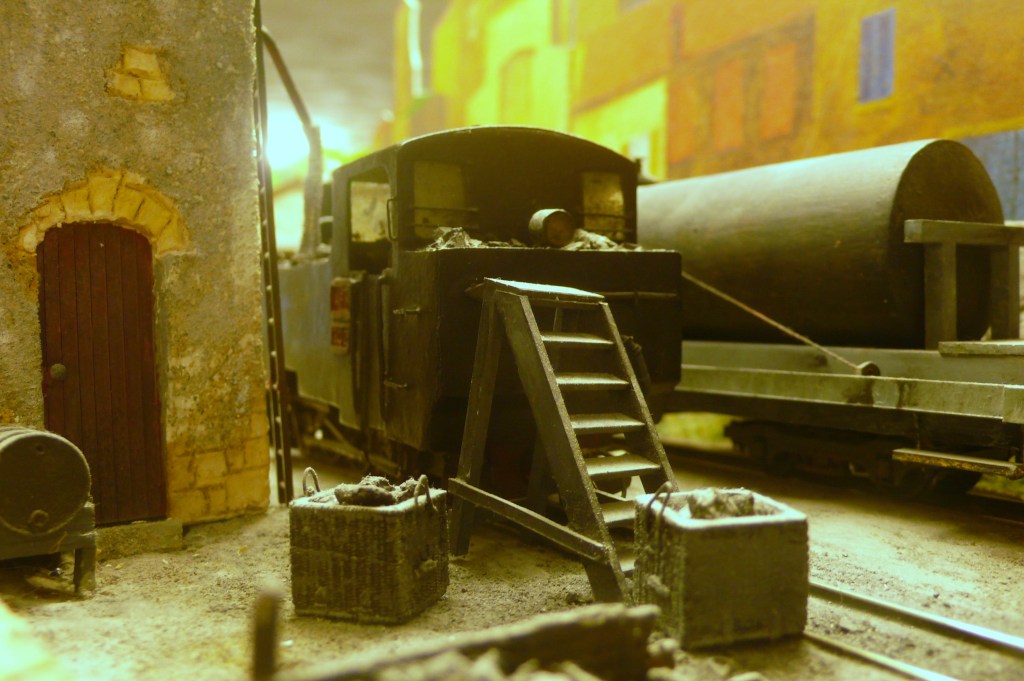
14-109. The more remote parts of the network are left to snooze whilst the action takes place elsewhere. The rack engine receives another creel of coal as it takes water at Jakarutu. It has woken up because it needs to make connections at Ithilarak with the down express. It will finish running round the train before departing. The timetable allows less than an hour for any shunting but this usually suffices.
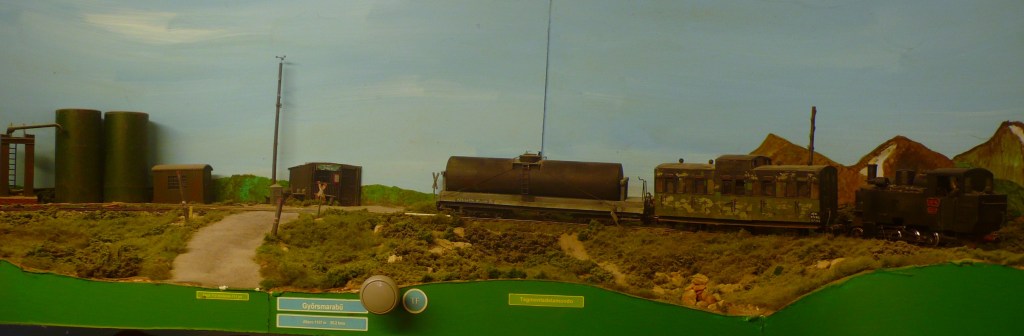
14-110. The moorland scene at Győrsmorabŭ is seldom viewed as a whole. This is the Tegmentadelamondo to use the Thalnian, rather than the Marronĝacan, for “The Roof of the World.” It sits directly above the lake at Varden (photo 14-60) which itself lies above Breĉo de Glissent. The loco has pulled the train past the point accessing the remote siding and is about to push the tanker into the small oil loading facility. It is another unlikely industry on yet another siding squeezed into a tight corner, typifying the AFK. The scenery here was finished some years ago to prevent damaging the lower scenes. The cairn, bottom right, and mountainous footpath were included to remind me of DofE “wild camping” expeditions that I helped to supervise with the sixth formers from the High School.
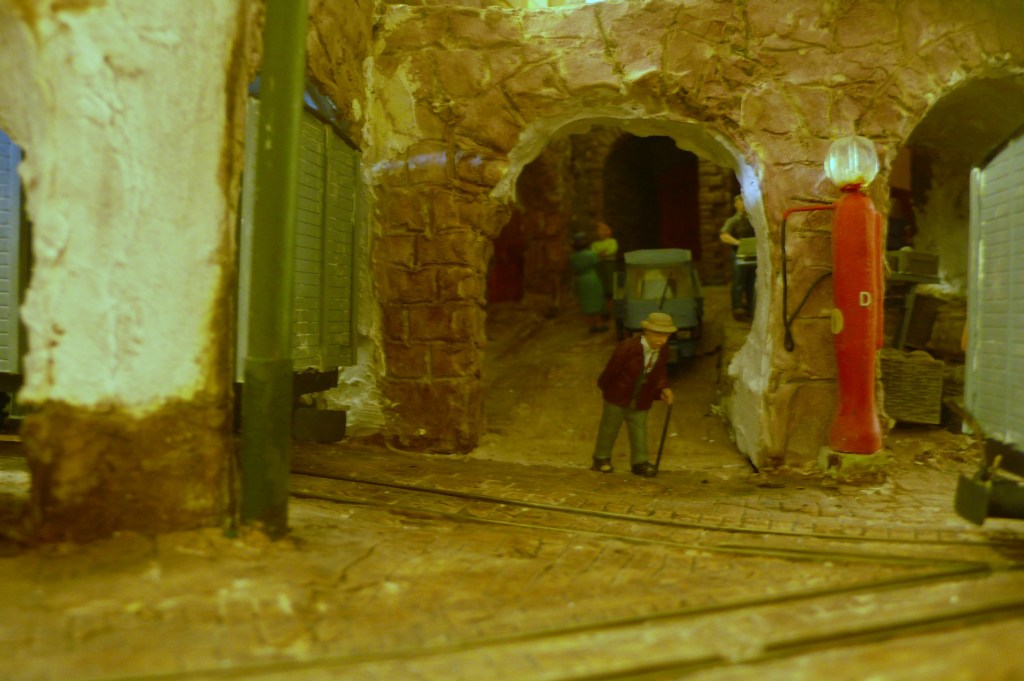
14-111. Y Brottuca at Isuri is well named as it translates as Steep Street. It abuts the market which can just be seen behind the petrol pump. The narrow street leads into the labyrinthine network of alleyways characterising the city. The shops beside the pavement at the left, where two women are talking, are effectively an extension of the market. The vans, loaded with blankets, on the left have been rolled down through the factory gate so that the pilot, propelling the vans on the right, can pick them up.
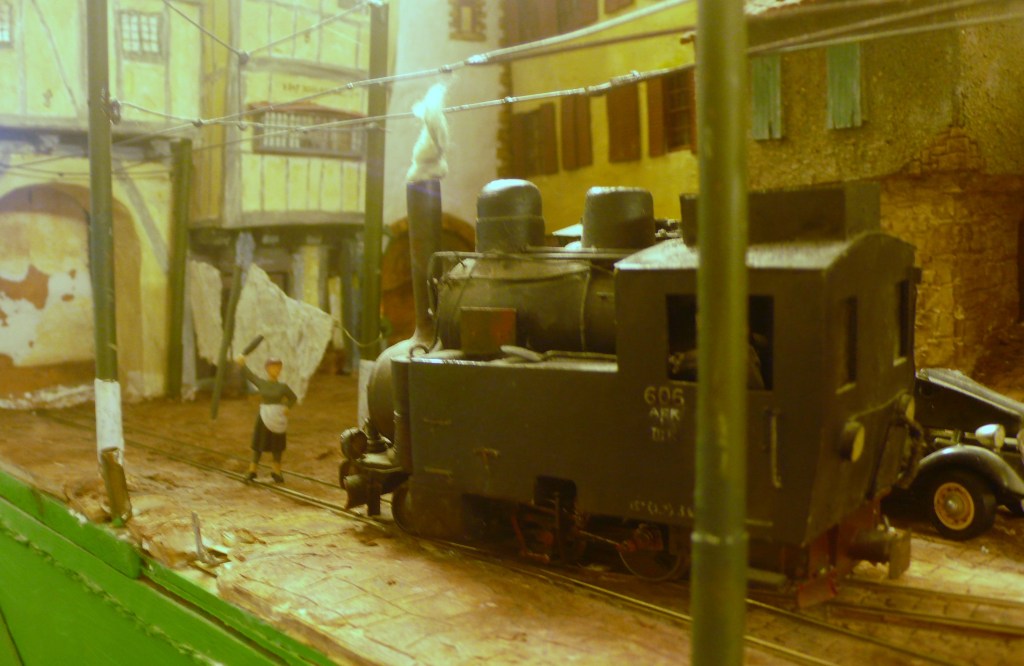
14-112. In another cameo scene typical of the city we can shortly observe the Vallisharimau or “Vallis tiger” defending her washing from the 2-4-0T. The viscous oil from the bunker, when applied to the fire for steep gradients with heavy loads, can produce filthy thick black smoke, which really winds her up. The crew are used to the pantomime as she is a well known eccentric. It is, I suppose, all part of an attempt to build up the background setting of the railway. Vallisfissura, by the way, was the Roman name for the city. My father told me the story of a bloke in York who lived near the northern exit of the extensive yards. He used to complain bitterly, and regularly, to the authorities about the noise at night. On one occasion he came out, in his pyjamas no less, to remonstrate with the crew of a couple of 37s. After that a couple of 37s were sent up there every night just to rev up!
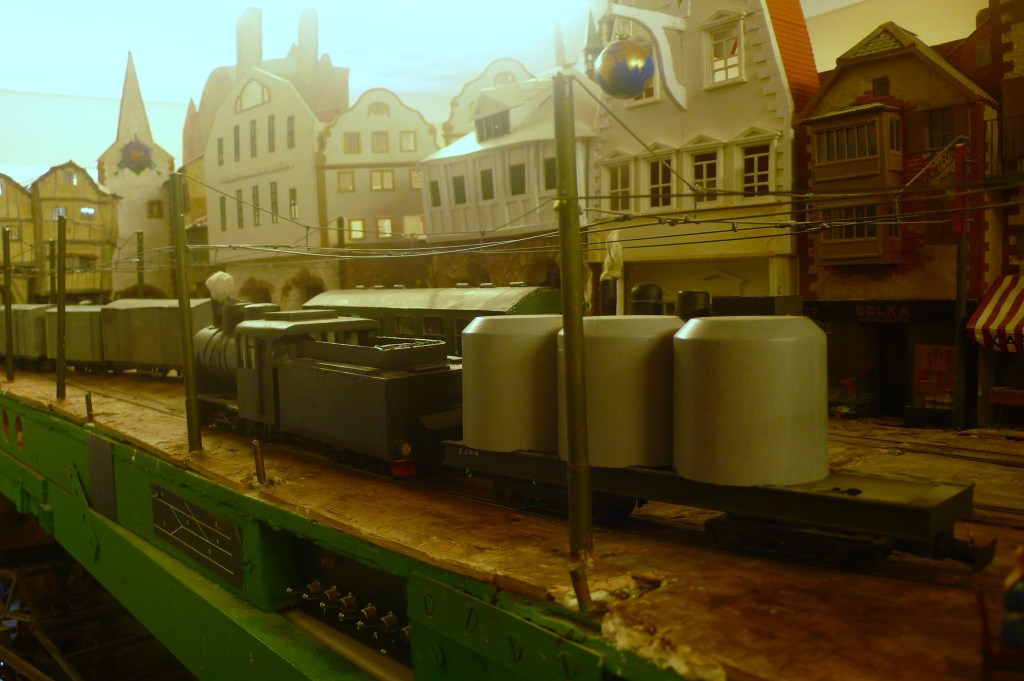
14-113. The FDV-RFK afternoon train will load to the limit this afternoon and leave traffic behind. The train engine arrives in the square with a cement wagon which must be attached to the front of the train, but behind the brake van, by the pilot. These extra manoeuvres make for a departure 20 minutes behind time.
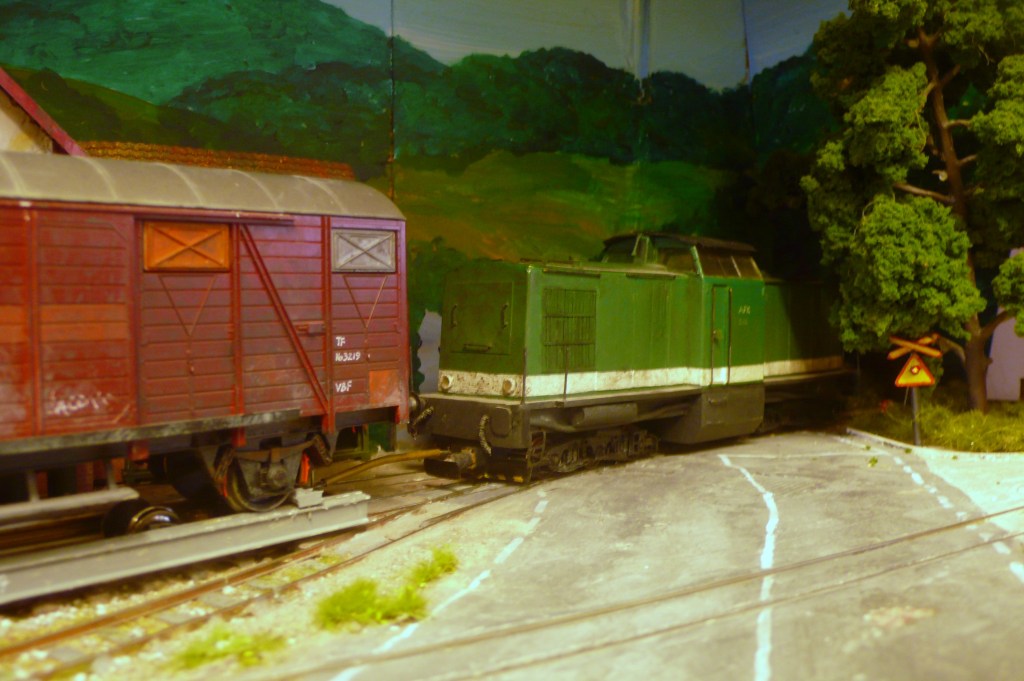
14-114. The counterpart RFK-FDV goods crosses the via murrannaccia (the modern day RN 424) at Boursson under the protection of the flashing lights. As is often the case on the model the train had been left in limbo for a couple of days as other locations took priority. The loco ran erratically when restarted and needed taking to the work bench for a wheel cleaning session. The early Heljan Class 47 mechanisms, one of which powers the loco, were notorious for this problem. Somewhere or other, if I remember correctly, there is a set of replacement wheels that need fitting. The session has been on the go for around seven weeks and these types of problems become more common as time passes. It is all part and parcel of running a large layout single-handedly over a protracted period of time.
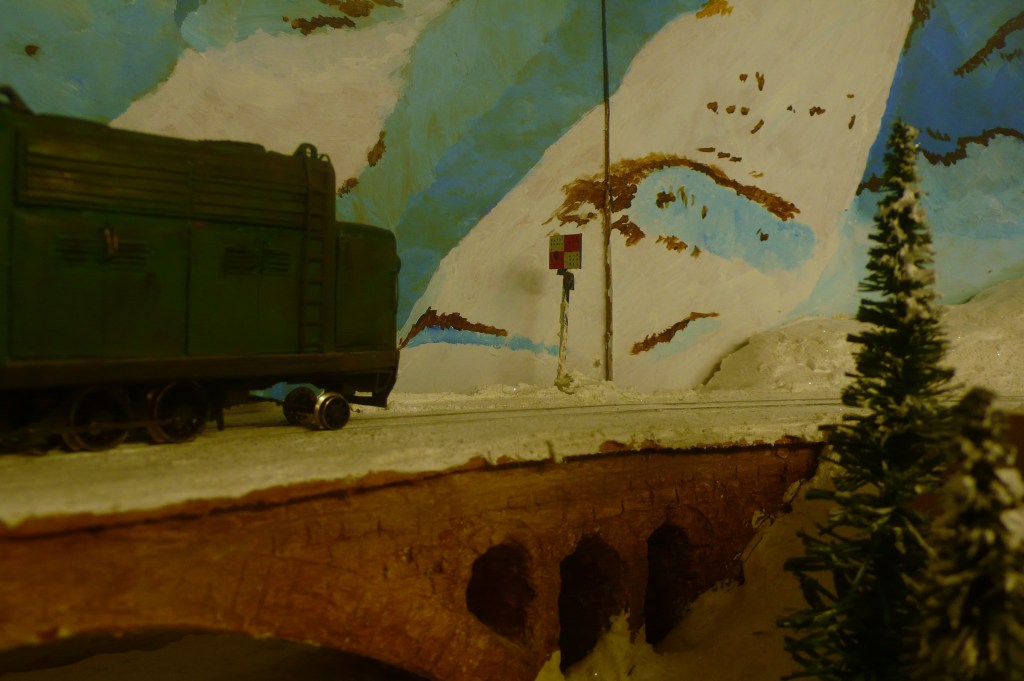
14-115. The market day special approaches Caladonno to find the home signal “on”. It comes “off” as the engine whistles, a sure sign that, as expected, the extra train will take the loop. It might be quite a tight fit with the six wheel brake on the rear.
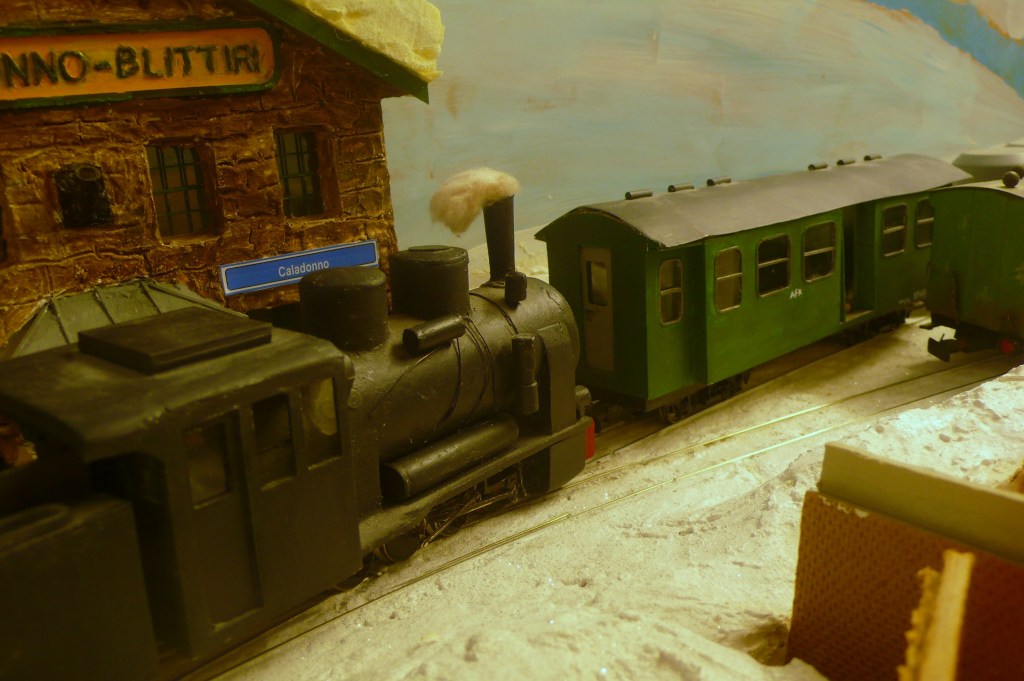
14-116. The RFK goods runs into Caladonno 20 minutes late to make the brief station stop. Any traffic for Caladonno will be removed from the road vans with premium parcels being handed up to the trajnaĉefo in the brake 2nd. It is possible that a few passengers may join or leave the train as well. There is not much clearance in the short loop for the market train.
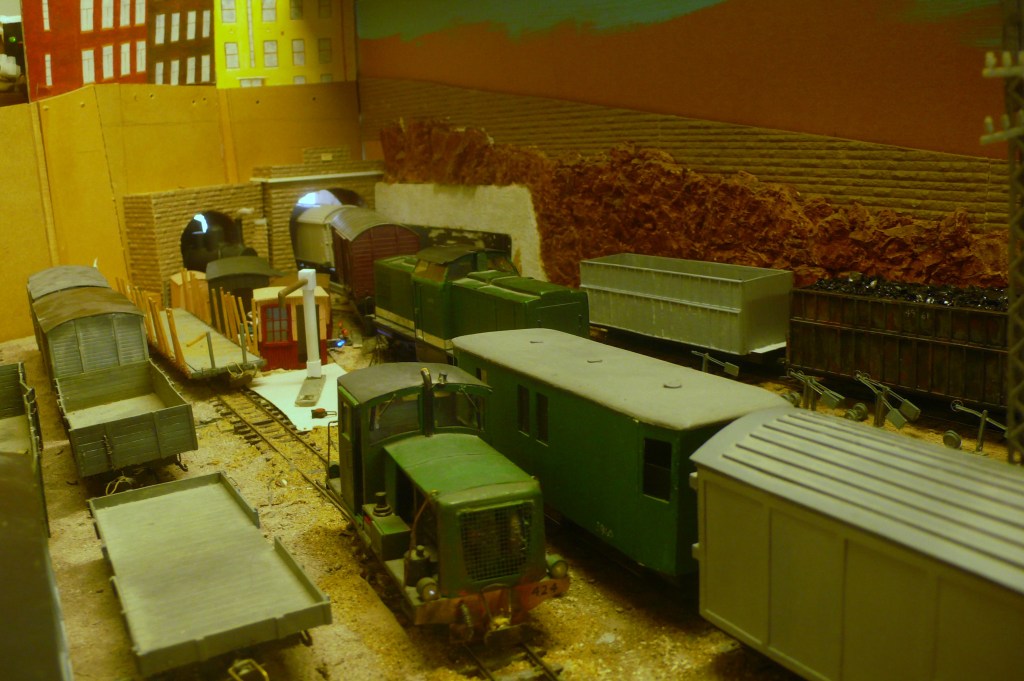
14-117. The up goods runs into Gasafabrikatastrato yard at Lacono. This is not, I suppose, the traditional image of the rural backwater narrow gauge but heavy traffic is commonplace here. In effect, as marked by the wagons on transporters, this is a surrogate extension of the national system. Such complex NG systems carrying heavy traffic could be found across Europe well after WWII, photos of which fired my childhood enthusiasm for continental NG. The yard will remain congested for a while as the goods is now booked to stand for almost 2 hours due to traffic demands on the single line at this time of day. Perhaps the AFK should consider double tracking various sections!
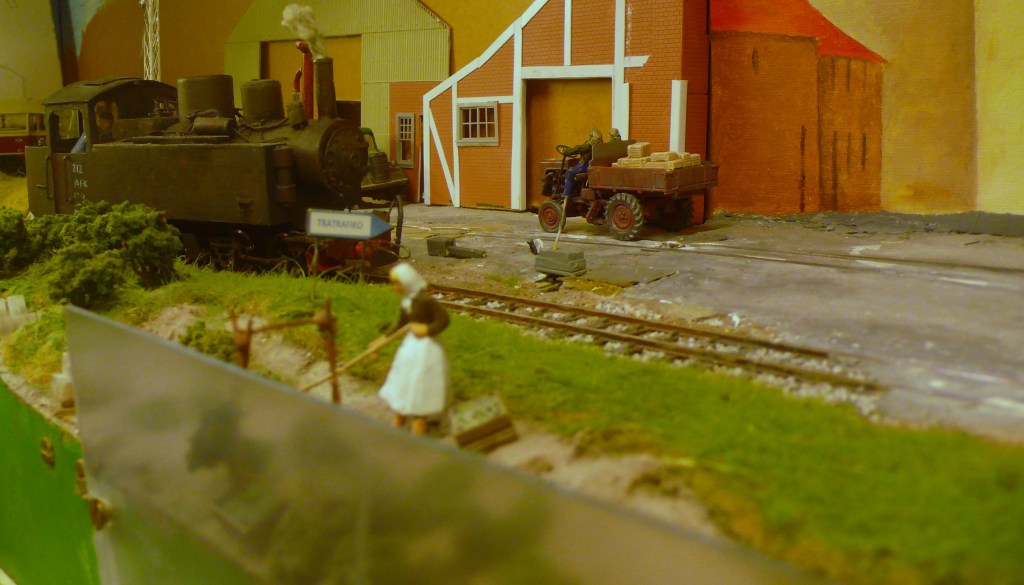
14-118. The peasant woman works her plot at Breĉo de Glissent as the loco for the Eromarbordo branch goods runs round its train. In the background two farm girls drive a typical continental backroads contraption to the station to load their strawberries into the van provided. The blacksmith’s and the machinery garage next door, have received some attention recently. The road sign directs through traffic away from the constricted village streets inside the gate.
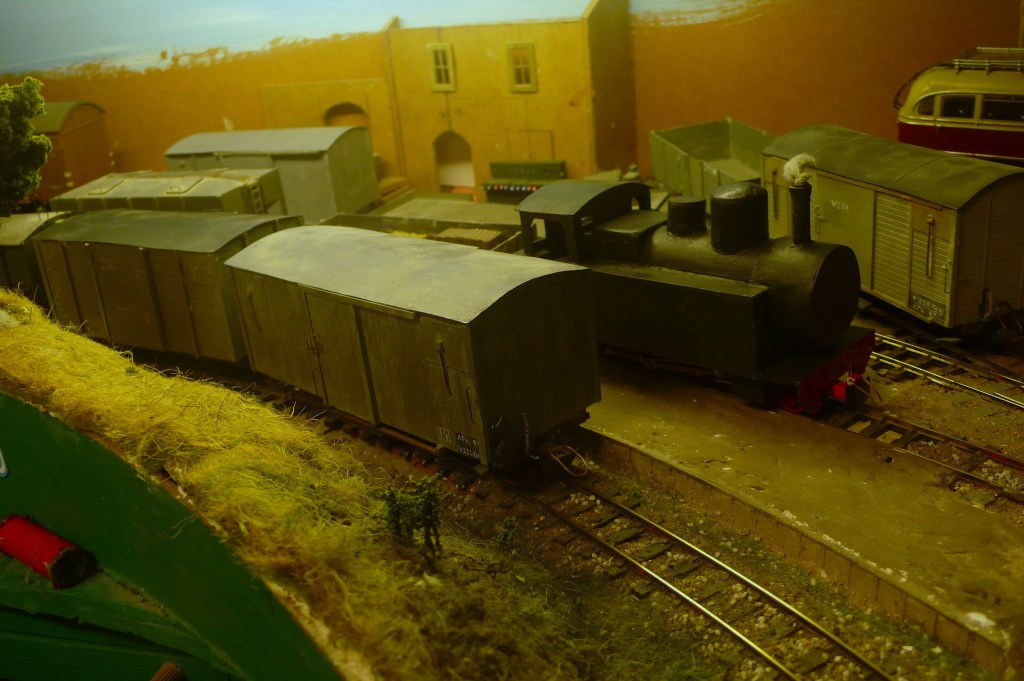
14-119. With the Eromarbordo branch train loco having run round, witness the tail lamp on the rear, the Kasatritikakamparoj local goods pulls in. It closely follows the branch train which is only booked to run round, rather than work, at the station. The van and the open, at the right, are meant to be parked on the spur behind the station building but space prevents this. If necessary they will be removed from the layout to create the room necessary to access the station siding.
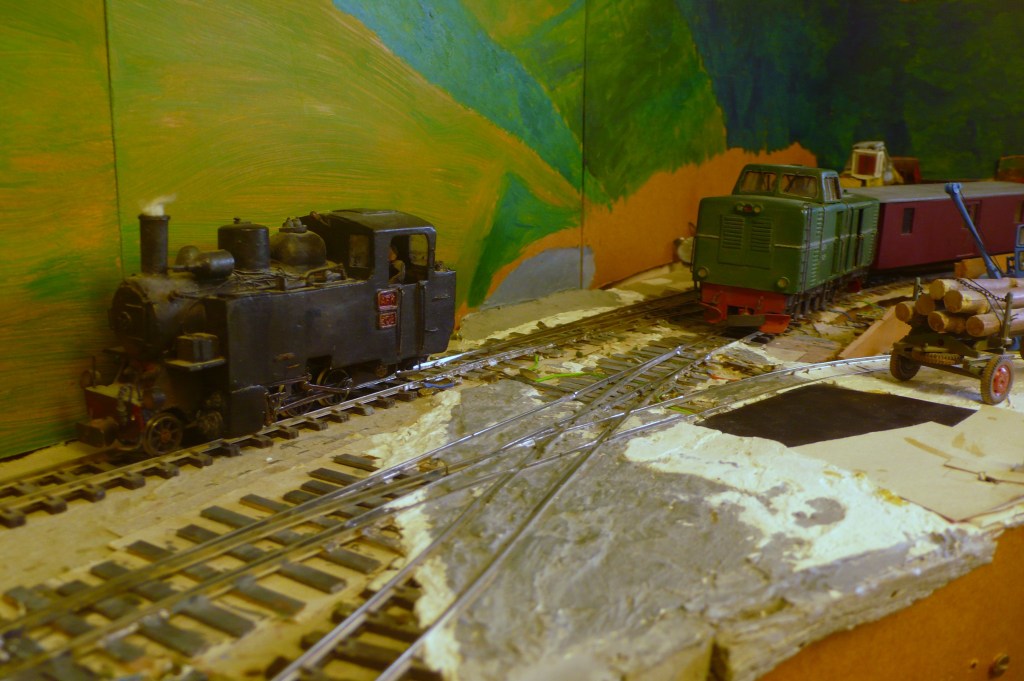
14-120. The rack loco from the Jakarutu train waits at the north end of Ithilarak for the down express to arrive. Its arrival was delayed by the shunting of the tank wagon on the moors. There will be plenty of time to complete any shunting once the express leaves. The level crossing and log loading area in the foreground were once more complete but a double slip was removed to improve reliability and the crossing waits for re-installation.
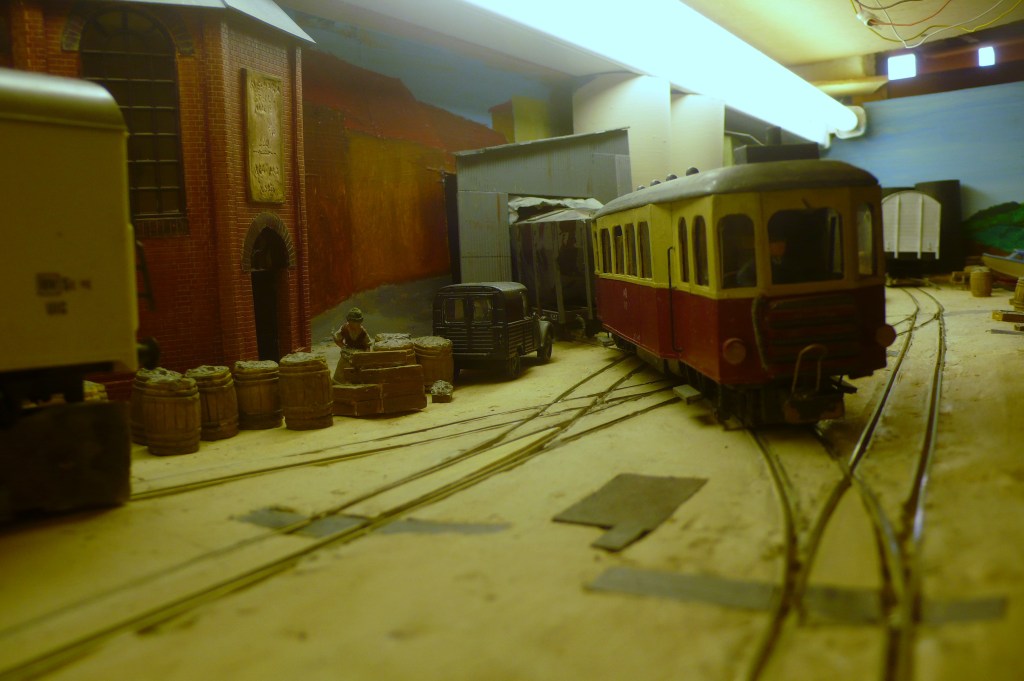
14-121. The Eromarbordo railcar shunts the hopper of grain into the unloading silo. It will be loaded into coastal shipping for onward transit. The hopper itself will return to Glissent on the rear of the next service. The fish traffic will be ready for picking up by the afternoon goods.
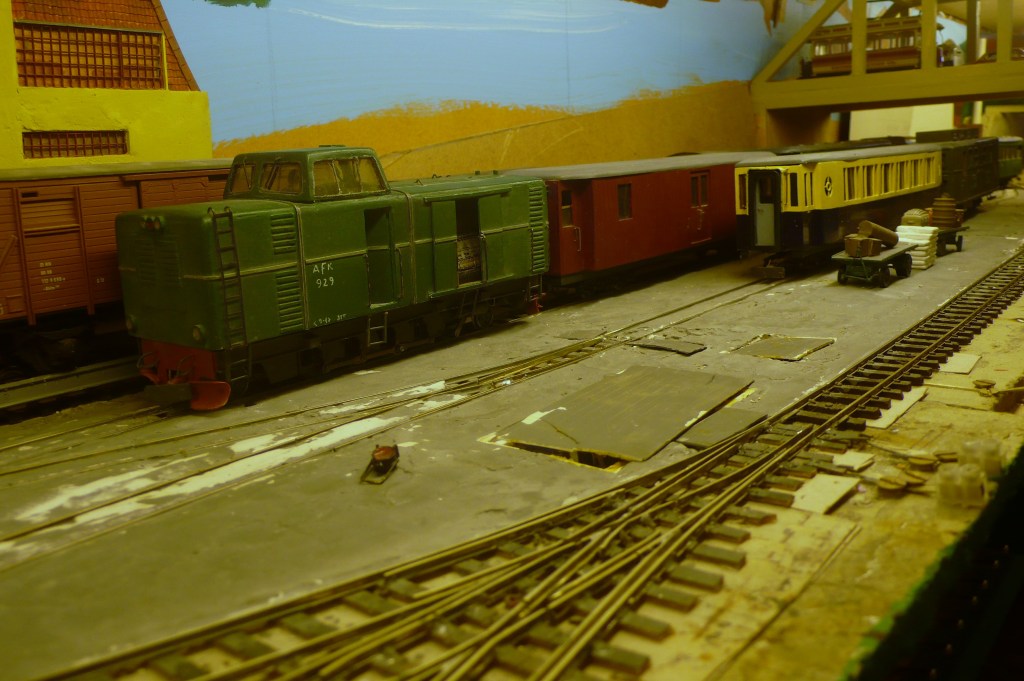
14-122. The late running of the market train and the reconfiguration of the mixto has caused operational chaos at Urteno. As the down express arrives the loco from the market day special has taken over the pilot/banker duties because, despite appearances the near goods loop is blocked with the market train. Although Control are not totally happy with this development they bear some responsibility in causing the delayed departure from Ithilarak. The market loco will transfer the Pullman onto the rear of the express and will then pilot the mixto up the vulpafaŭkangulo. The crews have changed engines because, although the locos have swapped duties, the crews’ hours must be monitored.
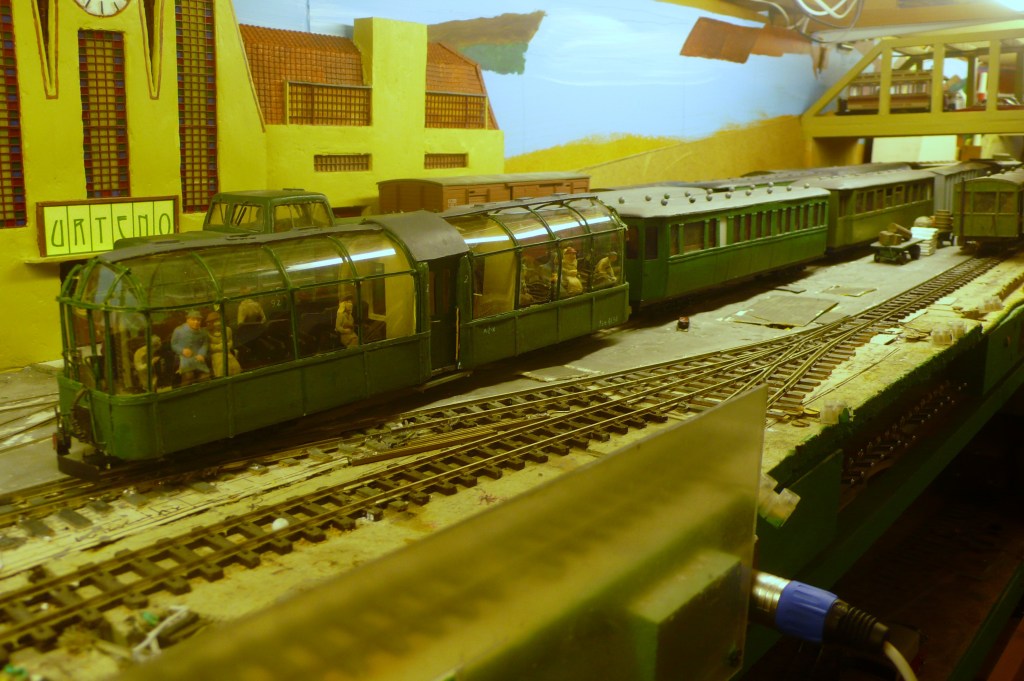
14-123. Because one selling point of the land cruise is a clear uninterrupted view of the Marronĝacan Massif the banker is obliged to pilot the train rather than push on the rear end. This operational alteration to the usual procedure had gone unnoticed by the time that the locos were positioned at Urteno leading to the problems. Hopefully the issue should be avoided “tomorrow” or more accurately in two days time, as the saloon will run southwards tomorow.

14-124. With the wayside shunting finished at Breĉo de Glissent the crew ask Ovidio, the staciaĉefino, for permission to leave. Unfortunately this is refused by Control because the time is 15.06 and they will have to run to the booked time. The crew are trying it on as they want an early ‘knock off’. Leaving now might be possible if the KTT passenger was held for a couple of minutes at Boursson but this could impact upon the timings of the express. Control is not prepared to risk this because both trains connect into services running into the Kernregio, the heartlands of the country. In any case the train from Narnia might well be on time because news has filtered through from Thalnian railways Control Room at Nerv that the afternoon Beruna Controller, in Narnia, is the Incompetent Talking Mouse so he has not yet had time to mess things up. There might be plenty of time, and reasons, for taking liberties later. The standard practice for the goods train is that it simply exchanges blocks of wagons at Glissent and then leaves early. Today the shunting was more complex, hence the delay, and the refusal to let it out. As it will not be leaving any time soon the train is split to allow passengers access to the mainline platform and the front pulls forward. This will allow the branch railcar to enter the loop behind it. The crew retreat to the Orabarscho, the Golden Perch, their favourite watering hole. It will be a long wait.
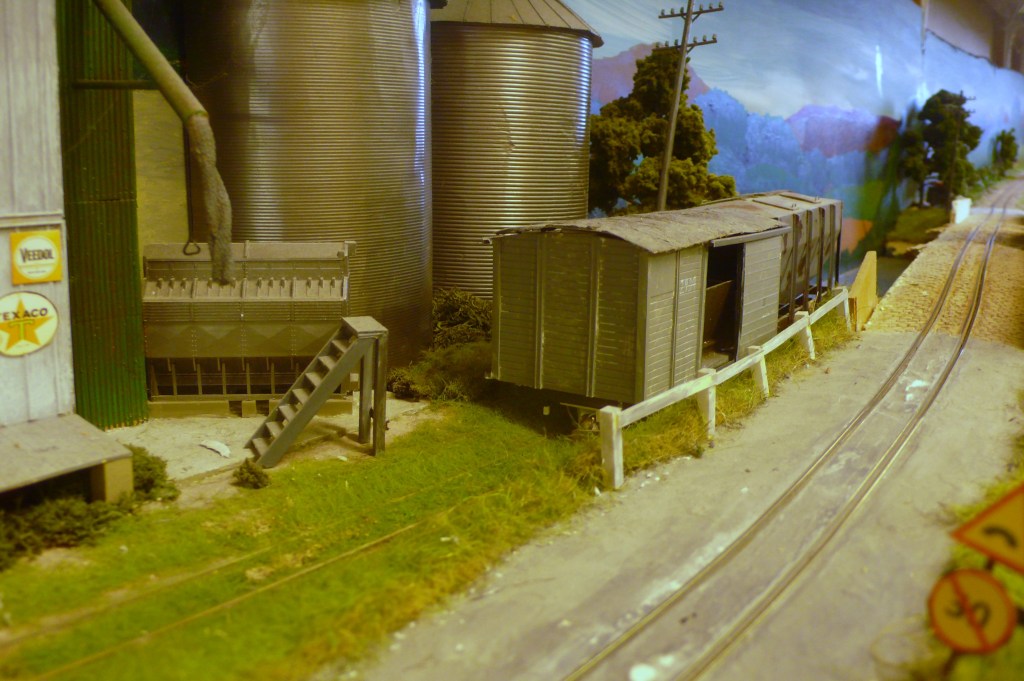
14-125. As the empty mainline stretches away into the distance the sleepy SudKTT Co-op siding at Glissent contains a couple of grain hoppers that have not moved now for some model days. It must be at least four sessions since the hopper at the end of the queue went in. This is one of the more interesting aspects of operating a “system” type layout that is probably lost with a simpler station to fiddleyard arrangement. The wagons will not be moved just for the sake of moving them so the hopper could be in there until the harvest rush starts, still a couple of sessions away. The long grass hides the track and the wheels rust. The model locos are not expected to get into the farther reaches of the siding. The wagons will be moved up by hand when they are called to duty.
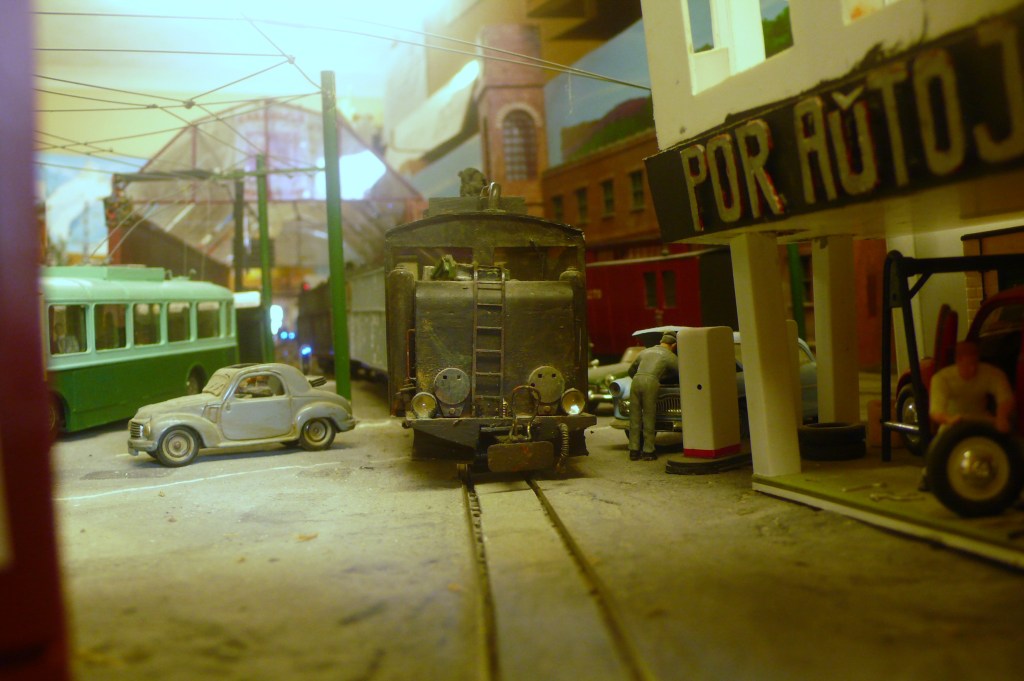
14-126. The Karushnastrato at Lacono presents a busy scene in contrast to the system’s backwaters. The “creature” sets forth along the Kapra Pordejo, or Goat pen, into the Danulbo arrondismento narrowly squeezing past “Everything for Cars”. The photo was taken through the door leading to the cassette. It is only available when the backscene and scenery at Ghealdaban have been removed. The hoppers will be dropped off at the paper mill before other industries are shunted.
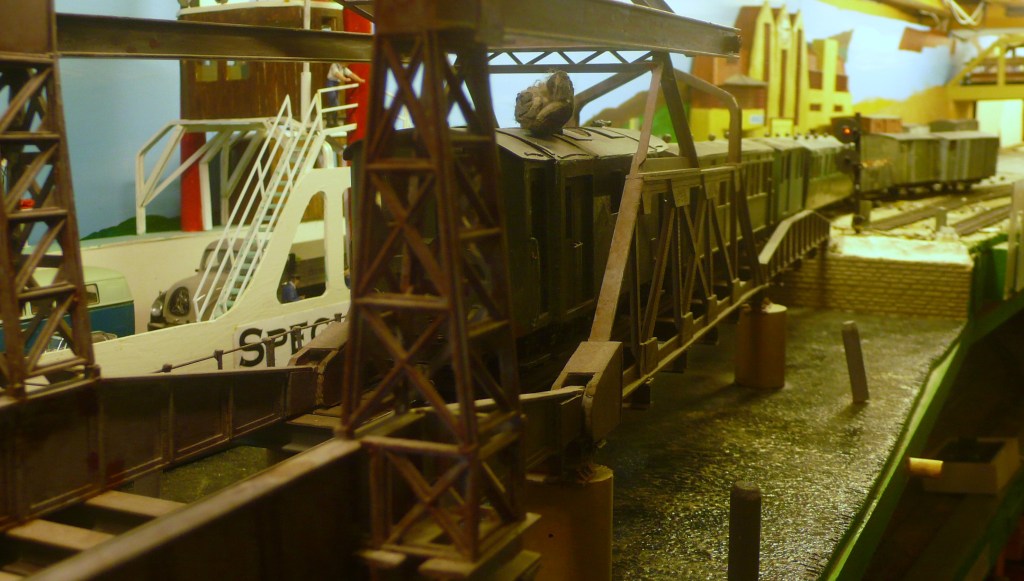
14-127. The market train clatters across the bascule bridge over the Spegulalaguno as it leaves Urteno half an hour behind time. The leading carriage will have to be marshalled into the seaside special but, even now, there should be plenty of time to do this.
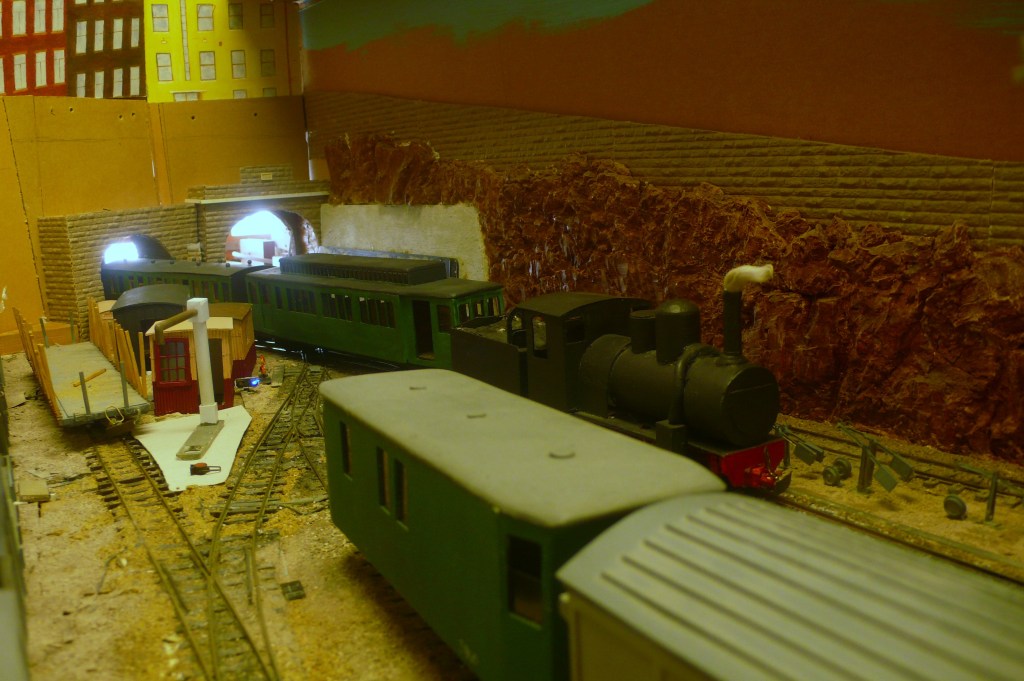
14-128. The express is booked to stand for some time at Lacono, as recovery time. This allows the shunter to remove the goods wagons from the rear of the train standing upon the reception road and the stock of the special train to run into Cittavecchia from Aspargo. The usual dowdy candidates will provide the stock. The clerestory carriage is the one where an impromptu bar has been set up in the rear vestibule, which would not be too bad except that the sliding doors are open, allowing people to potentially fall out, thus adding to the excitement. You might remember the incident with the Scolari and the troll “yesterday”, following the horse race meeting.

14-129. The down passenger makes the stop at Abateĵo de Narrasson, the loco halting above the drainage channel. The Cistercian Abbey is prominent in the background, although the steeple rising above the sky is a faux pas. The estate’s machinery workshop in the foreground is intended to distract the eye from the hole in the sky. A 3D station building will also be placed here to help disguise it.
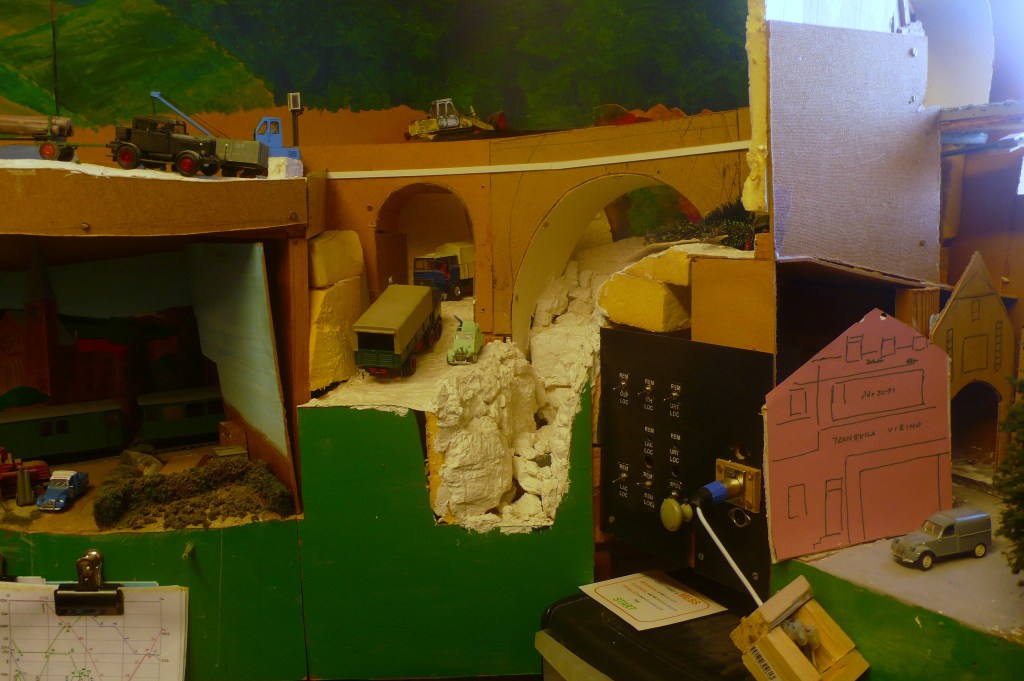
14-130. The scenery from the upper level was brought down in front of the lower level in this corner to help convey an impression of height. At the top left we have the woodyard at Ithilarak placed above Narrasson, where the local is just visible in the gloom. The central area is taken by the viaduct across the upper Aepto Gorge. The lorries battle it out for priority along the narrow RN424 whilst a previous casualty, the Citroën 2CV, rests precariously above the plunge pool. There is a deliberately allocated space for a quite spectacular waterfall at this location, emphasising the contrast with the lowlands. The road makes a horseshoe turn to come out of the nearest arch of the viaduct which is not visible in this shot. The main control panel is visible at the bottom and next to it stands the hideous pink place holder for the Quiet Woman. The lower level track can just be seen behind this, entering the gate.
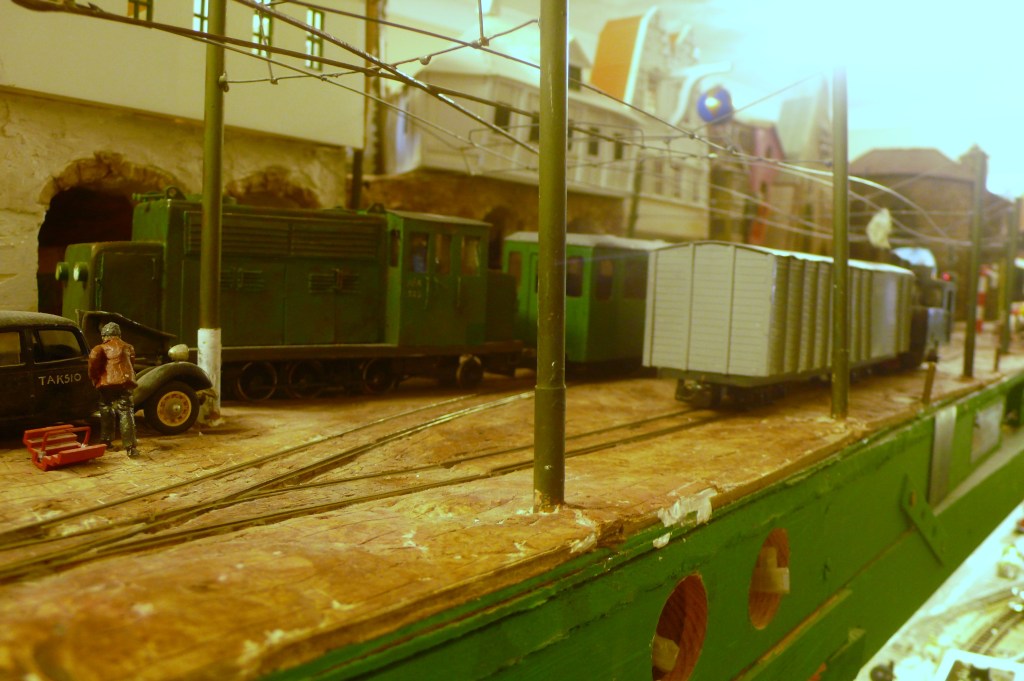
14-131. The loco of the market special has been sent down to Rivabordo at Fenditavalat to bring up the stock from yesterday’s mixto so that it can be swapped with the spare set forming today’s train. The stock has arrived in plenty of time to allow for marshalling, although timings for the mixto’s turn around are tight.
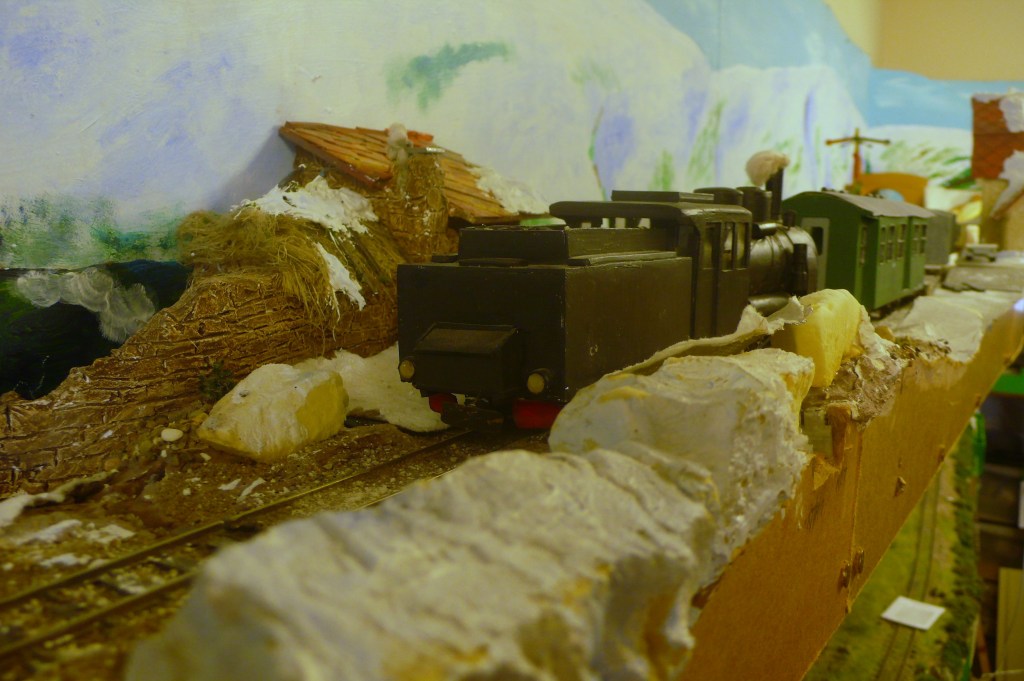
14-132. The down Altingablecaŭtoj goods is booked plenty of time for shunting at Ospicio, although there is not usually much to do on the high moors in the afternoon except listen to the wind and the cries of the lapwings, better known as “peewits”. In effect the slack timings allow time to be clawed back for late running trains such as this one. Prototype timings always puzzle me in that goods trains are often only booked 10 minutes or so to shunt wayside goods yards that must have demanded much more time. I assume that these timings were nominal. The trolley wagon, which had earlier carried the bulldozer, is removed from the loop and added to the train which leaves 5 minutes behind schedule. It is let out because there is time to get into the loop at Ithilarak before the mixto arrives. The tumbledown barn and sheep pen alongside the track has barely withstood the ravages of winter and will need repairing if it is to last another. The shepherd’s hut, with the smoke coming from the chimney, slots out to give access to the light switches for the room and has already had to receive repairs.
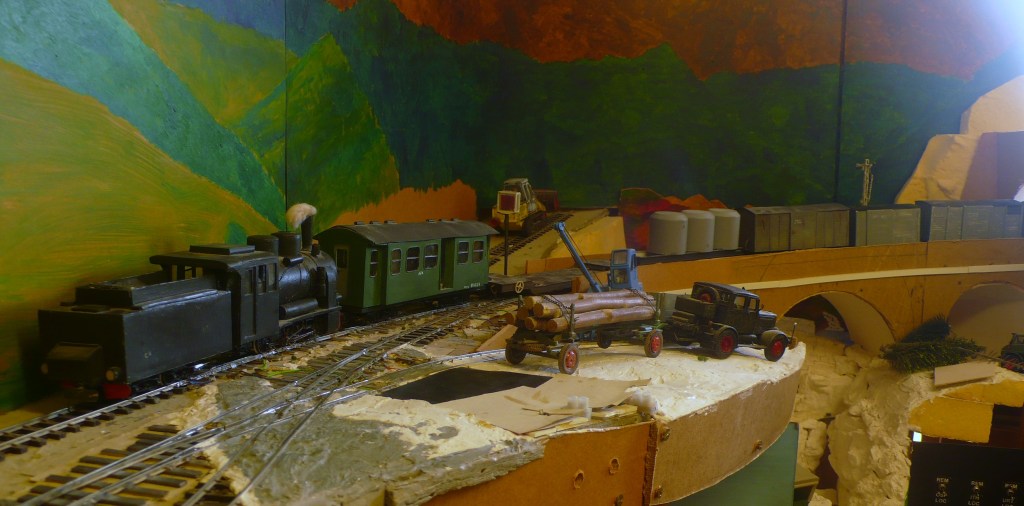
14-133. The goods is usually a short train, over the northern half of the line, which picks up most of its traffic at Lacono. It pulls in cautiously off the Upper Aepto viaduct into Ithilarak loop, having only just entered Altonia canton. In the course of its journey it has previously crossed Calviero canton, the Narnian enclave and Rolnth canton. Sacansa, the staciaĉefino, has been warned of the train’s length and has demanded that the branch train pulls forward to accommodate the goods. There is just time, once it is safely in the loop, for her to walk down the RT (Rektatracko or main line) to prevent the mixto from pulling too far forward. The goods train is just within the tonnage limit for the vulpafaŭkangulo and will have the retainers on the Westinghouse brakes turned up whilst it sits in the loop. You do not want a runaway on this gradient!
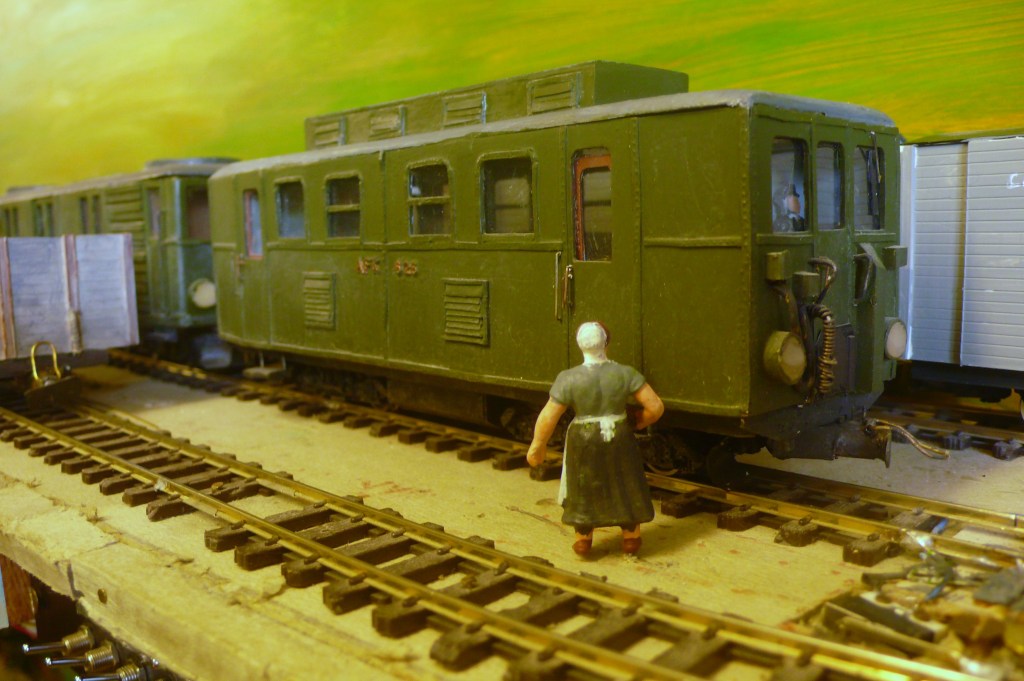
14-134. Sacansa stops the mixto short of the points accessing the exchange siding. She jocularly congratulates the crew on their new engine and tells them that they will need to back into the exchange siding (at the front of the photo) because there is not enough room in the loop for them. She reminds them to whistle once they are in the clear because piloting has not been allowed for in the timings and the mixto will leave late.
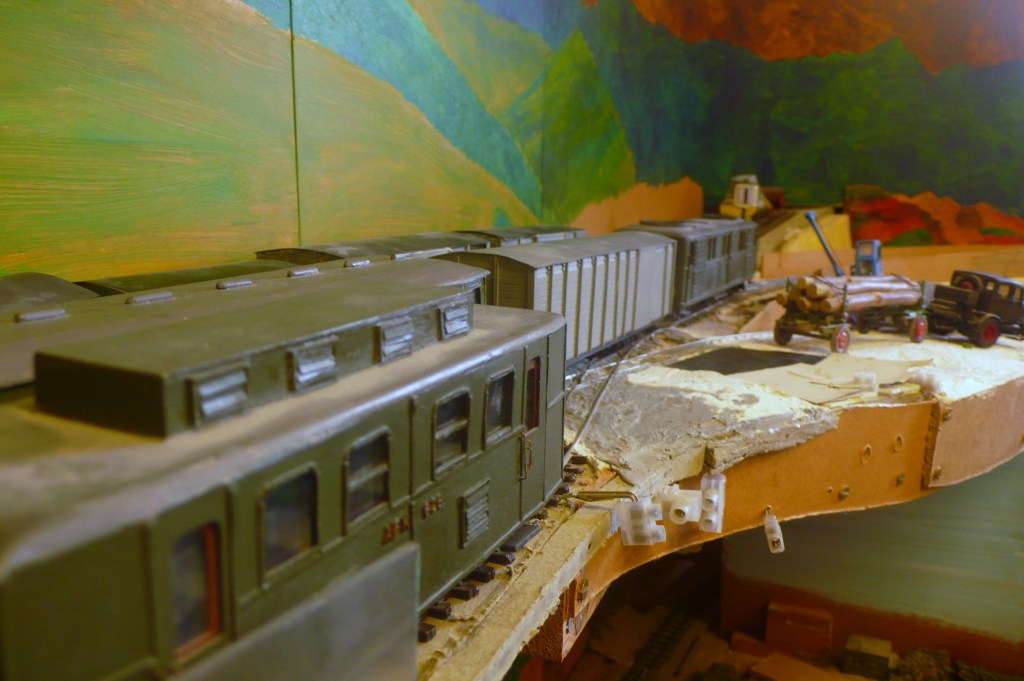
14-134. With the pilot in the loop Sacansa has walked to the frame and worked the signals to get the mixto away as quickly as possible. The pilot is partially protected by a fence to prevent it taking a trip to the floor. This used to be longer but has been cut back. It could probably do with reinstating to its former length. The crude homemade nature of AFK controls is apparent. They are simply rods, placed alongside the equipment that they control, fitted with a chocolate block connector on the end. The loop point controls use gauge 1 rail, hence the larger connectors. The small one, at the bottom right, works the track brake in the colliery siding. I sometimes wish that I could remember which was which!
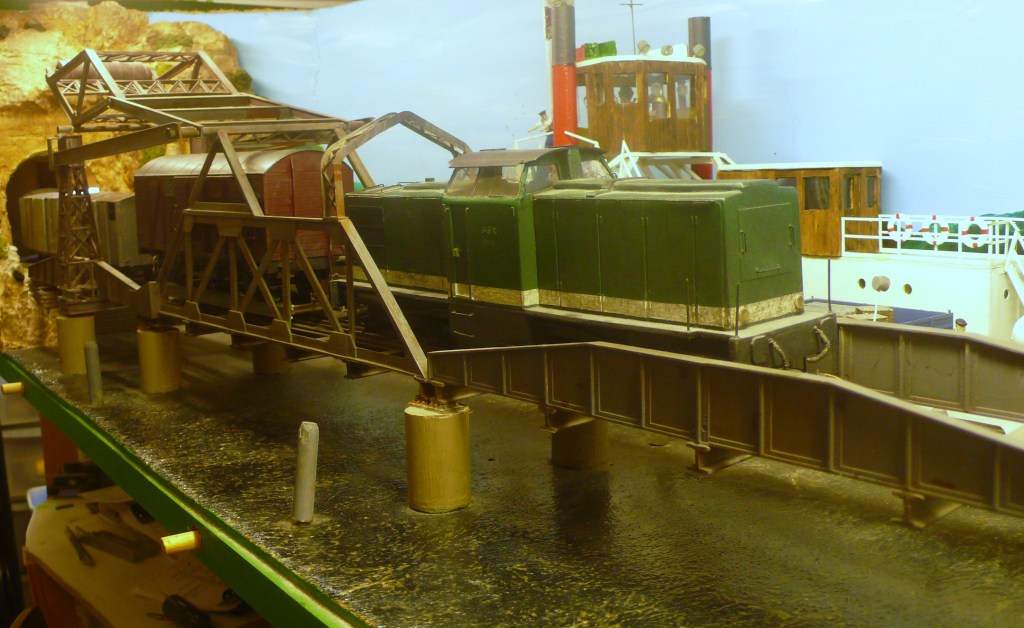
14-135. Despite the late arrival of the market train at Lacono the slack timings ensure that the Fenditavalat goods crosses the Spegulalaguno into Urteno on time. The train is no longer booked for a banker, as it used to be in days gone by, but there are some wagons that need detaching for Urteno/Karamspur so it is likely to meet the vulpafaŭkangulo tonnage limits without leaving any loads behind.

14-136. Attention returns to Lacono once more, as the yard was blocked by the outgoing Fenditavalat freight. The excursion loco has run round the stock and waits beneath the box. The market special loco has just transferred the Urteno coach onto the excursion train and is waiting to set back onto the train that it brought in. This is the continuation of a busy spell for the signalman. The track layout permits a number of simultaneous moves which, obviously, are carried out sequentially, but allocated one click of the clock/timer. There is the obvious proviso that conflicting moves are not allowed. It might seem that, to the uninitiated, the excursion could leave via the loop to cut down occupancy of the mainline. This is not allowed as it is not authorised by a running line signal. I remember attending a briefing on this subject regarding an incident at Selby, with which I was vaguely familiar with as my parents once lived there. Due to a train failure the signalman apparently authorised an unusual move by creatively using the shunting signals. Unfortunately these were not locked in the same manner as the running line signals and he diverted a through train into the bay, as permitted by the subsidiary aspects, and nearly rammed the local unit standing there.
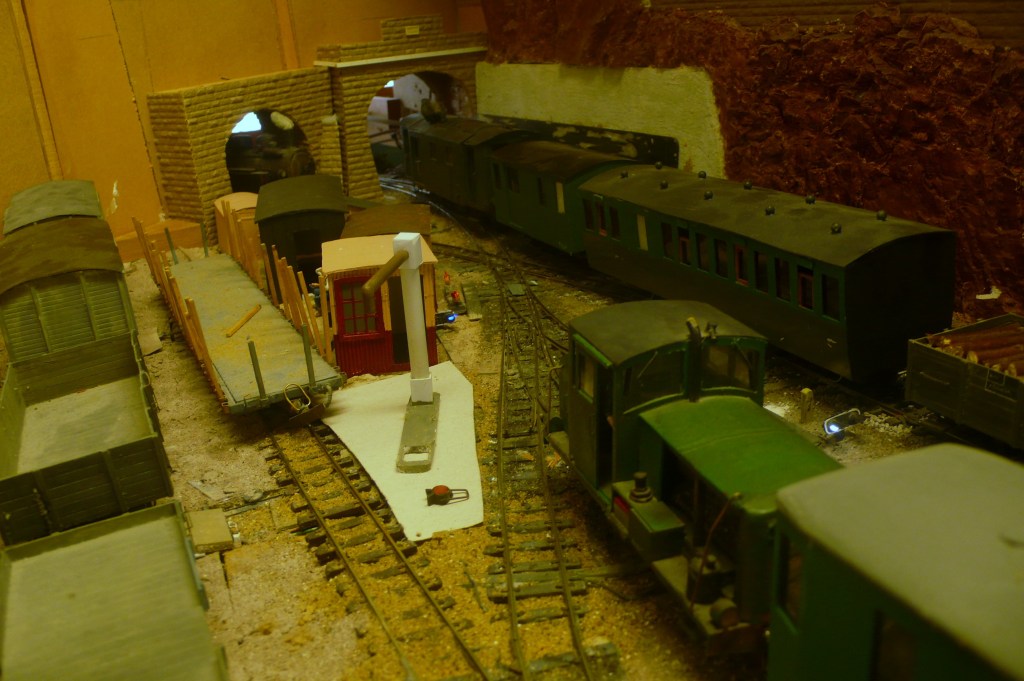
14-137. Sisyphus is forced to wait as the stock of the market day special is pulled forward to set back into the yard. The 0-10-0T is waiting to come off shed, on time, to work the Altingablecaŭtoj goods. Unfortunately the stock for thisis still waiting to come into the station from the paper mill.
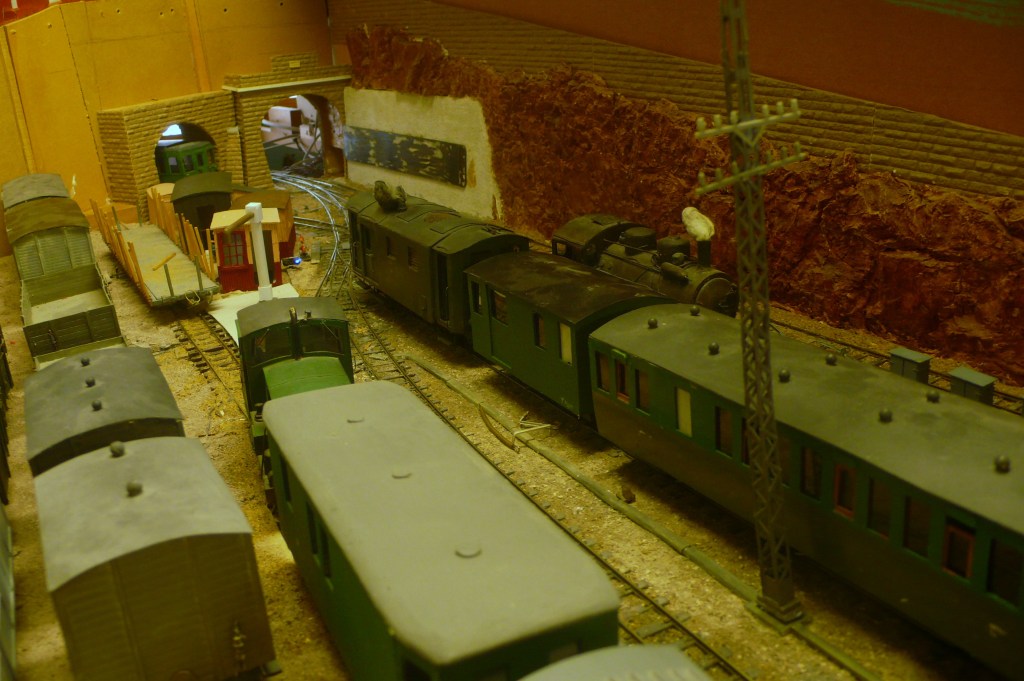
14-138. The stock from the market day special has now been run into the reception siding. The 0-10-0T will temporarily run into the yard via the “short” crossover to wait for its train and possibly help with the shunting. Its place at the Aspargo exit is immediately taken by the Urteno schools’ train which was queuing just behind it. This is permitted as the shed connection is worked with the German equivalent of permissive block, (if such a thing exists) allowing them to stand nose to tail. The pilot is desperately trying to fish out the crew van for the KTT local so that it can leave roughly on time, although it will be ‘rough’ in that it is unblocked.
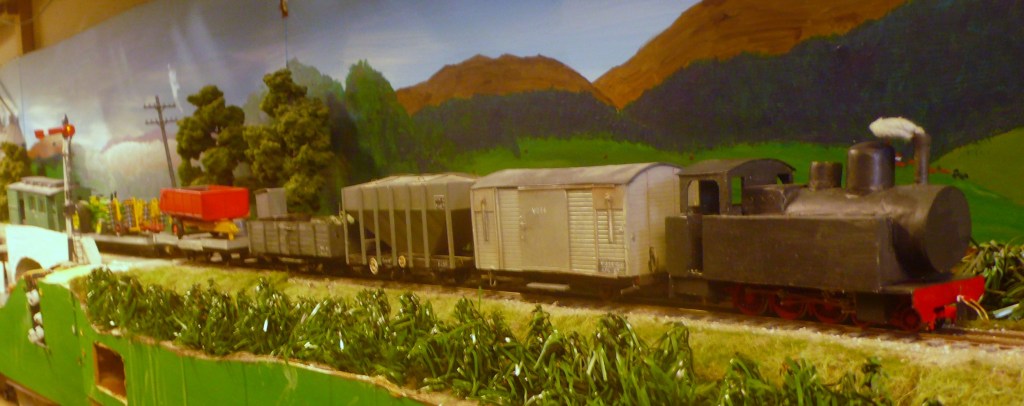
14-140. With the express having passed by the Kasatritikakamparoj goods heads north, away from the river crossing at Glissent, with the afternoon train. The problem with sticking to the booked timings is that shunting time is reduced at Boursson which can create congestion when the down local goods arrives. The train is already a bit of a mess in that the prominent red farm trailer is going through to Lacono and interfering with the wagons for Boursson. Control, and Relforka yard, regularly expect local train crews to deal with these problems to make their lives easier.

14-141. The KTT goods’ arrival at Boursson just allows time for the loco to shunt the hopper and open into the Co-op siding. The excursion then arrives. The clearances are much tighter than would have beeen allowed on the prototype but I overlook them to allow for more action. The special stands for a couple of minutes, to let passengers board, which takes more time away from the shunting crew. The agricultural machines come from a variety of sources. The (way too modern, I suspect) tractor is by Ertl, if I remember correctly, the disc harrow is a chopped up Dinky Toy and the trailer is by Corgi.

14-142. Other places are also having problems. The presence of the replacement stock for the down mixto in Fenditavalat square means that clearances are reduced to a minimum, and the AFK schools’ train, which usually shunts the CFS trailer, is departing from the main loop. The trailer will be pushed up the hill by the shunter before running onto the rear of the electric railcar by gravity. Questions are also arising as to how the railcar will collect the observation saloon.
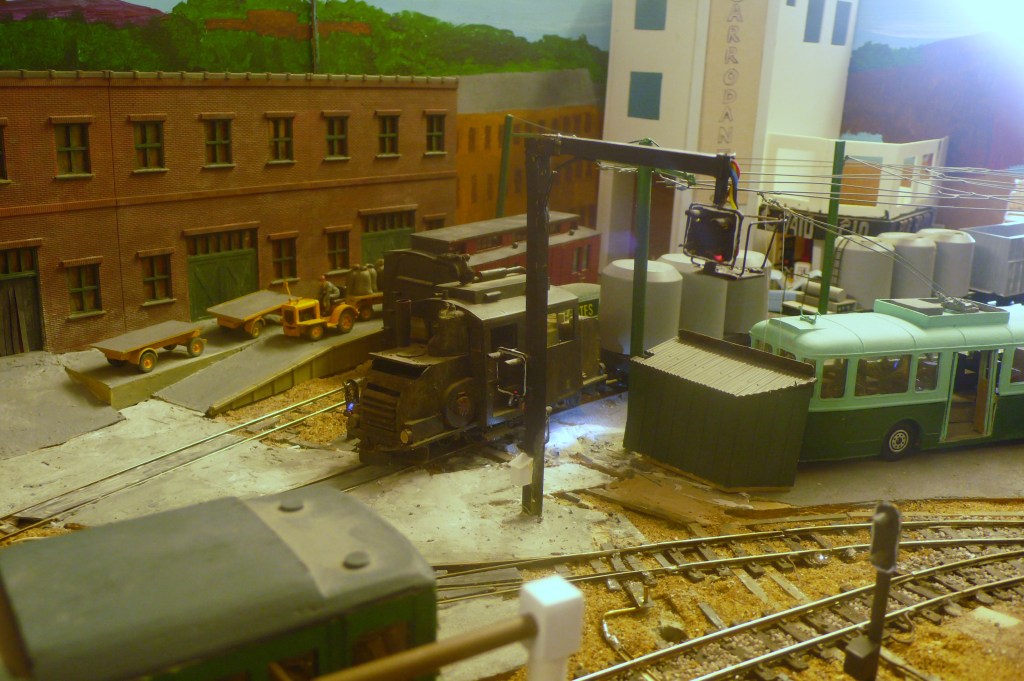
14-143. The Danulbo shunt arrives at the most inconvenient time in the evening. As was noted earlier this was one reason for introducing the magnetic shunting boards, although the timings of this working will need to be reviewed. The shunt is blocking the Karushnastrato right at the evening rush hour. Komagre, the second shift crossing keeper, informs LaC, the controlling box, that they will have to wait for the road traffic to disperse before the Urteno schools’ railcar can leave. Komagre is on the sharp end in that he has to stand amidst the pedestrians to wind the barriers down, not that this stops agile pedestrians from crossing at their own risk.

14-144. The observation saloon passengers are certainly getting their money’s worth, in terms of dramatic scenery. The snow bound wastes of Narnia seem quite alluring, although I would be wary of alighting and speaking with the locals. Strange things can happen here!

14-145. The evening Altingablecaŭtoj schools’ railcar has arrived at Ospicio, where the Post-Bus waits to transfer the bairns to the lower valleys. This is only possible in summer when the roads are clear. In winter the poor buggers, little darlings, have to become weekly boarders. And yes, incredibly, in this day and age, I worked in a state run boarding school facility, in a seaside town, whilst on teaching practice during the seventies. It was, apparently, not all sweetness and light, although I lived in a rented flat at some remove from the school! My favourite story was about one young miscreant who was detained after school, for some misdemeanour or other. He jumped out of a first storey window and legged it. I was advised to check that the windows were closed and locked before detaining him, if necessary.
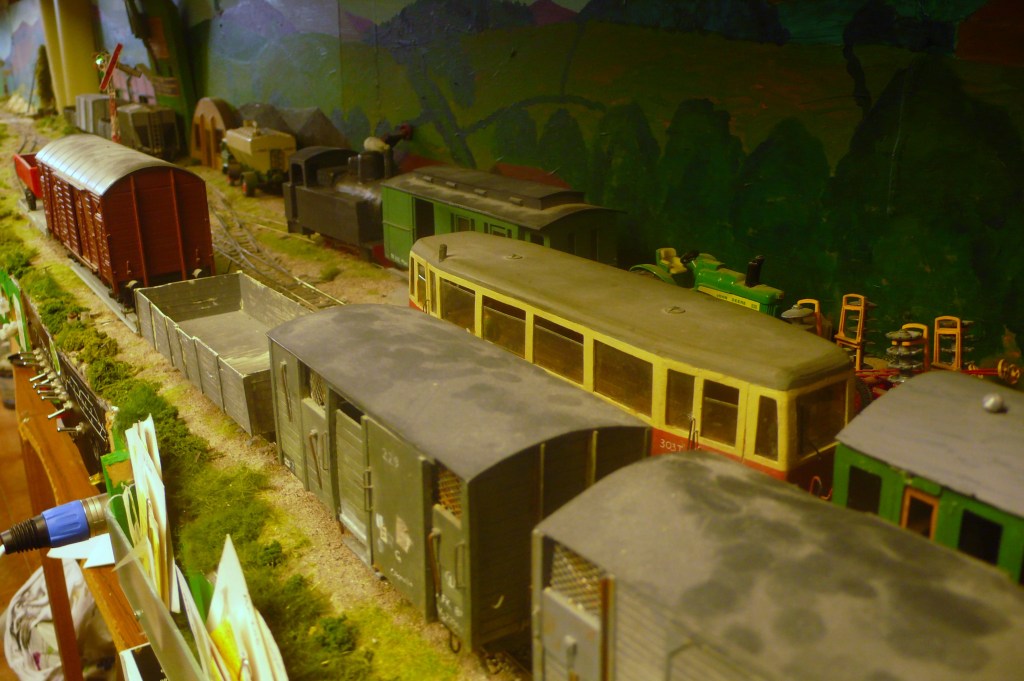
14-146. The KTT schools’ railcar rolls into Boursson a couple of minutes late. It found the home signal at danger because shunting was taking place. The crew of the local goods deliberately made the decision to hold the railcar so that they could move the agricultural machines to the unloading dock. It will only put a small amount of time into the railcar and it does not provide an important SG connection. It might well facilitate an on time departure for the goods, however. The boxes holding the paperwork are visible in the foreground.
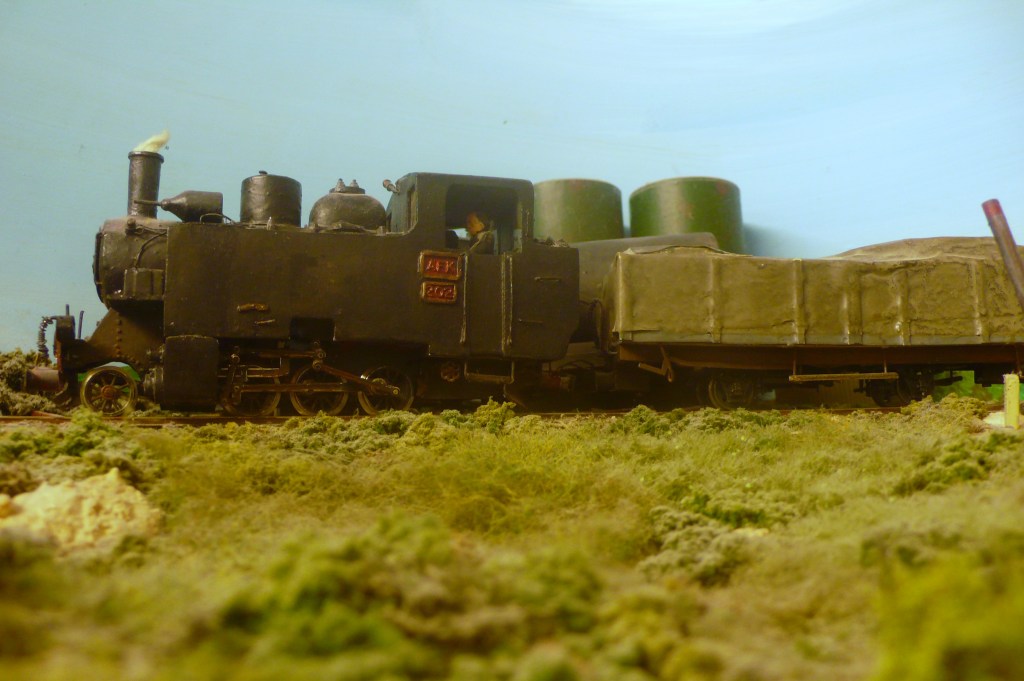
14-147. The larks sing and the wind whistles as the Jakarutu train rolls to a stop at Győrsmorabű. The duty is not too onerous for the crew during the summer months but they earn their corn in winter. Although the moorland is idyllic in summer, an ephemeral season at this altitude, winters are brutal. There are not too many railwaymen that wish to serve in a remote snowbound outpost in the back of beyond.
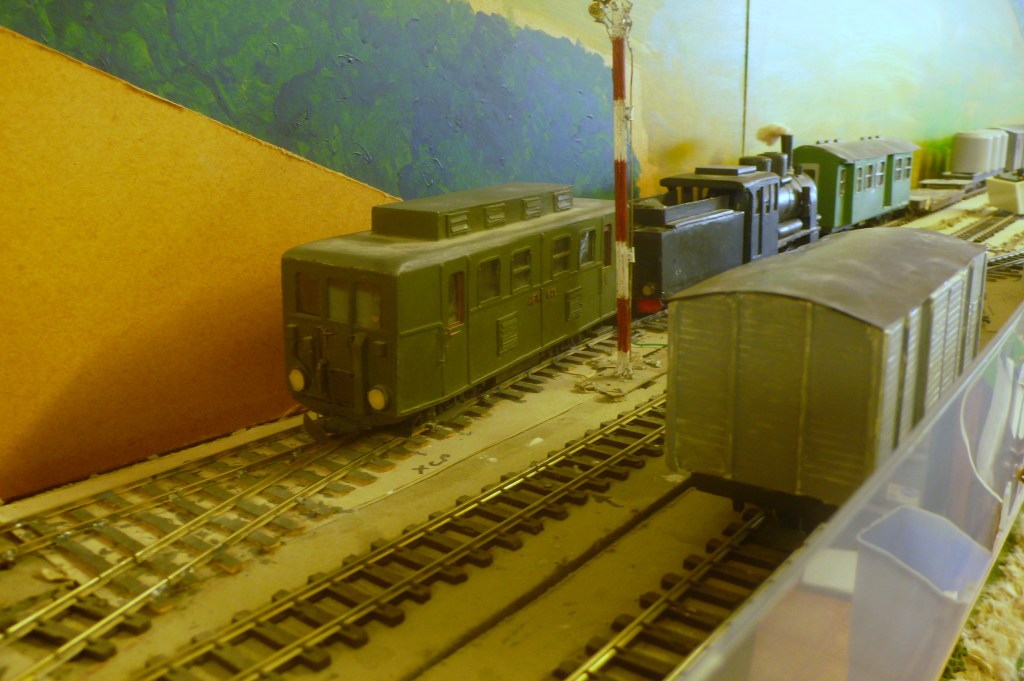
14-148. The decision is made, by Control, to attach the banker to the front of the FDV-RFK goods. This adds 15 minutes to the timing but there is no purpose in leaving the banker at Ithilarak today. It will be of much more use at Urteno.
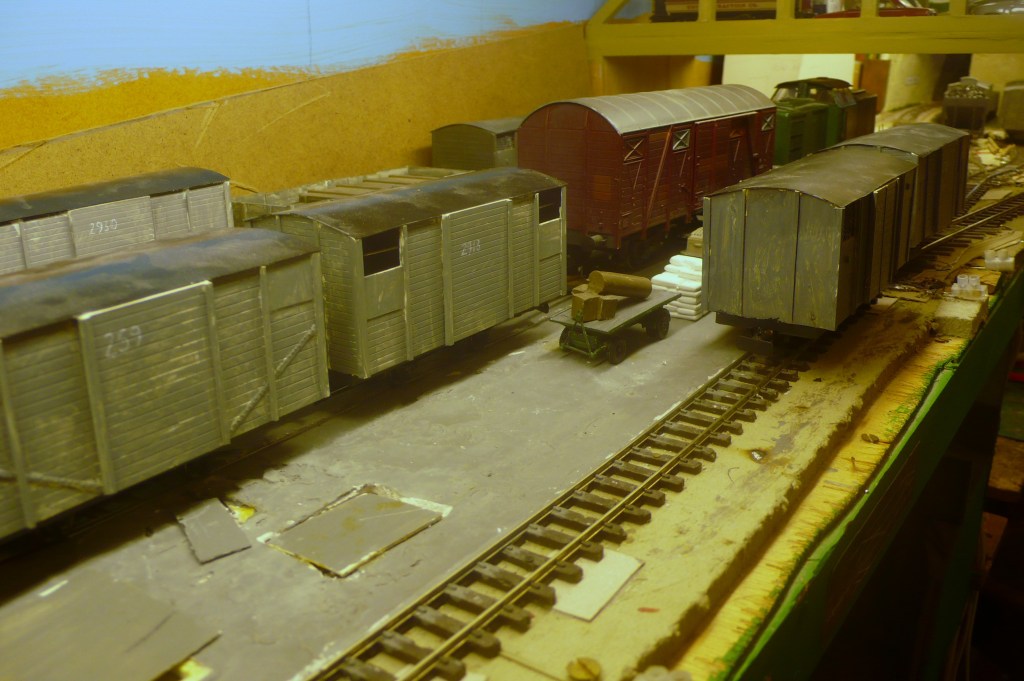
14-149. The RFK-FDV train is busily cutting out wagons for Urteno and Karamspur. By the time that it has finished the consist will be well within the tonnage limits for the vulpafaŭkangulo.
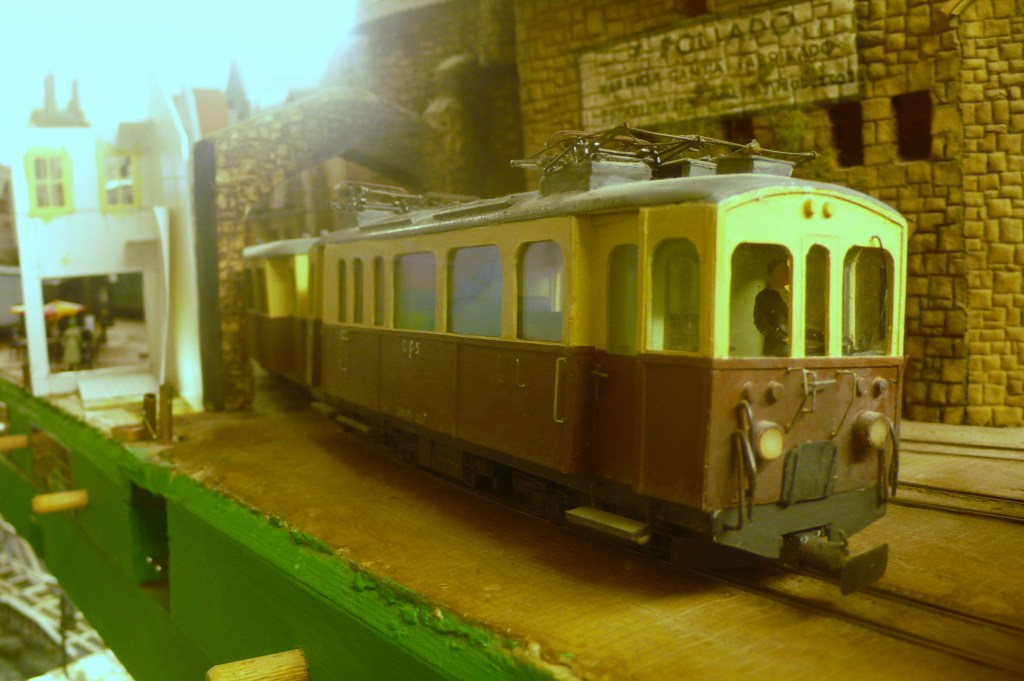
14-150. The CFS railcars have the facility to run without contact on the overhead. A series of batteries are provided that allow light trains to move at slow speeds for a short distance off the wires. The facility is rarely exercised at Fenditavalat but, due to the unusual circumstances, it is required today, and the pans are lowered accordingly. The railcar and trailer pull into the goods yard before backing onto the observakalo, which was transferred onto the loop by the pilot.
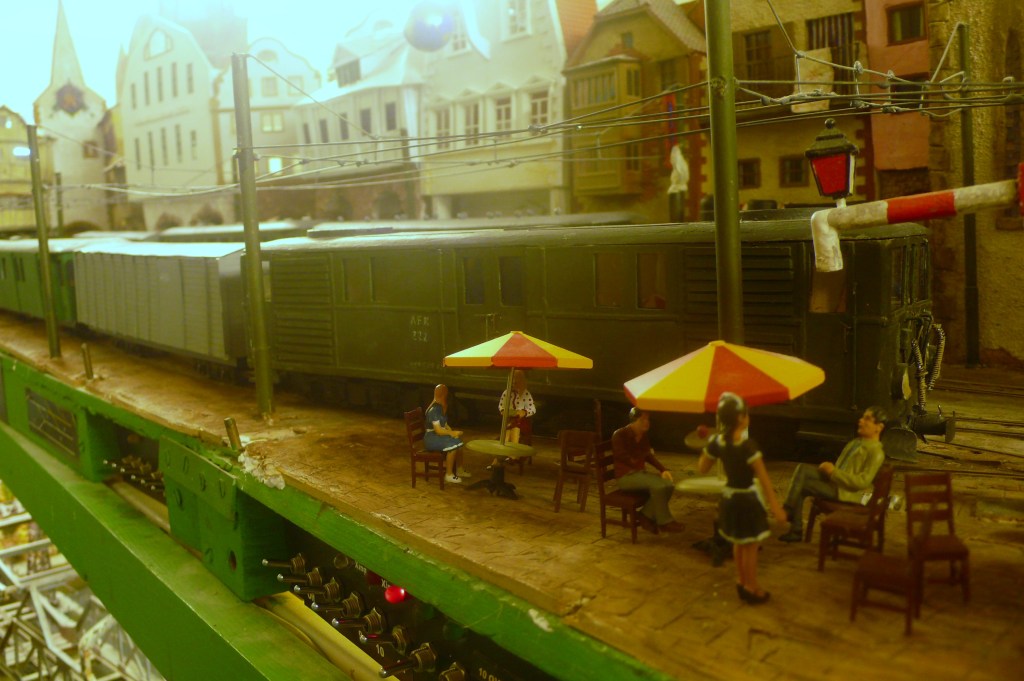
14-151. The mixto loco backs onto the replacement stock, which was late in arriving “yesterday”. What with the toings and froings of the shunter, there is little time left for a punctual departure. I suppose that I should stick some more seated figures onto chairs to provide a little more variety at the café.

14-152. Eromarbordo has fallen behind the times again. Situated at the end of the branch it is often left for some time until another train needs to use the station. It is being brought up to speed by the Meyer 0-4-4-0T which is shunting the afternoon goods. All the traffic is fish brought in by the fleet. With the end of the main fishing season approaching the loco is pulling the spare SG refrigerated van out of the headshunt to take it to the fish market. There should not be any problems in providing SG vans in the foreseeable future.
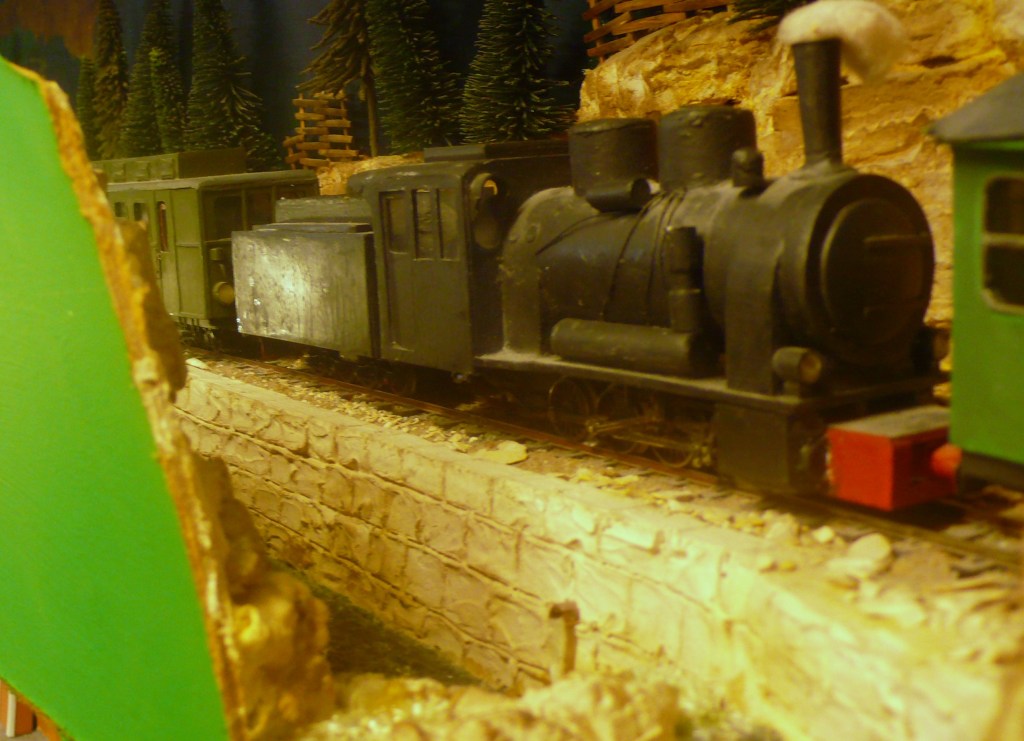
14-153. The Bo-Bo seconded as Urteno pilot/banker, and the 0-8-0 heading the Relfoka bound goods, drop down the vulpafaŭkangulo beside the boiling waters of the Aepto. The train is leaving y höggormshöfuðgöng, or Serpent‘s Head Tunnel which was constructed through a spur in the hillside.
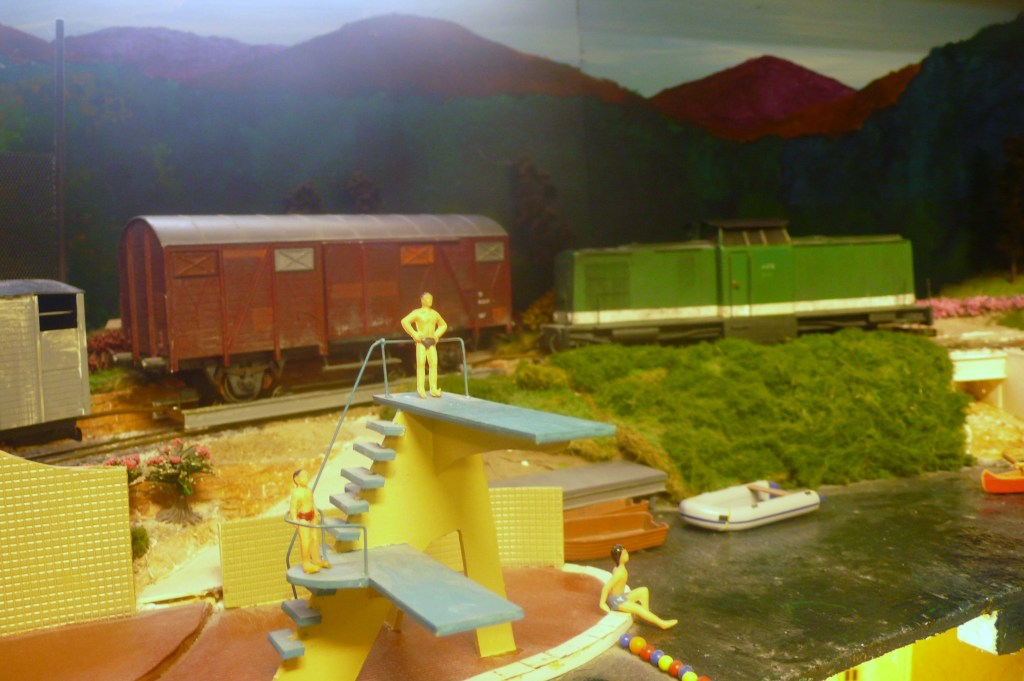
14-154. With the down train having reached Urteno it is only a short time before its up counterpart blasts up the grade as it rounds Varden lido. A couple of likely lads eye up their chances of impressing the girls by diving off the high boards. The swimming section of the mere is separated from the boating area by the floats.
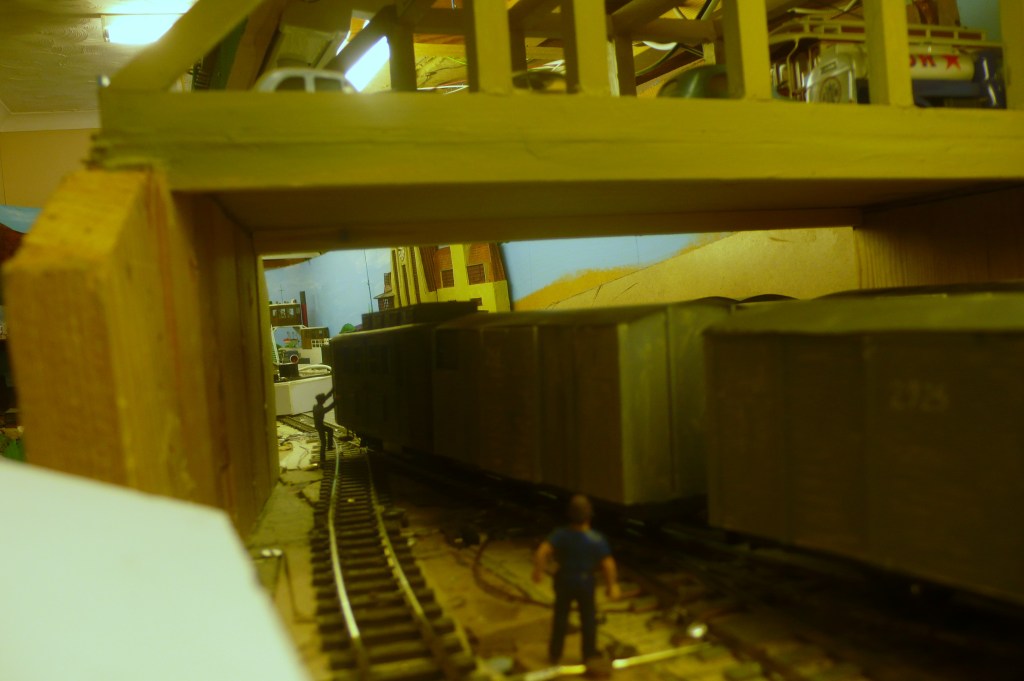
14-155. With the return of the pilot to the bottom of the hill some much needed shunting can take place in Urteno’s karbaflankatrakoj or coal sidings. Alomle, the shunter, has spoken with the driver, who is returning to the cab, about the work required. (Pity that the controller insisted on getting in on the shot!)
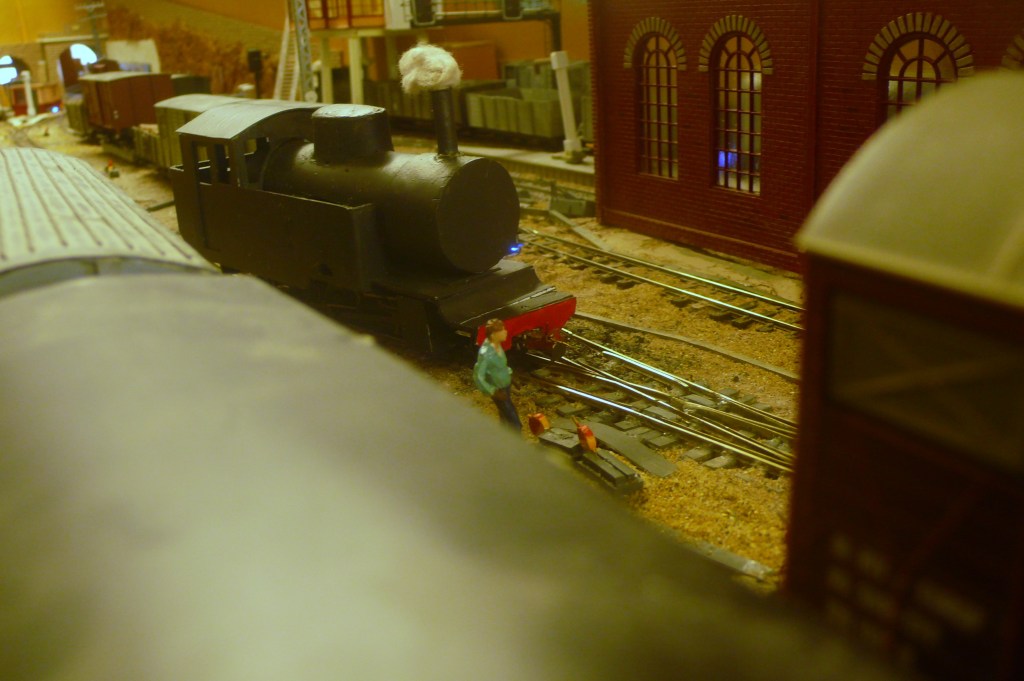
14-156. Meanwhile things are still in a tangle at Lacono. The 2-8-2T turns up for the KTT goods, having being held at the shed exit for some time, to find that it is deep in the yard and completely “rough” in that it has not been shunted into blocks. This will not help with the working of the train at subsequent stations. After a tortuous passage the loco is about to back down onto the train which is behind the brown SG van at the right.
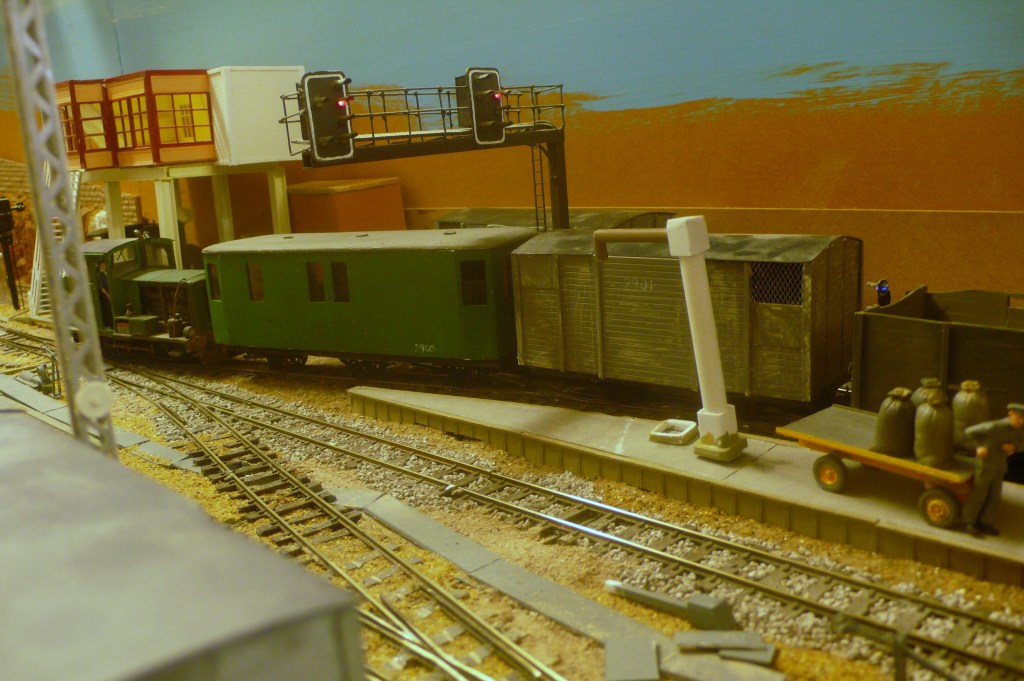
14-157. The up Altingablecaŭtoj goods has been thrown together in the passenger station out of dire necessity. The yard pilot attaches the road van and brake onto the rear. The train quite possibly exceeds the tonnage regulations for the loco but no-one in authority is looking and it is simply a case of, “get it out of here!”
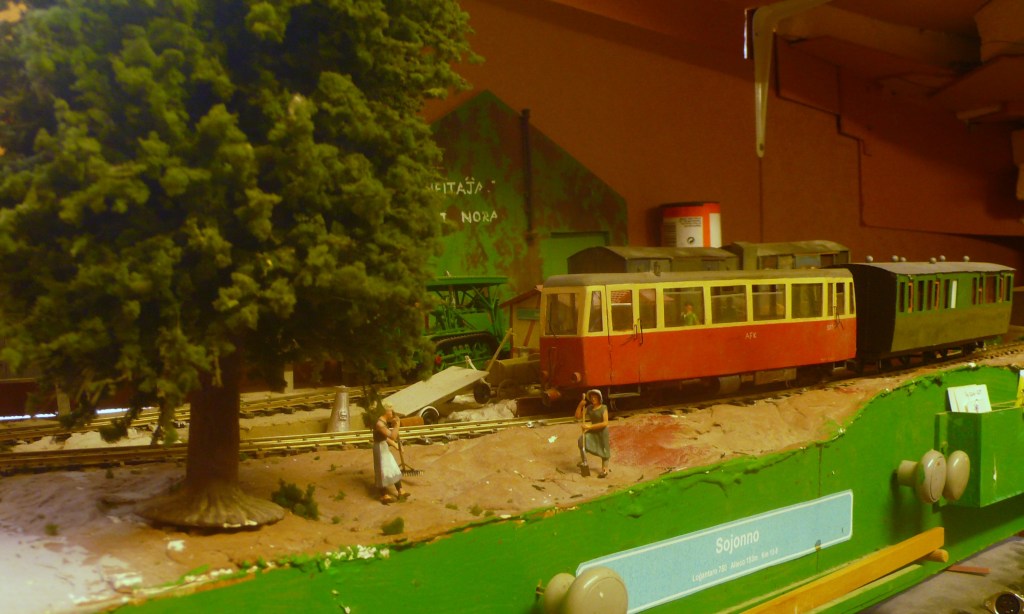
14-158. The afternoon schools’ railcar calls at Sojonno, where the peasant women are still working the fields. This area remains a work in progress and, given the calls elsewhere, it is likely to remain so for some time.
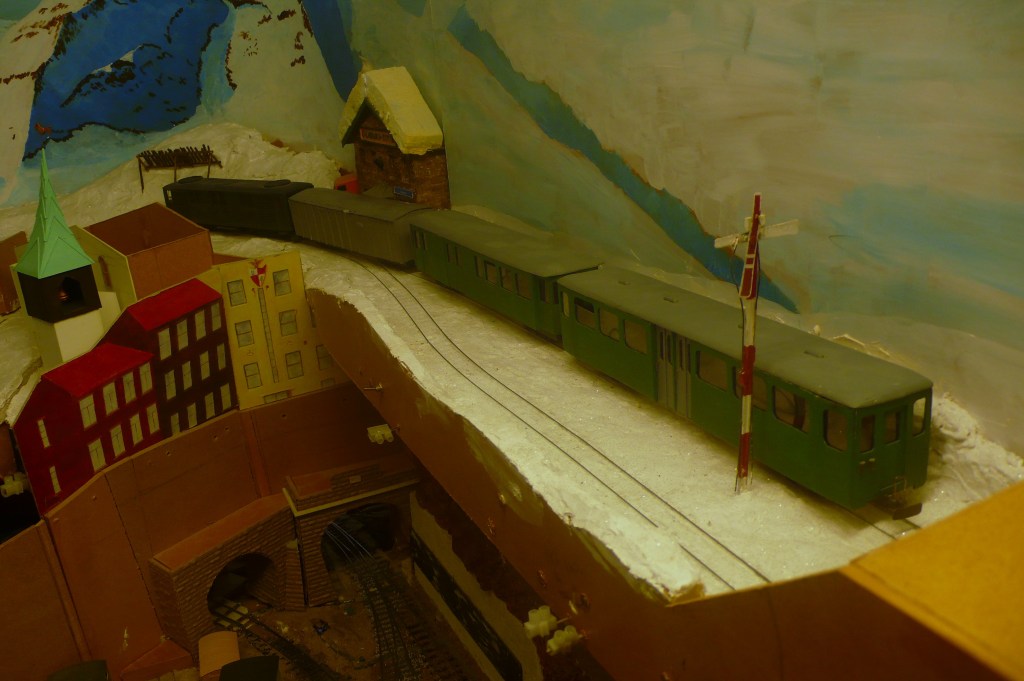
14-159. The third long distance service of the day is the down mixto. This, as has been previously noted, is on a tight timing to connect with the FT (Thalnian Railways) trains at Relforka. It forms the first stage of the overnight journey to the Kernregio, or Heartlands of the country. The SG train, which connects with the Narnian train at Gascari, conveys sleeping cars and couchettes and is guaranteed to be held, within reason, at Relforka to make the AFK connection. Its performance is subjected to excessive scrutiny because it is patronised by the politicians and functionaries from the Svæŏisþing, or Marronĝacan Provincial government, travelling to the National Assembly. The amount of hot air generated by these half wits could easily melt all the snow in the Narnian enclave, especially if their train is late!
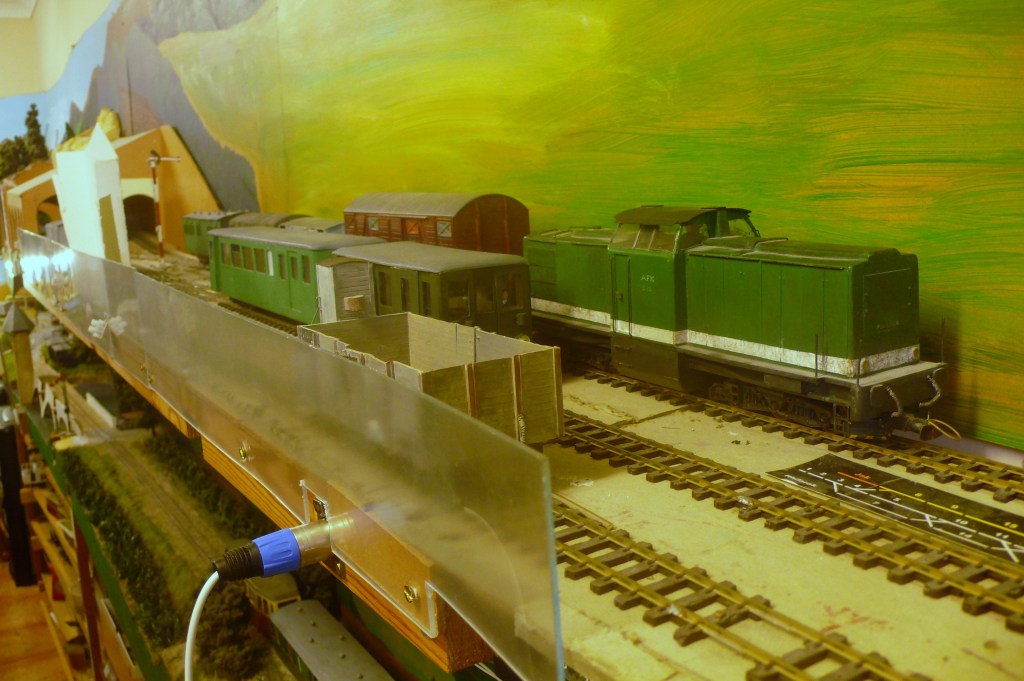
14-160. The High Reaches schools’ railcar discharges the remaining children at Ithilarak and does not normally expect to see too many passengers between here and Urteno. Unfortunately the crew of the freight have erred. The train was retimed, about four sessions back, so that it runs without a banker and is not timed to shunt Ithilarak. As per usual I have forgotten this alteration and there is the van of seaweed fertiliser to set out. The train could gainfully have taken the empty cement silos currently on the local train. There will be a review of these arrangements after the session closes. There is just about sufficient slack in the timings at Ospicio to drop off the van.
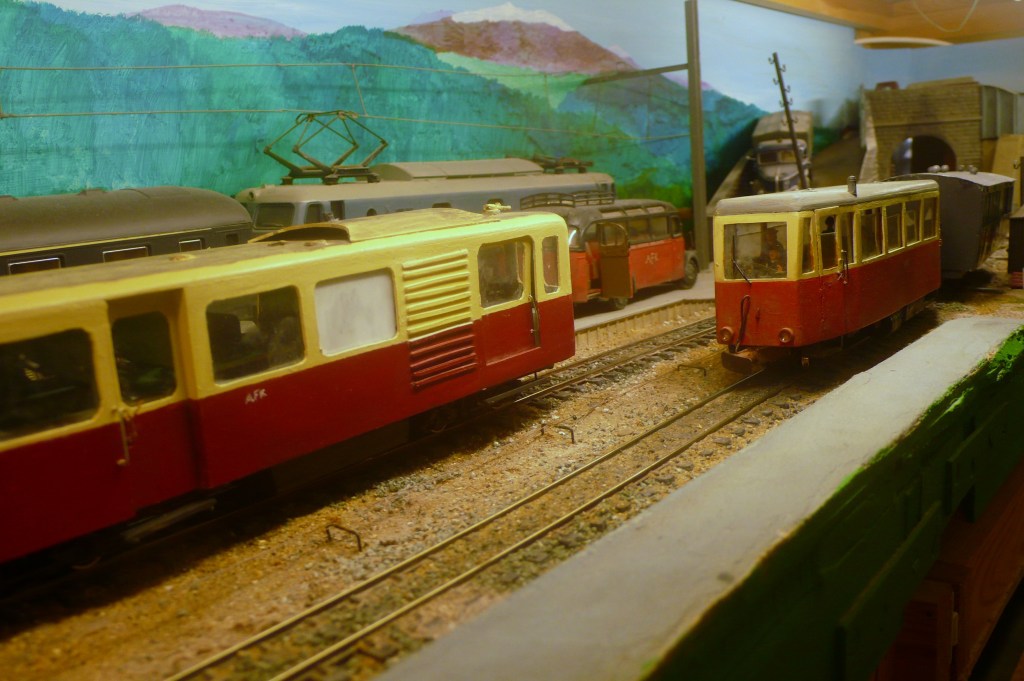
14-161. The evening railcar, at the left, provides the third, and last, service over the whole line in the northward direction. The schools’ railcar, at the right, arrives slightly late today and only just provides a SG connection towards Gascari. This is not advertised because the timings are tight and the railcar often loses a few minutes. The up railcar used to be notorious for its own late running over the Altingablecaŭtoj, or High Reaches, but punctuality has improved now that the timetable has been revised, much to the chagrin of those imbibers that used to frequent the bar at Urteno whilst the train waited for a banker to be found to assist it up the hill. The decline in “von Ryans” has also positively impacted on timings being adhered to.
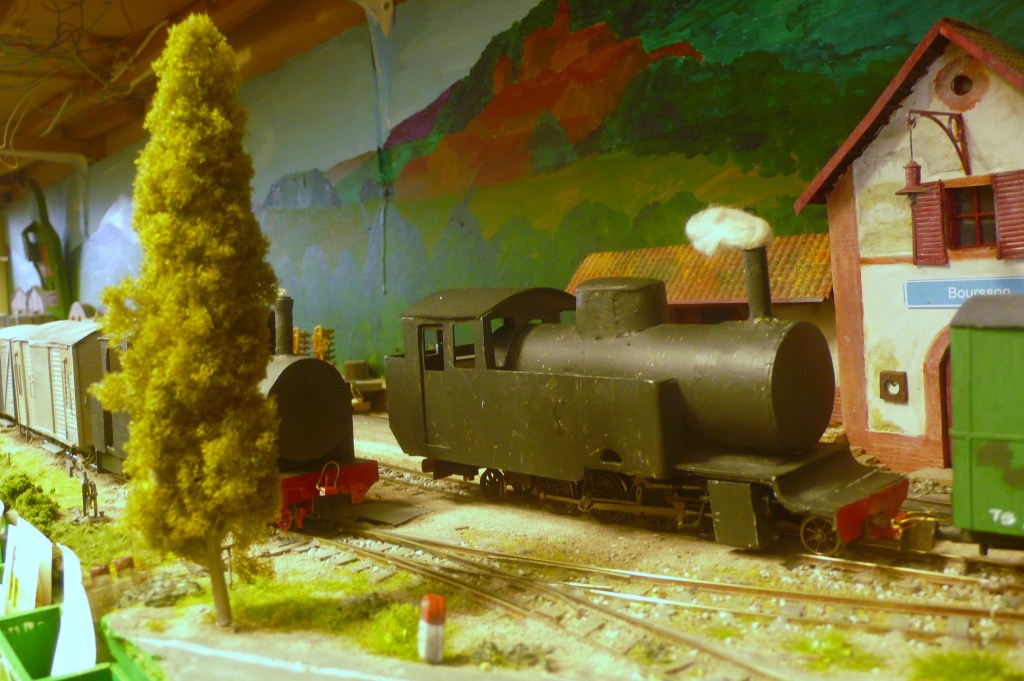
14-162. Deep in the Kasatritikakamparoj the two afternoon local goods meet as planned. The up train, in the loop, is well loaded today whereas the down train, headed by the 2-8-2T might need to spend some time organising its relatively light train. Both locos are still on trial, and unfinished. I thought that I had dealt with derailing leading pony truck of the 2-8-2T but I am not now quite so sure. The 4-6-0T is a smooth runner but seems prone to the occasional stall for reasons not yet apparent.
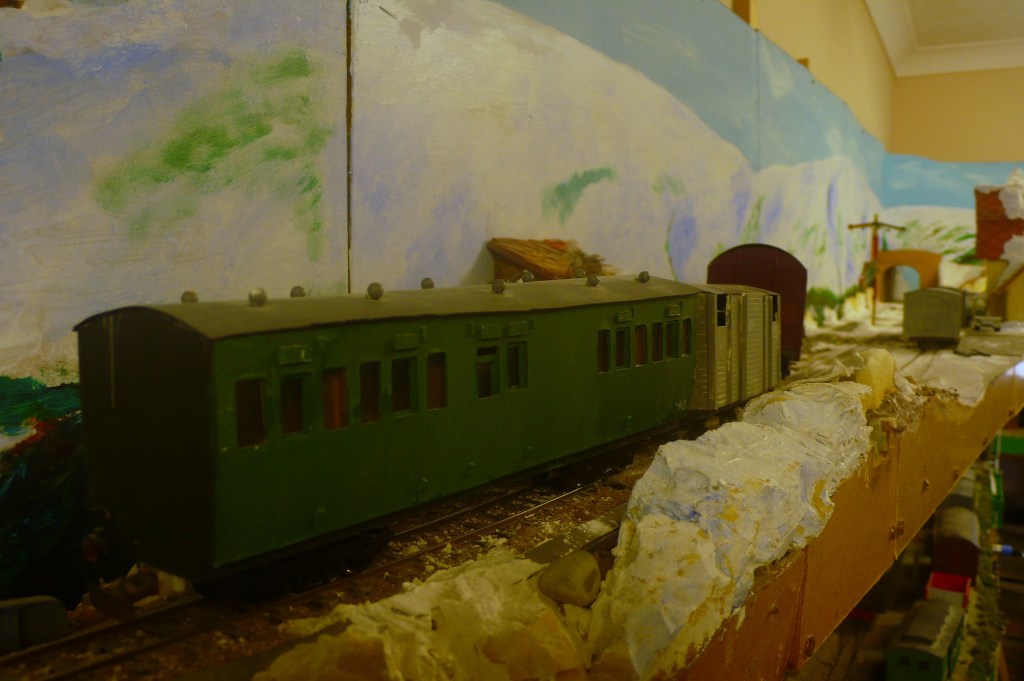
14-163. It would appear, to the uninitiated, as the up goods pulls into the loop, that it has made Ospicio without delaying the mixto. In reality the mixto is standing at the signals outside the northern entrance to the station to provide the overlap. This will incur a short delay as a consequence. This might not seem to be a problem but it can soon escalate, so a watch will be kept. The chances are that the Incompetent Talking Mouse in Beruna Control will provide a cushion. If he doesn’t then perhaps he provides a cast iron case to be presented to the politicians for the extra investment needed to provide “run offs”.

14-164. The Eromarbordo branch goods train has arrived at Breĉo de Glissent, having waited for the seaside excursion to pass by. There is a minor problem in that there are two consignments of fish for the Boursson cannery which would be delayed if taken to Relforka. The SG van is put into the siding, as it is refrigerated and going to Relforka, whereas the NG vans simply contain fish boxes covered in ice. The siding “behind the station building” now contains five vehicles and a note has been made of what they are and the order that they are in.
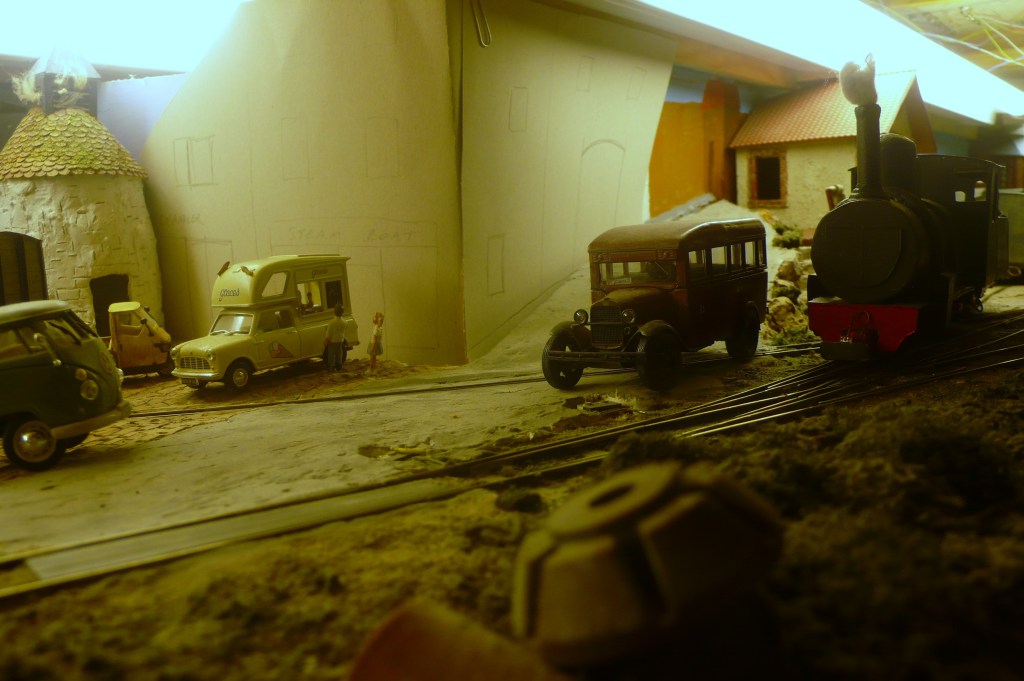
14-165. Once the branch goods departed Eromarbordo the excursion loco ran round the special and went to the water column. It will remain here until the late evening departure beckons. The ramshackle railway bus, exiled to this outpost, provides a more convenient connection to Patanzaro on the coastal line than travelling to Relforka Lacono. The ice cream seller and the kids have returned for the summer. Although being a French manufactured model the van is configured for left hand drive roads. It is based on a mini chassis so it would be interesting to know whether Leyland produced separate versions for European roads. The beaches are on the other side of town but there are many good seafood restaurants for adults to patronise.
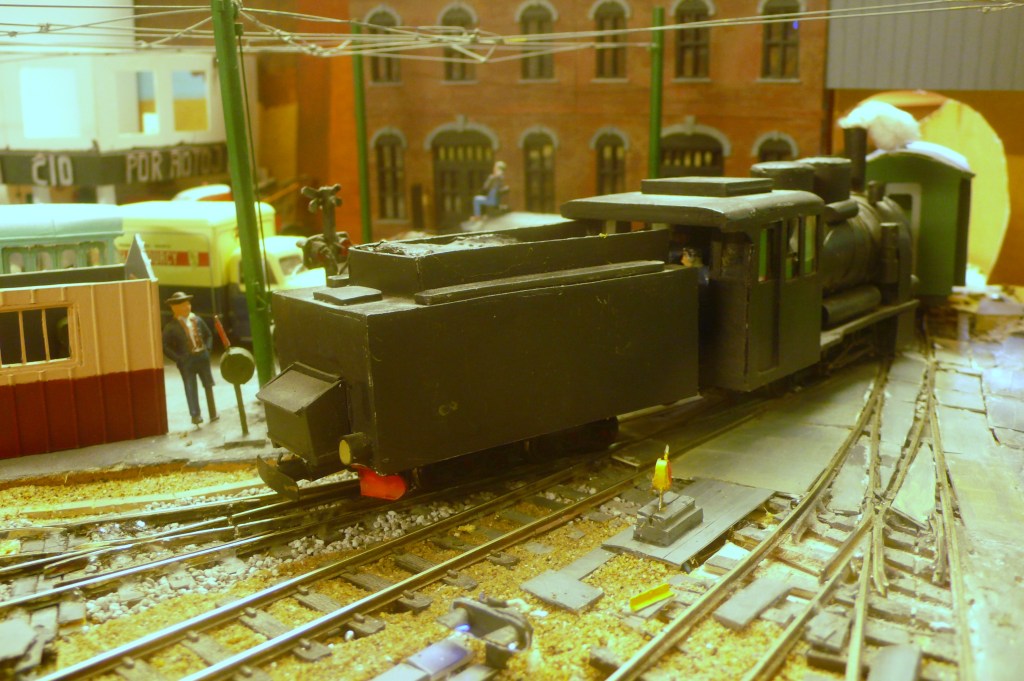
14-166. The FDV-RFK goods is held outside Lacono until it can be dealt with. It is seen here crossing the Karushnastrato. The delay was not a long one and it will be possible to leave on time as the train is booked to stand for almost two hours. It will be remarshalled before it leaves.
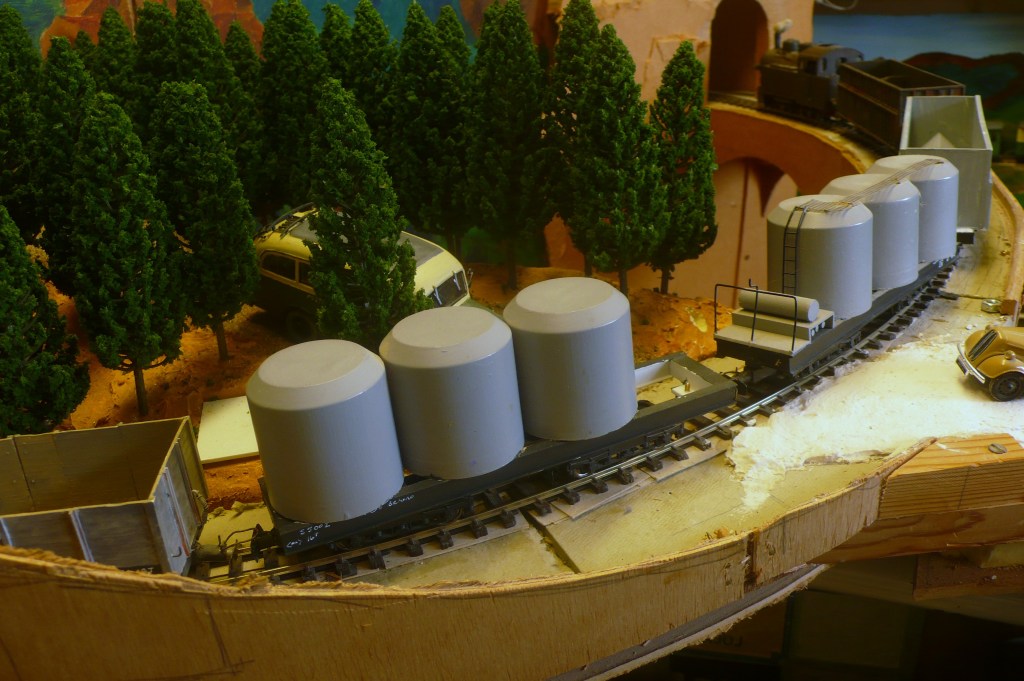
14-167. The heavily laden northbound local goods leaves Lacono immediately, once the down train pulls in, running late. It is seen here rounding the curve onto akvalando viaduct heading towards Urteno. As has been noted, the timing of the Danulbo shunt will be reviewed because the cement silos could have gone on the earlier train.
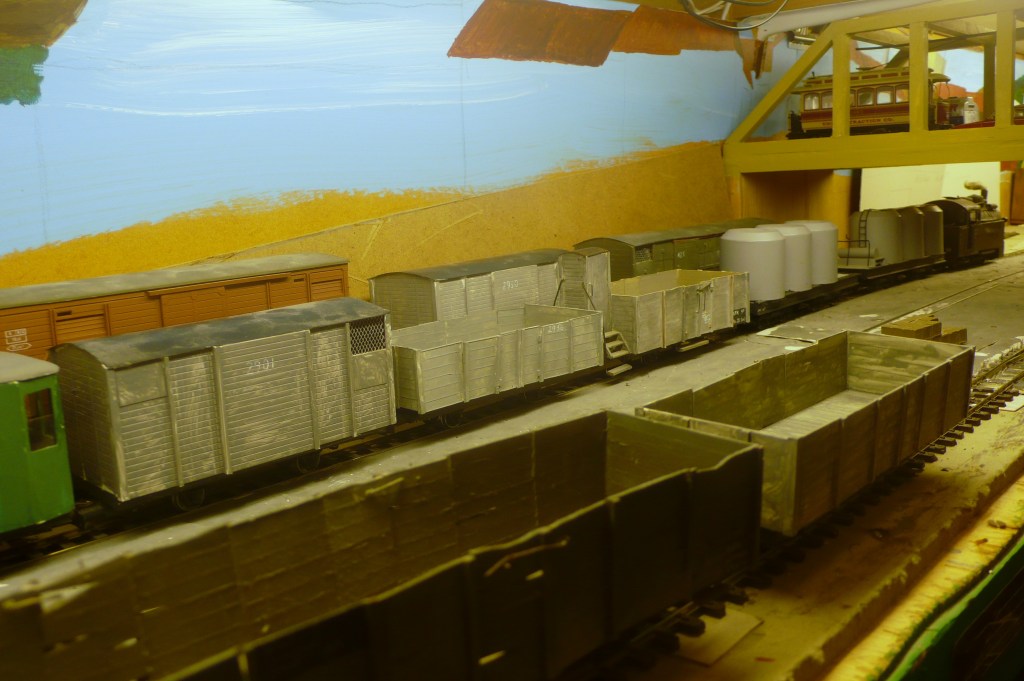
14-168. The Magasoromban goods, this being the Marronĝacan for Altingablecaŭtoj, has been reformed at Urteno, with the help of the pilot. The five vehicles, equivalent to 120 tons, are within the load limit for the 0-10-0T. It looks as though a trip working will be needed later this evening to take wagons to the colliery. The train is now over half an hour late and attempts to discover the whereabouts of the Narnian connection for the mixto have failed dismally. The Incompetent Talking Mouse could hardly be expected to answer the phone could he?! Control reluctantly orders the train to wait for the mixto to arrive. The lord knows when it will get to Fenditavalat.
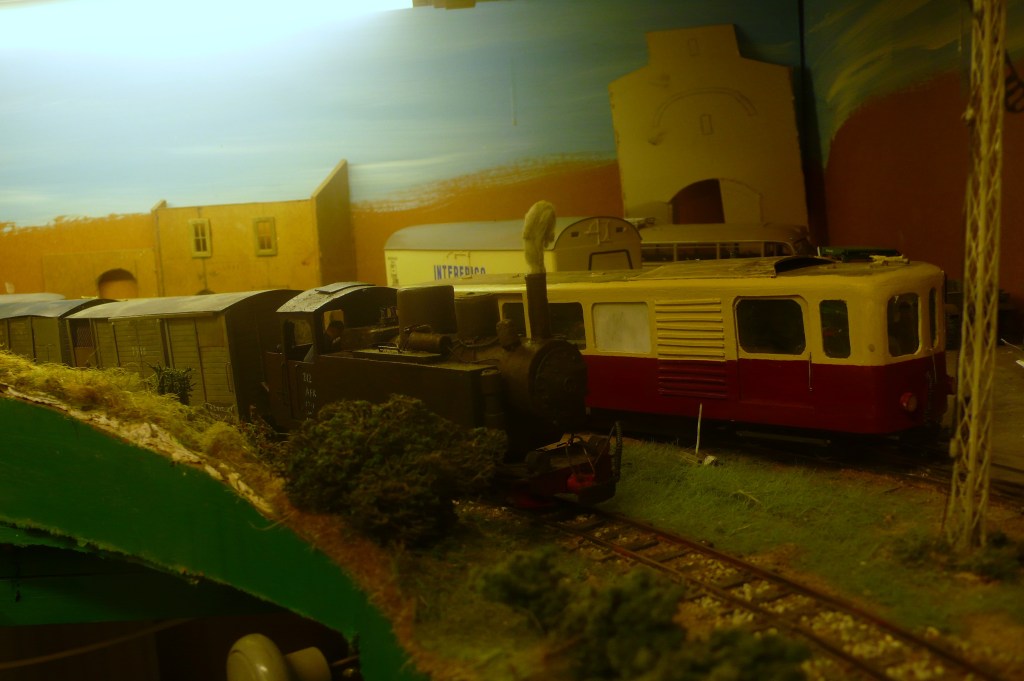
14-169. The up evening railcar uses the loop nearest the station at Glissent whilst the fish special stands on the mainline. The railcar, providing the connecting service for Eromarbordo, is standing behind the freight.
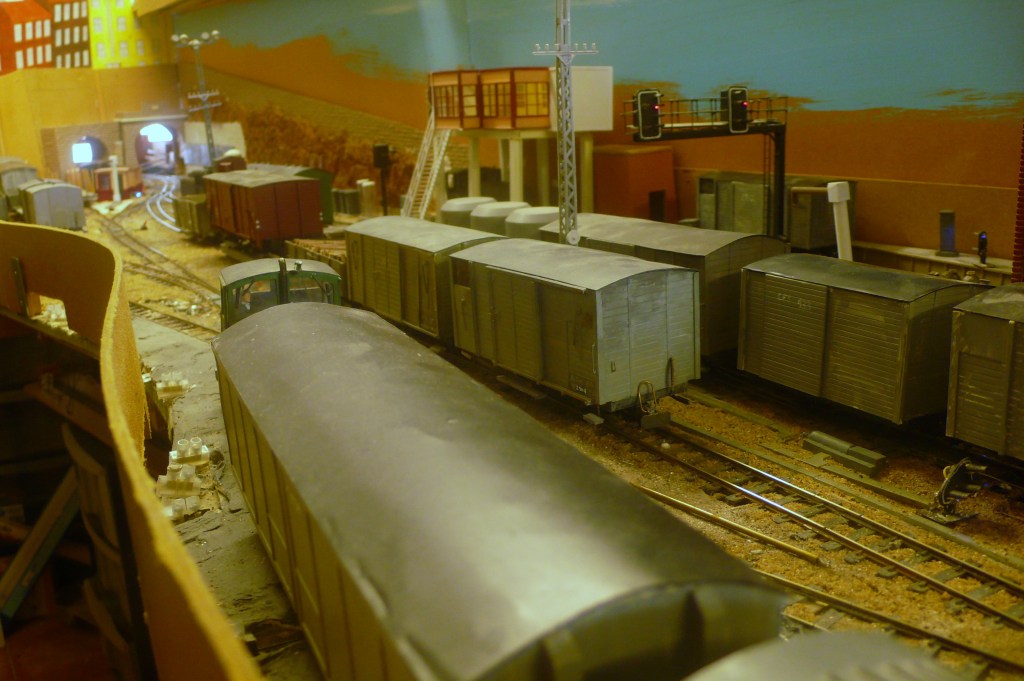
14-170. I try to avoid too many photographs of Gasafabrikatastrato yard because they all look similar. To the uninitiated it is just a bank of sidings filled with wagons. This photo does illustrate the problems with keeping the yard fluid. It has been a busy afternoon and no time has been found to deal with the wagons in the central loop. The main reception loop is occupied by the Relforka goods, which stands here for some time. The up local goods is “standing on the mainline waiting entry to the yard”. In effect it is doing no such thing as it has not left Boursson yet and, because of the short run on the model, it will not do so until the Lacono shunting is finished. ‘Sisyphus’ is about to cross to the chocolate factory to carry out the evening shunt.
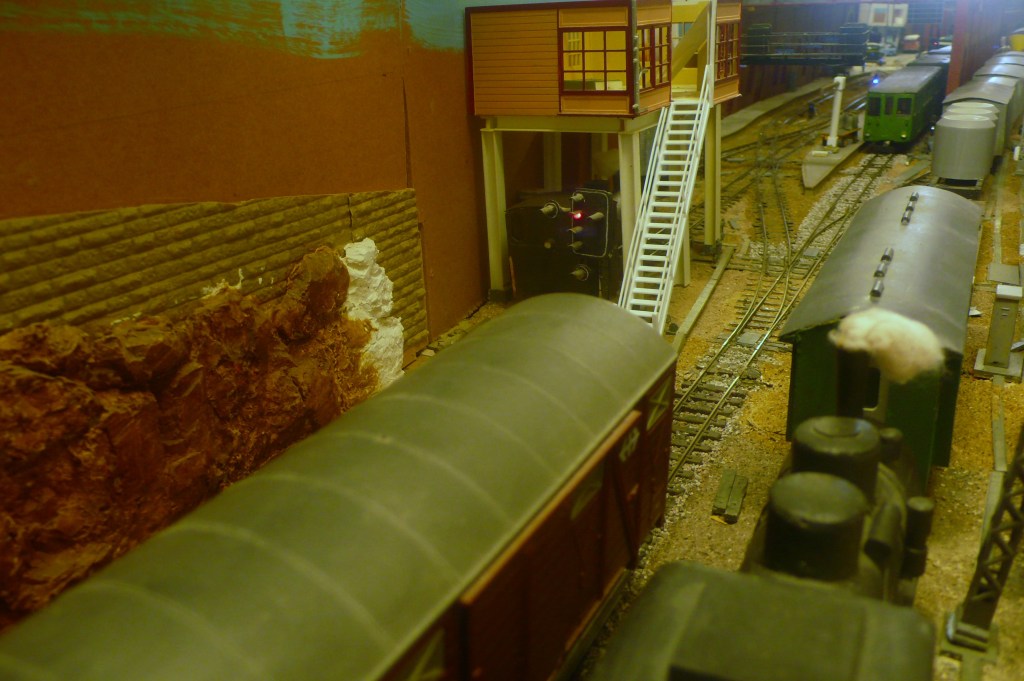
14-171. A few minutes later the Carrodantis shunt, named for the chocolate factory, is held at signal C, on the left. The route is clear to the factory but the railcar is pulling into platform 3 and the shunt is held to provide the overlap. The locking will not allow signal C to come off when a train is signalled into Cittavecchia from the north. In reality, as with nearly all models the overlap is too short and there is no locking but it is the principle that counts. Contrary to appearances the 0-8-0 is still attached to its train in the reception siding. The first vehicle is the bogie well wagon.
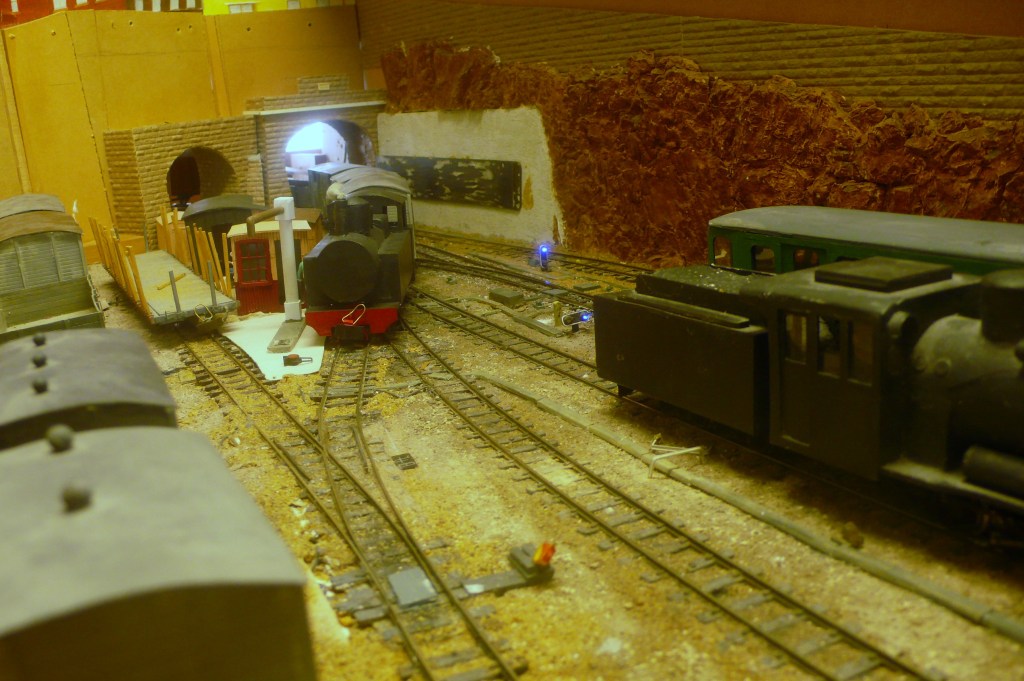
14-172. The incoming Kasatritikakamaparoj goods is stopped beside the yard office to receive instructions as it is going on safari. These amount to, “proceed very slowly to the clear north end loop and check that all the points are set correctly.” I suspect that the loco’s wheels are not quite pushed out to the AFK standards which might account for the stalls. The AFK wheels are set slightly wider than normal so that the check rails and point knuckles are tighter. That is the theory anyway. AFK pointwork pays nominal homage to gauge integrity at the best of times. This would cause problems with visiting engines if any were presented to run on the layout. I suppose that the stock on all large home layouts is tailored to fit the track.
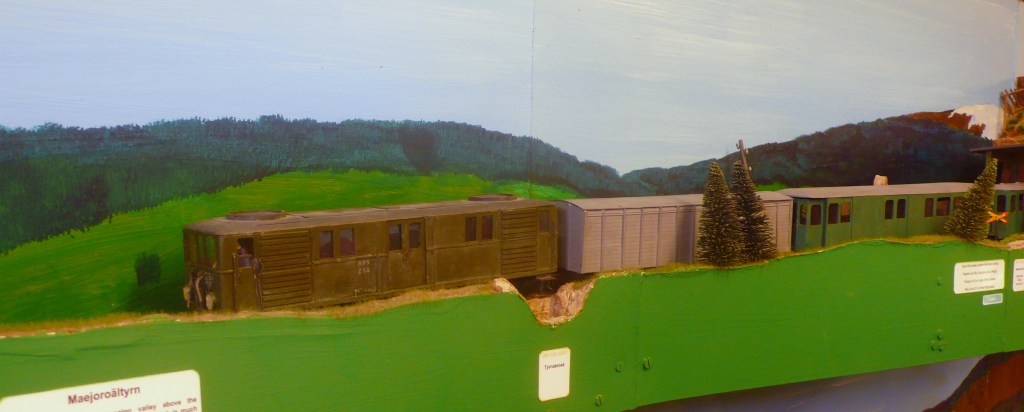
14-173. Much of the operating time is effectively spent on shunting so it is nice to let trains stretch their legs occasionally. The mixto is crossing the Maejorältyrn, the hanging valley above the Spelcia valley in Rolnth canton. In reality this amounts to little more than the length of the train but I am grateful for this as it is more than many modellers can dream of. The valley has its own microclimate due to the winds rushing down from the Helcaraxë Pass and is well known for snow lying longer than elsewhere. A year round patch can just be seen above the snow shed beside the level crossing.
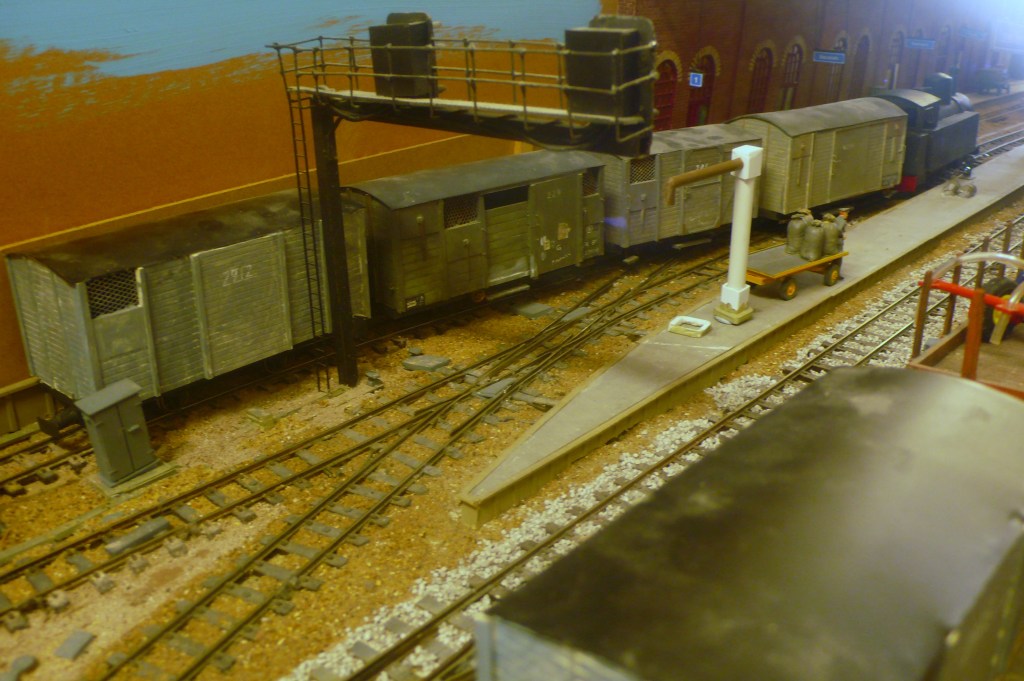
14-174. The loco from the KTT goods is suborned to shunt the Boursson cattle wagons across to the horse landing. The van standing there has been cleaned after unloading but it needs removing which adds to the complications. Avoiding such additional chores was one reason, of course, why the crew wanted an early start from Glissent earlier in the afternoon.
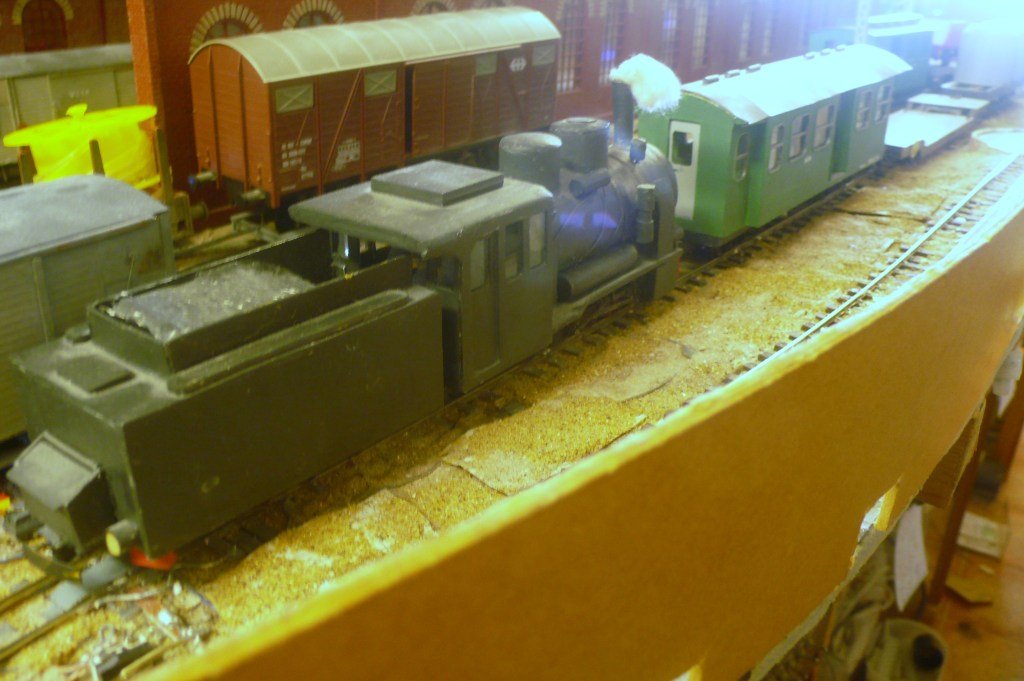
14-175. Deep in the yard the crew of the FDV-RFK goods are similarly obliged to carry out some shunting. Normally Sisyphus takes charge but the pilot is across at the chocolate factory. A couple of road vans from the CFS have been left at the goods shed and the empty trolley is being moved to the rear of the train.
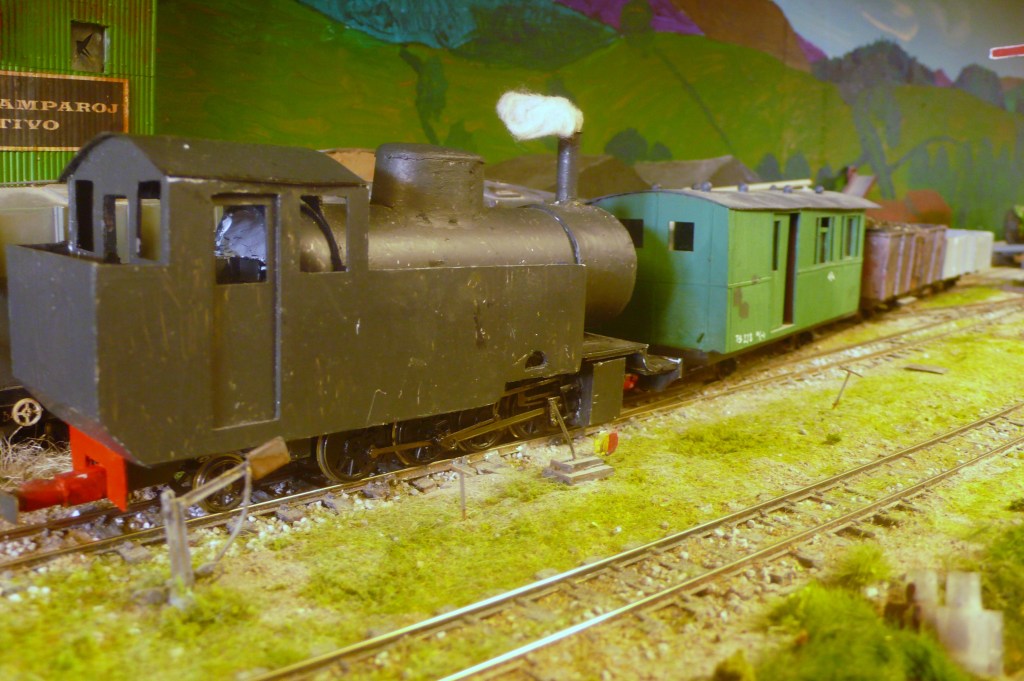
14-176. The Kasatritikakamparoj goods has dropped an empty hopper at the Co-op, behind the loco, and is remarshalling its train to shunt Sojonno, the next station down the line. There is no outgoing traffic from Boursson tonight which is unusual. There might be problems, however, because the fish train needs a path and this train needs to shunt Sojonno which could impact on the mixto’s running. It is about time that Nerv Control, or, Heaven forbid, Beruna, rang through with some info as to the connecting trains’ whereabouts. Pigs might also fly!
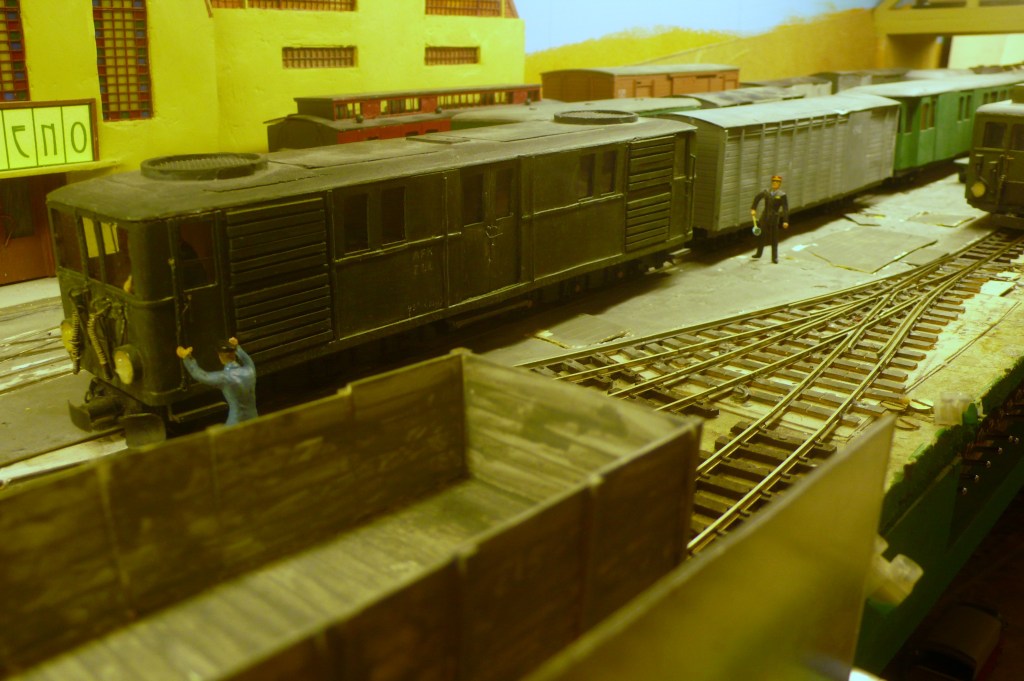
14-177. The mixto rolls into Urteno, still 5 minutes down due to the delay at Ospicio. The driver climbs down from the cab for a quick stretch during the short halt, only to be told by the staciaĉefo that no-one on the AFK knows anything about the running of the connecting Narnian services. The Incompetent Talking Mouse in Beruna is supposed to have informed Nerv Control, by 18.45 at the very latest, of the train’s running and Nerv should pass the information on to Lacono by 19.00. Nerv must have some idea of what is happening because FT train 11017, which carries the through couchettes and sleepers, is booked to leave Gascari at 19.27. Nerv has to co-ordinate with Carbelona Control and the main Control centre in Sarip, however, and Lacono is low down the list of priorities, let alone the ‘outback’ such as Urteno.
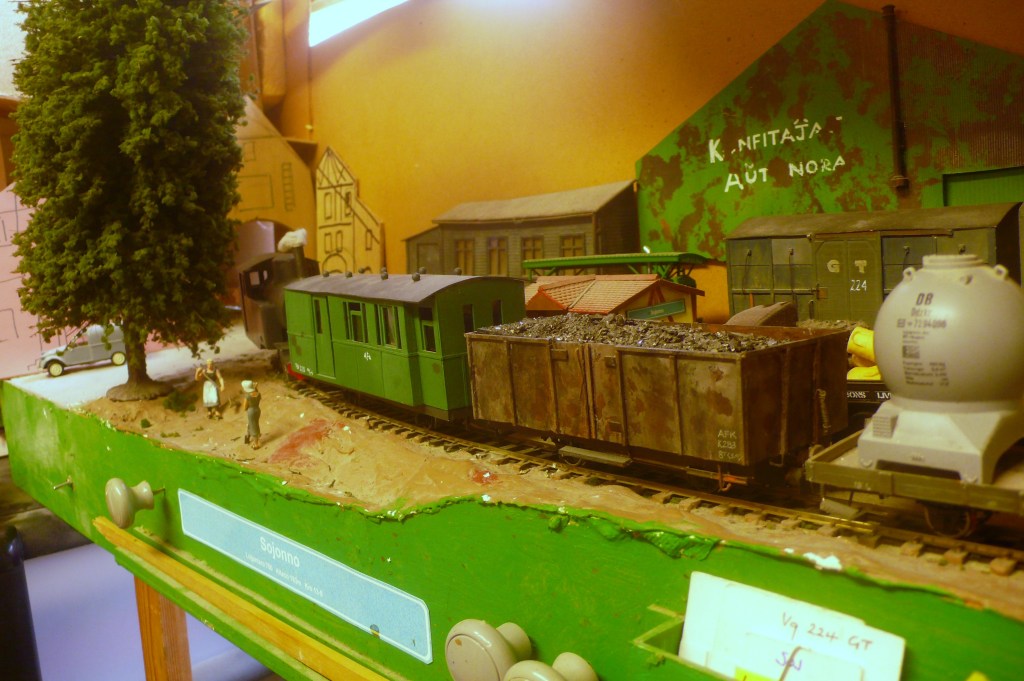
14-178. Decisions have to be made, however, to keep the AFK functioning. Control decides that the KTT goods should have priority over the fish traffic, for which alternative arrangements are now being made. The KTT goods does not directly impact onto the mixto’s timings but it affects other trains which do. The train arrives at Sojono to find that the peasant women are still digging, blissfully unaware of the railway’s dilemmas.
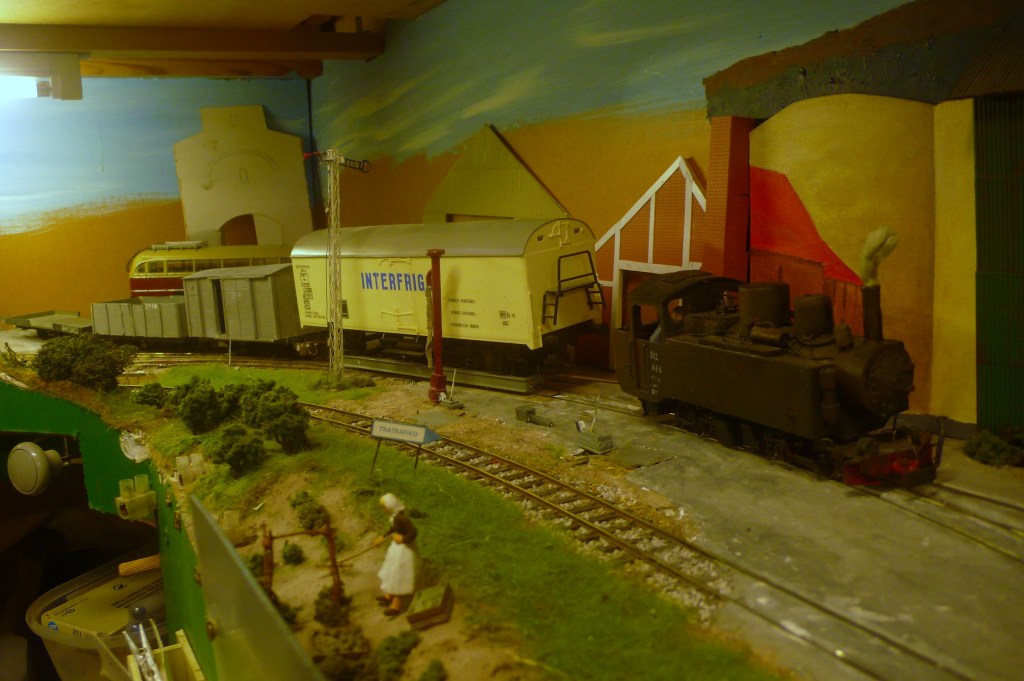
14-179. Control rings through to Ovidia, the staciaĉefino at Glissent, with plan B. The scheduled fish special is now annulled and the Eromarbordo goods is instructed to collect the empty NG wagons and SG fish van to run to Relforka as quickly as possible. The Meyer is pulling these vehicles from the glassworks lead, which is open staging in effect.
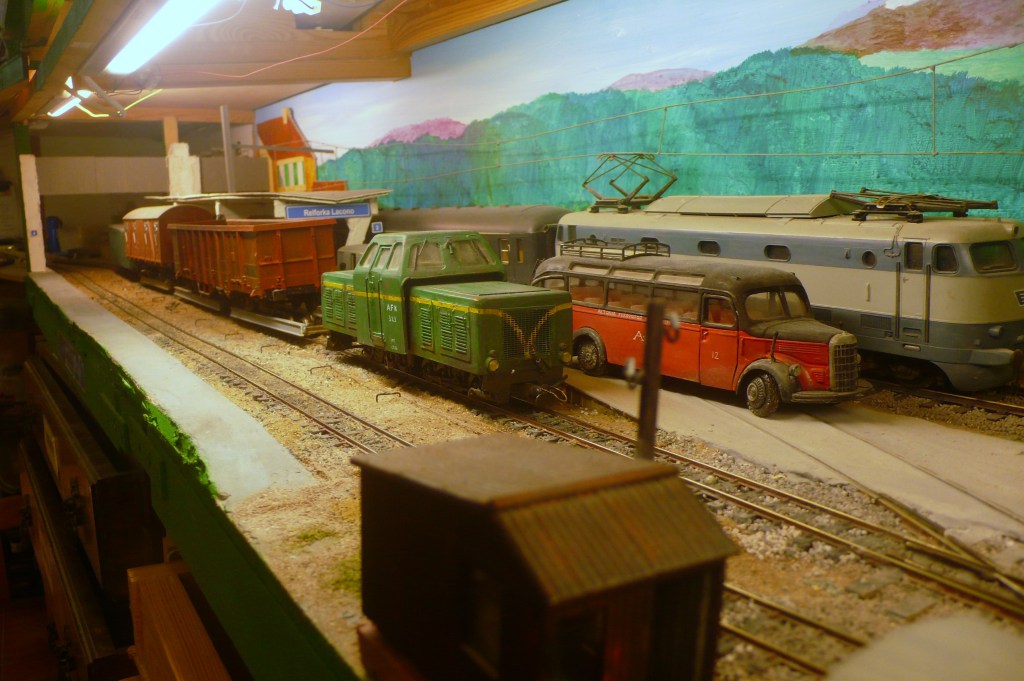
14-180. The fly in the ointment for Lacono control is the evening goods scheduled out of Relforka at 19.10, immediately after the branch goods arrives. The train was added to the timetable years ago, well before I began documenting sessions, to bring in SG wagons to where they were needed on the system. This train should cross the mixto at Boursson but, as this is a busy time for freight, there is no capacity to loop it at Glissent should anything go wrong. Once it is out Control is committed irrespective of how much time accrues against the mixto. Of course, if it is known that the connecting service is late, the mixto is normally held at Boursson, if needed. The freight is not a priority and is today formed of coal for Lacono gasworks, simply to top up reserves during the summer, and an empty van for paper traffic.
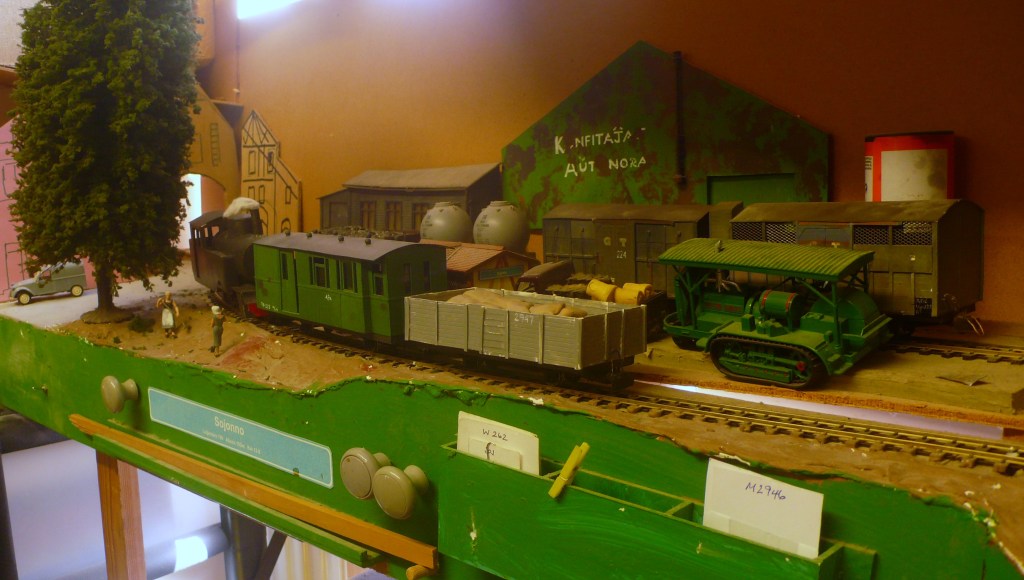
14-181. The KTT local has finished shunting Sojonno by 19.20 and is about to leave, with its one wagon, on time. Shunting time is restricted here if the up evening goods runs on schedule. The small factory at this wayside station is full of wagons and the works shunter will have its work cut out to re-arrange them, using the turntable to access the factory building, into the required order. The shunter, still awaiting weathering, is a brute of a thing, much more suited to the task than its puny predecessor.
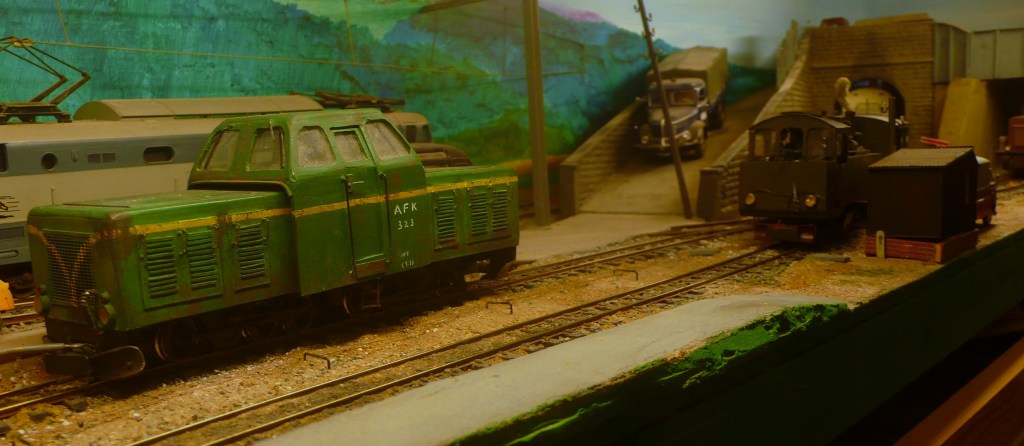
14-182. Inevitably, in the circumstances, the up goods is held for the branch service. This arrives in Relforka at 19.27, roughly the time that the up train should arrive at Glissent. By this stage in the proceedings news filters through that the Talking Mouse has allowed the Narnian connection to run over one hour late leaving Control with a free hand for delay attribution. If he had bothered to ring through in time a lot of trouble could have been avoided.
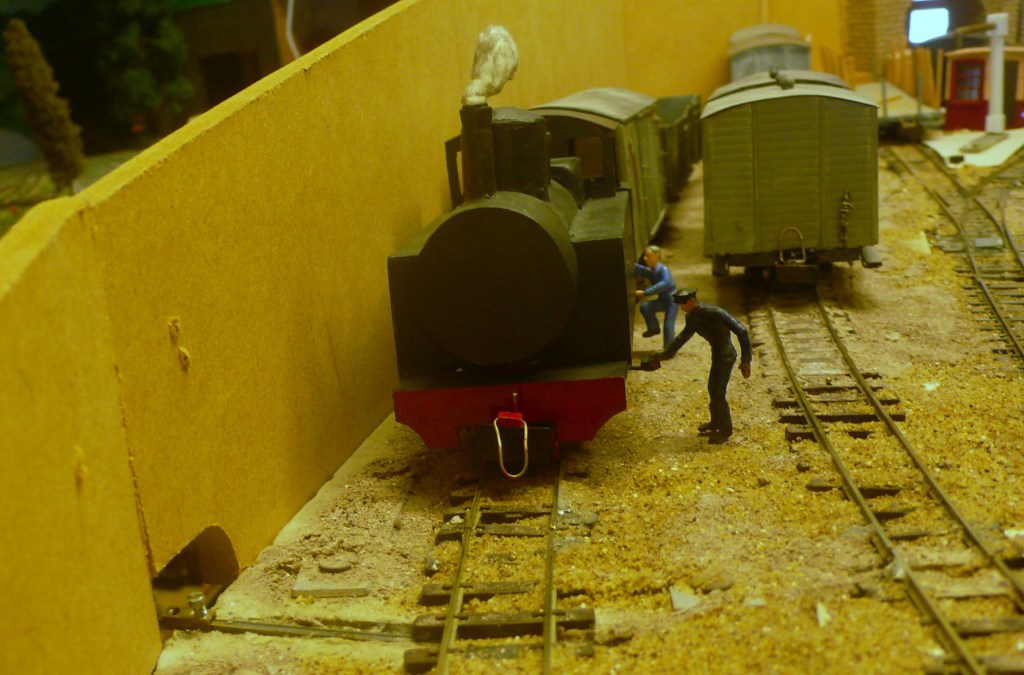
14-183. The loco from the up Kasatritikakamparoj goods has finished shunting the vans of pigs and has pulled into Gasafabrikatastrato sidings. The footplatemen are being relieved by a scratch crew, who will work a Danulbo trip when traffic dies down. A fair amount of shunting will still be needed to form the train as the new crew oil round and generally check over the loco.
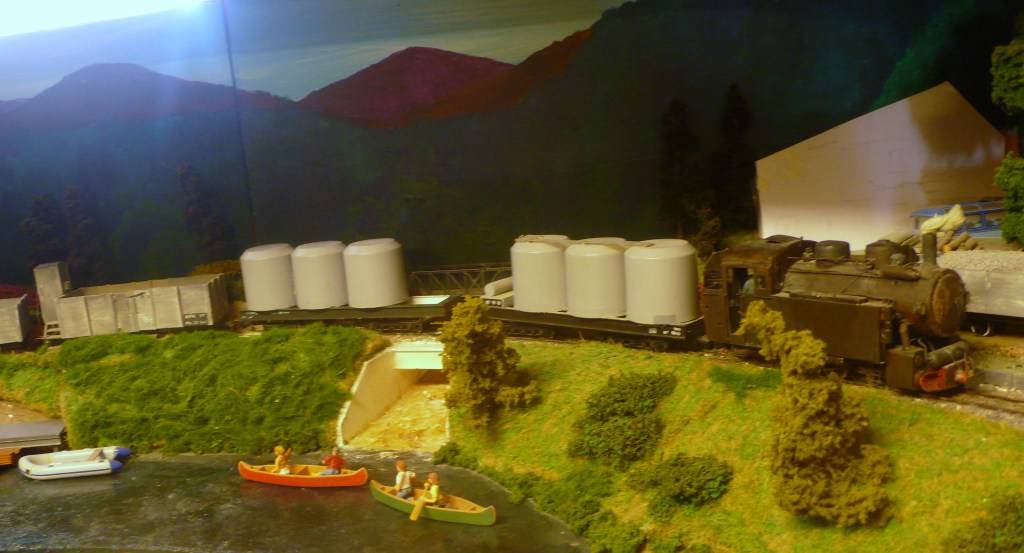
14-184. The Magasoromban evening goods finally gets underway, over an hour behind time. It was forced to wait at Urteno for the mixto, before the lateness of the Narnian connections was known. It is pulling steadily up the vulpafaŭkangulo with a full load. The coal wagons will have to come up the hill on a later working.
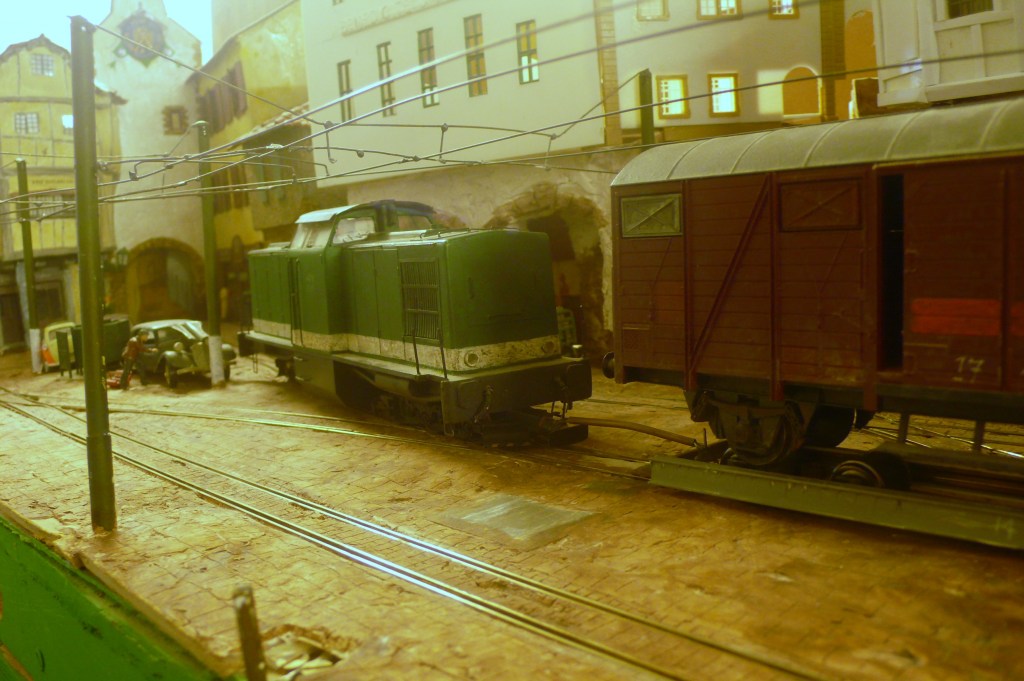
14-185. The long distance RFK-FDV goods pulls into the Basabazaro at Fenditavalat in the early evening. The SG van will be reversed into the yard and the crew will take the loco and van down to Rivabordo to finish their day. The blanks for the SG buffers clearly show that the Co-Co was once a SG loco before conversion.
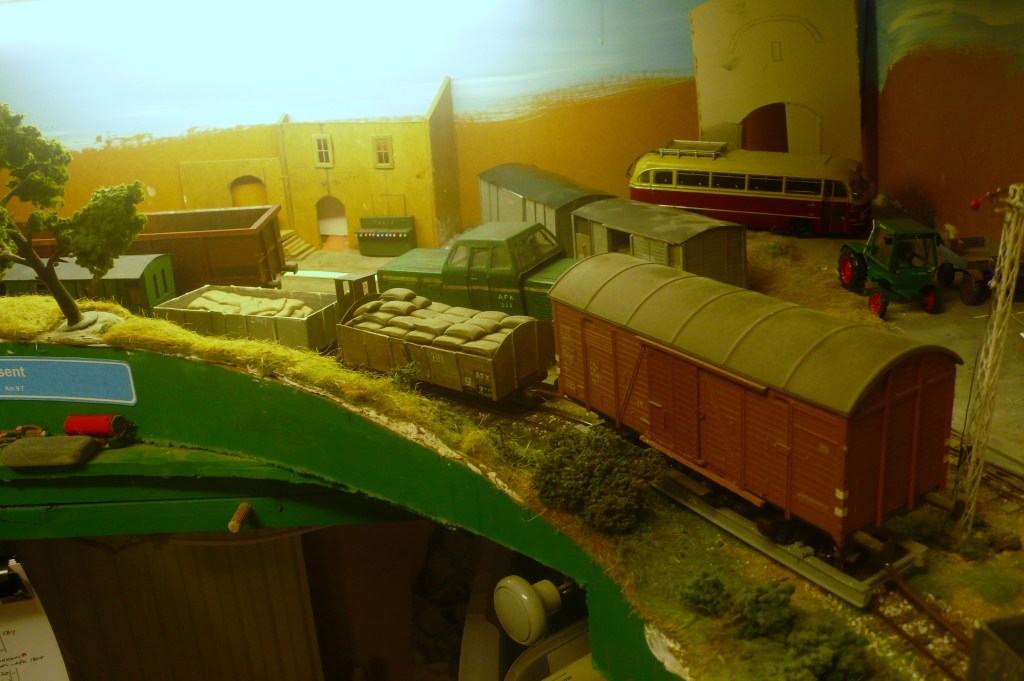
14-186. The local goods has finished shunting Breĉo de Glissent and stands on the mainline. A load of carrots in the second open and a SG van of strawberries fill out the tonnage. Both these seasonal crops can only be represented by a token gesture on the layout but they help to establish an individual flavour for each session. The evening goods, on the loop, has been let out from Relforka. It will pick up the fish vans, in the siding behind the loco, and take them to Boursson. This will leave the station without any wagons for tomorrow so it is likely that a later goods will make a special stop here with some replacements.
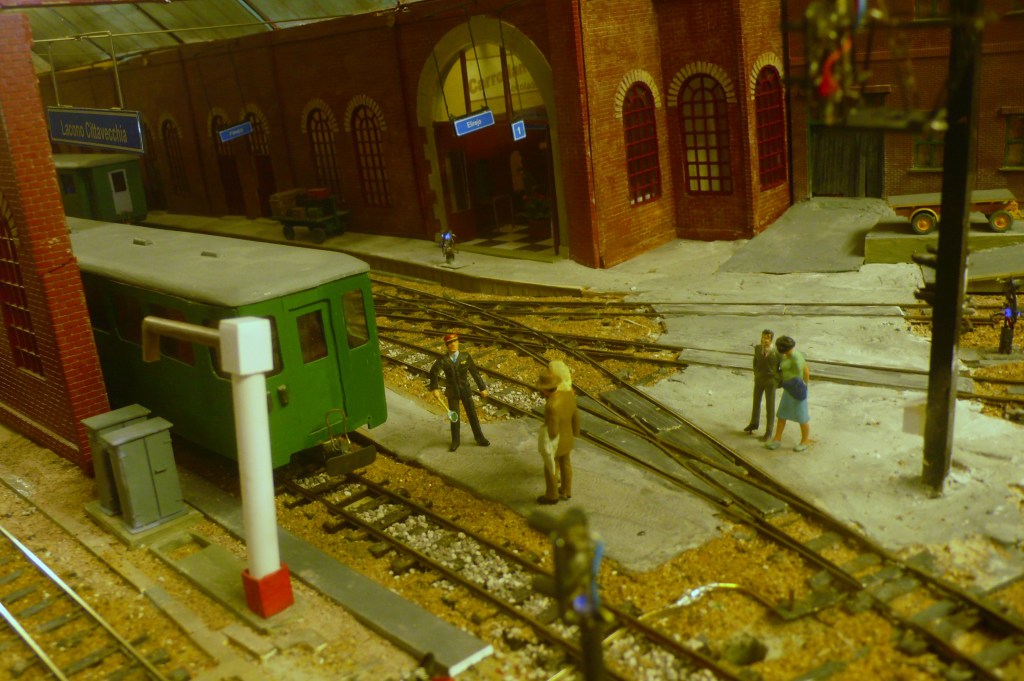
14-187. The entitled politicians are not impressed that their train is 5 minutes late in arriving at Lacono. Demopho, the Cittavecchia staciaĉefo, accordingly takes great delight in telling them that their train is likely to be held in a wayside station whilst a freight train takes priority, due to the Narnian Railway’s incompetence. Let’s hear it for the mouse!

14-189. The evening goods has pulled forward, at Glissent, so that the fish vans are coupled onto the rear of the train. This will make it easier to shunt them into the factory at Boursson. The trajnaĉefo is about to couple the NG vehicles to the SG transporters using the pole.
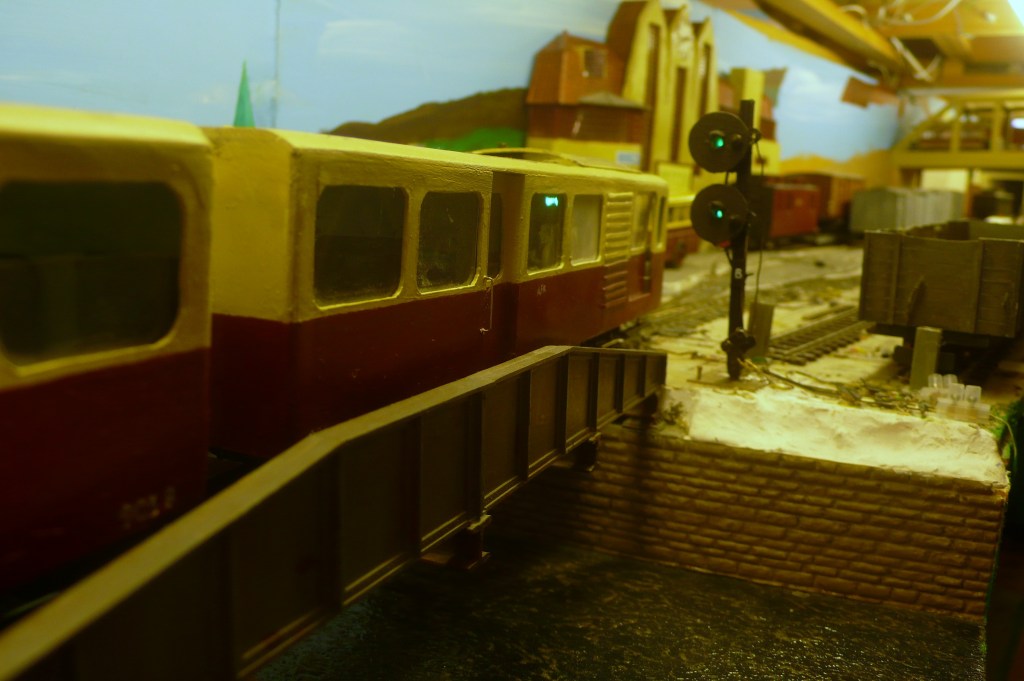
14-190. The RFK-FDV railcar sees green over green indicating that it is signalled into the “goods loop” at Urteno. The term is a loose designation as trains pull onto whatever road is convenient for traffic purposes and there is no strict allocation of platforms. The green aspect indicates caution, following French interwar practice where white indicates clear. The experienced regulars will be glad to see that the pilot is not attached to the TPO which suggests that there will be time for the traditional visit to the bar.
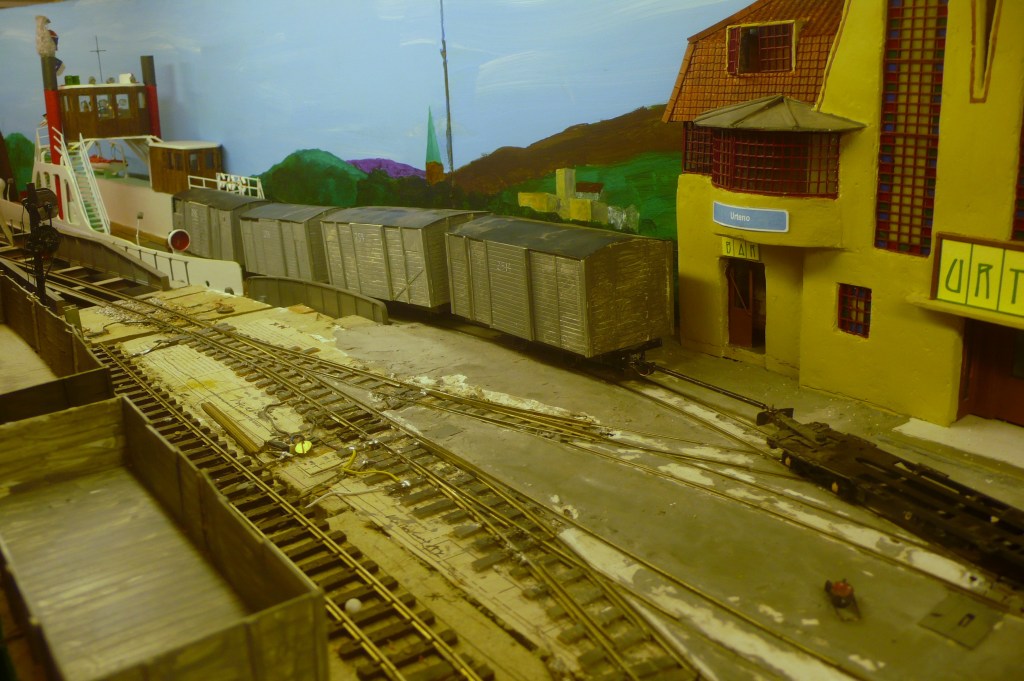
14-191. The unknown whereabouts of the Narnian connections caused the already late running Altingablecaŭtoj goods to be held at Urteno. This delayed the shunting of the ferry and the pilot gives this priority. The ferry has also been delayed. It is amazing how the ripples of late running spread across the network. There is plenty for the railway enthusiast to observe but the train’s regulars are, as usual, at the bar, which acts as unofficial “clubhouse”. The railcar cannot depart until the TPO has been attached and the wily regulars have schooled the staff to give plenty of warning before departure.
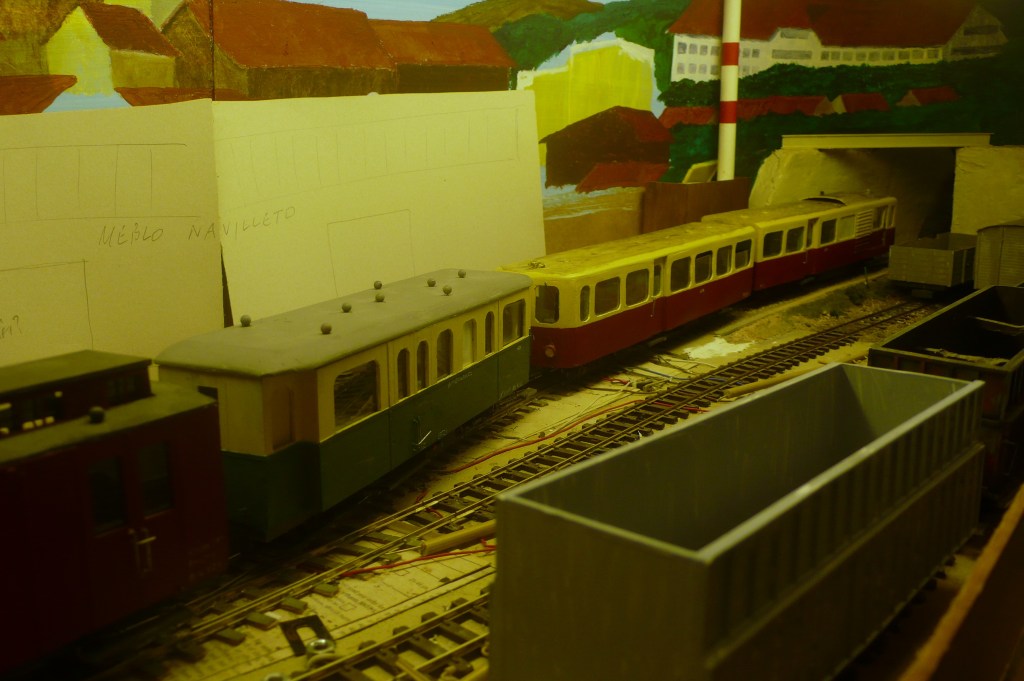
14-192. The railcar finally leaves at 20.20, 35 minutes behind the booked time, once the waifs and strays have been rounded up by the station staff. The coal sidings hold the hoppers for the trip working which will return them to the colliery.
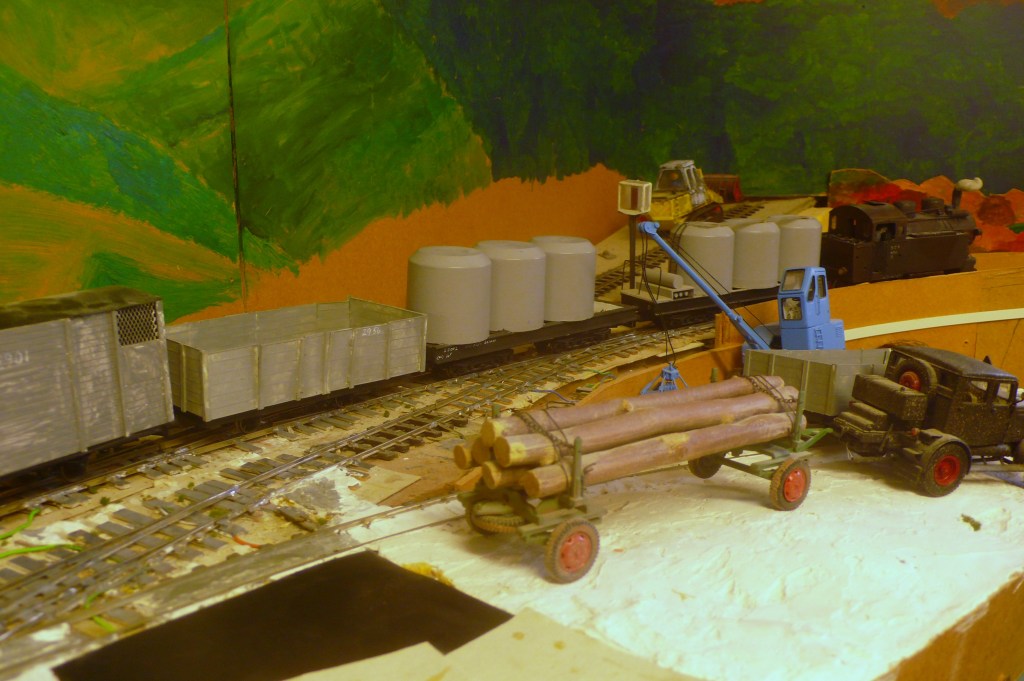
14-193. The evening goods has finished shunting Ithilarak and pulls out with the remaining wagons, most of which are empty.
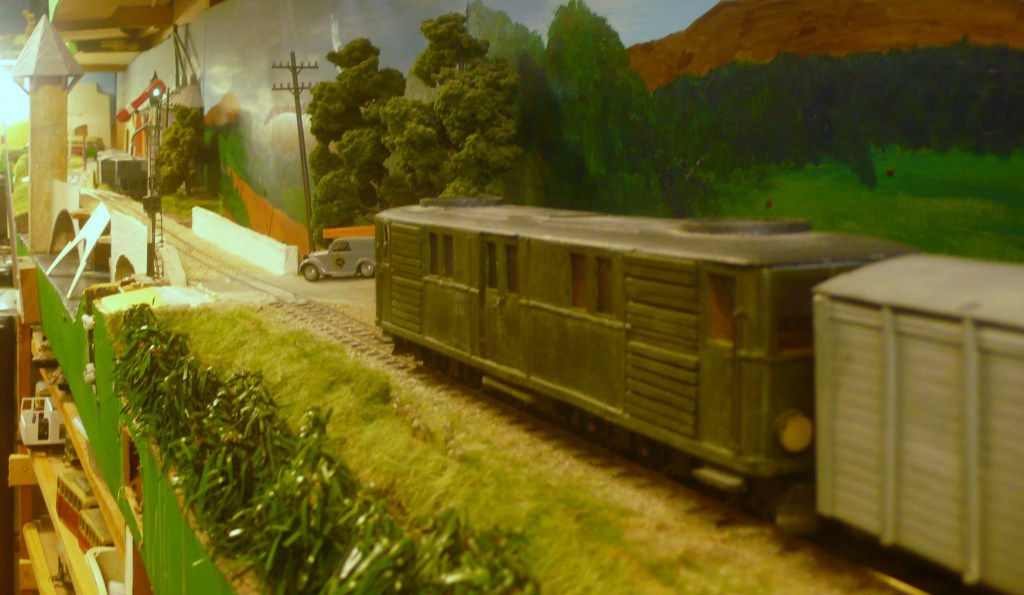
14-194. Contrary to what they were told the passengers on the mixto have not been delayed and the train approaches Glissent under clear signals. They will be able to avail themselves of the lavish facilities at Relforka as they await their delayed connection.
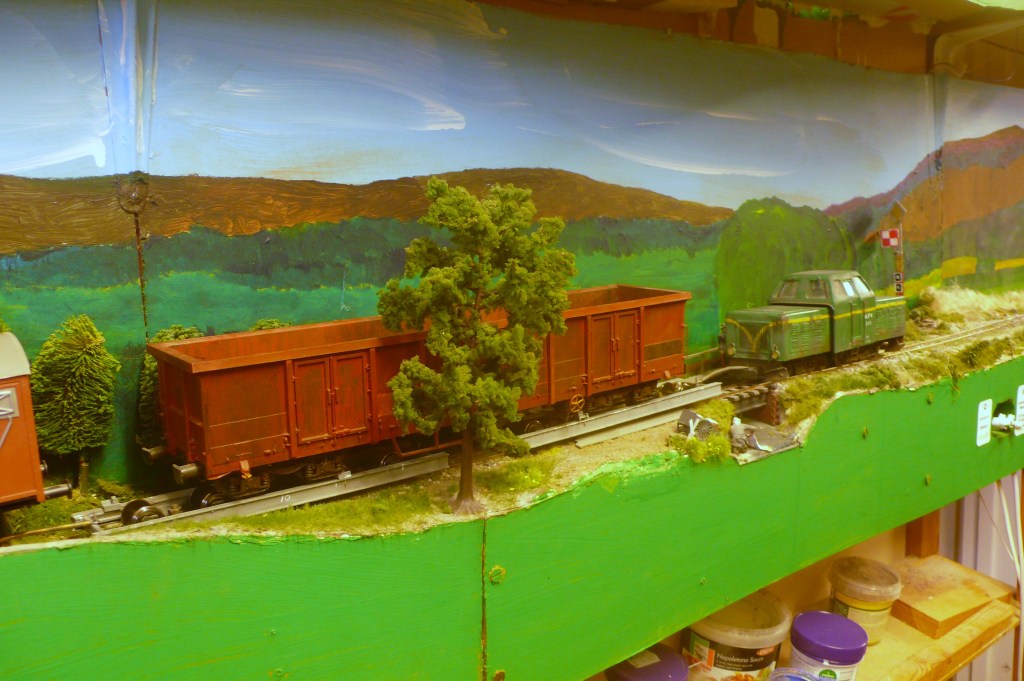
14-195. The up goods somewhat surprisingly gets checked at Boursson’s up home. Once it has stopped it is called forward to slowly enter the mainline. The down goods, which it is crossing, is too long to fit into the loop. Boursson is one of the shortest loops on the lower part of the system. The SG open should be full of coal, another thing to attend to.
NEW PHOTOS
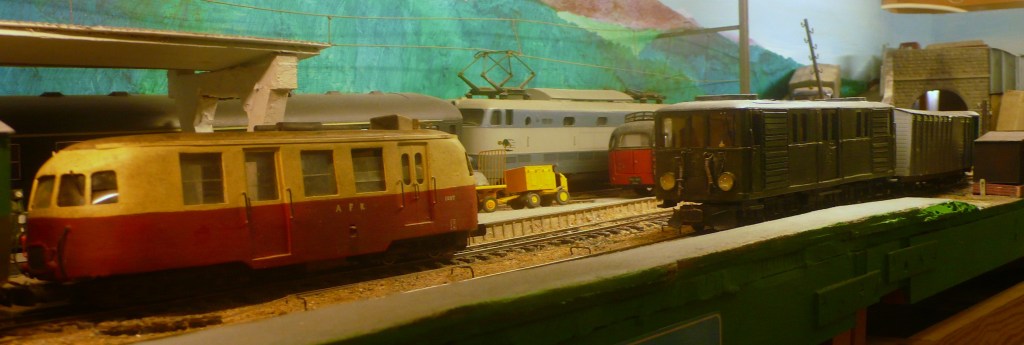
14-196. The mixto pulls into Relforka a couple of minutes late. This is somewhat ironic given all the problems that its almost punctual running has caused. There will be over an hour’s wait before the connecting train arrives. There are plenty of waiting rooms, bars and cafes in which to while away the interval and doubtlessly one or two politicians will be having “off the record” conversations. The Billard railcar is providing the last up service of the day and will terminate at Urteno. Fortunately there is not much demand for its services except for people from the connecting SG trains and between Lacono and Urteno. Lacono Control is scrambling to make use of the delay to put freight trains out early.
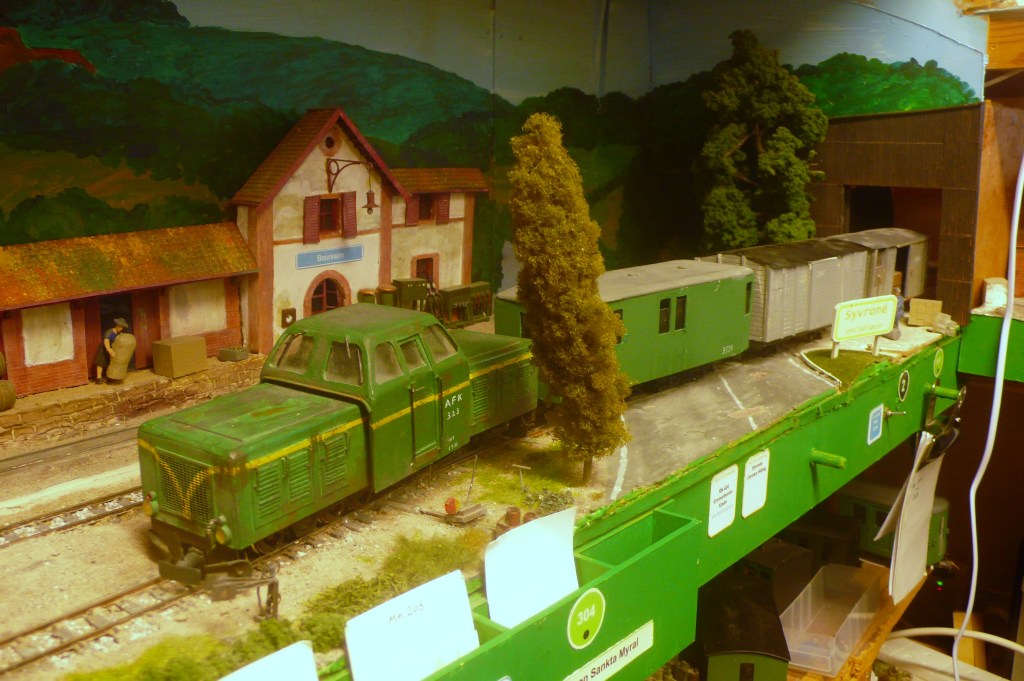
14-197. By this time in the evening the AFK is very freight orientated over the lower part of the line. It is around 21.00 when the up goods shoves the fish vans across the RN424 into the Syvrone cannery at Boursson. The fish will be placed into the refrigerated store for processing tomorrow. The diesel is slightly misfiring (i.e. it is stalling too often, even allowing for dirty track and the length of the session) and the crew have called ahead to Aspargo to request that a fitter has a look at it.
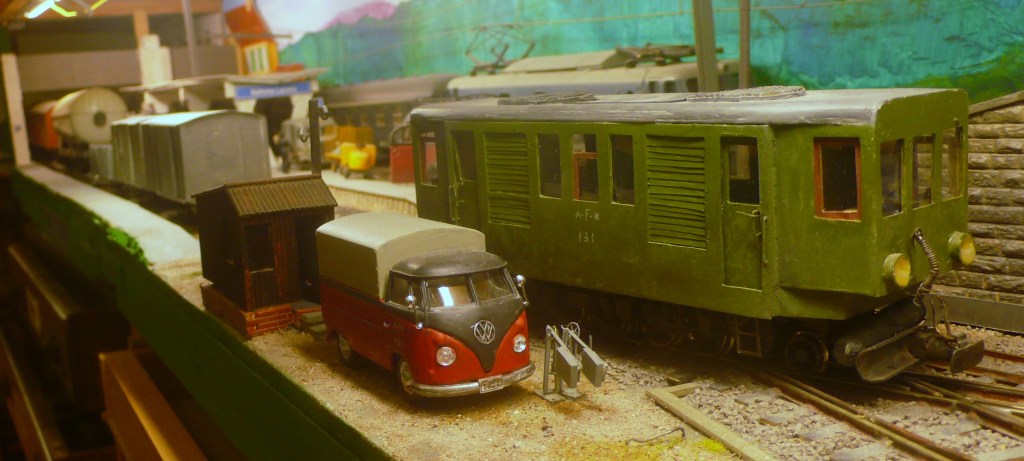
14-198. Control decides that, as the Urteno railcar will run over one hour late, they might as well let the “paper train” out early. There is currently no crew for this but the railcar driver is told to shut down the railcar and get into the cab of the asthmatic I-B-B-I that they have dug out for the job. The loads include a SG bogie tank of chlorine and a van of recycled paper behind the NG vehicles which are going to Glissent. The first wagon is the well wagon which caused problems “this morning”. It has been re-wheeled using some ancient parts dug out of the scrapbox. This technically puts the train over the limit for the first leg of the journey but a blind eye is being turned. The AFK approach to recalcitrant wagons is kill or cure. If the flat does not perform this time it is likely to end up in the bin.
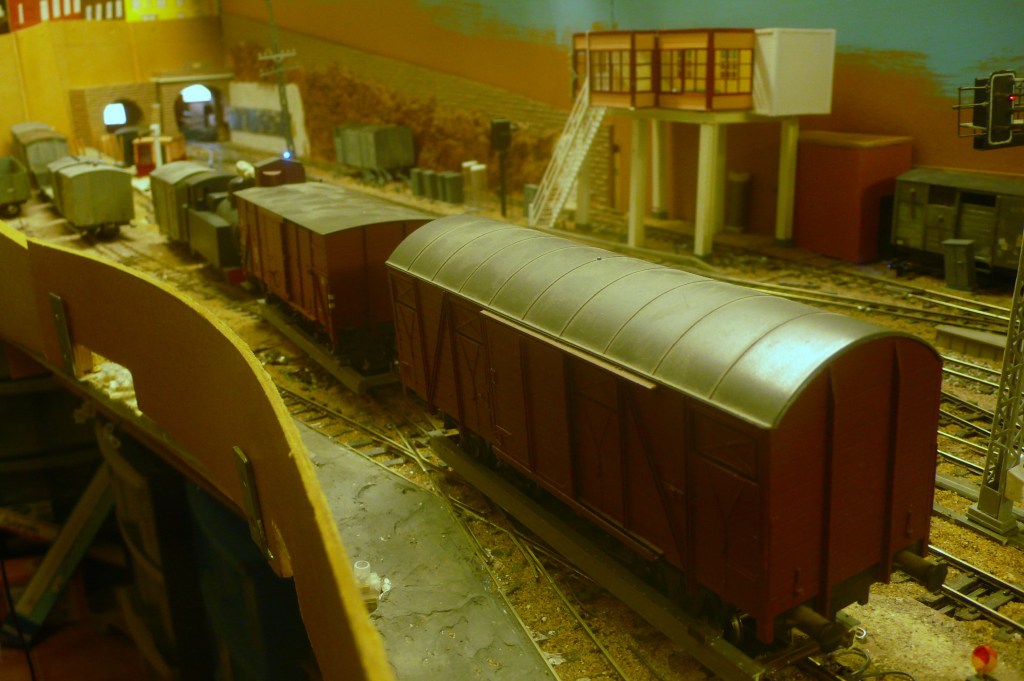
14-199. Lacono Gasafabrikatastrato is not under as much pressure as it was but the work continues as the 4-6-0T shuffles vans. The two SG examples might well be used as a buffer against future demands but Urteno is short of SG vans. The wily crew of the pilot has arranged to work the Danulbo trip and has cleared off into the industrial area. Of course no-one will quite know where they are and what they are up to giving them an ideal opportunity to swing the lead. They will get away with it unless they overdo it.
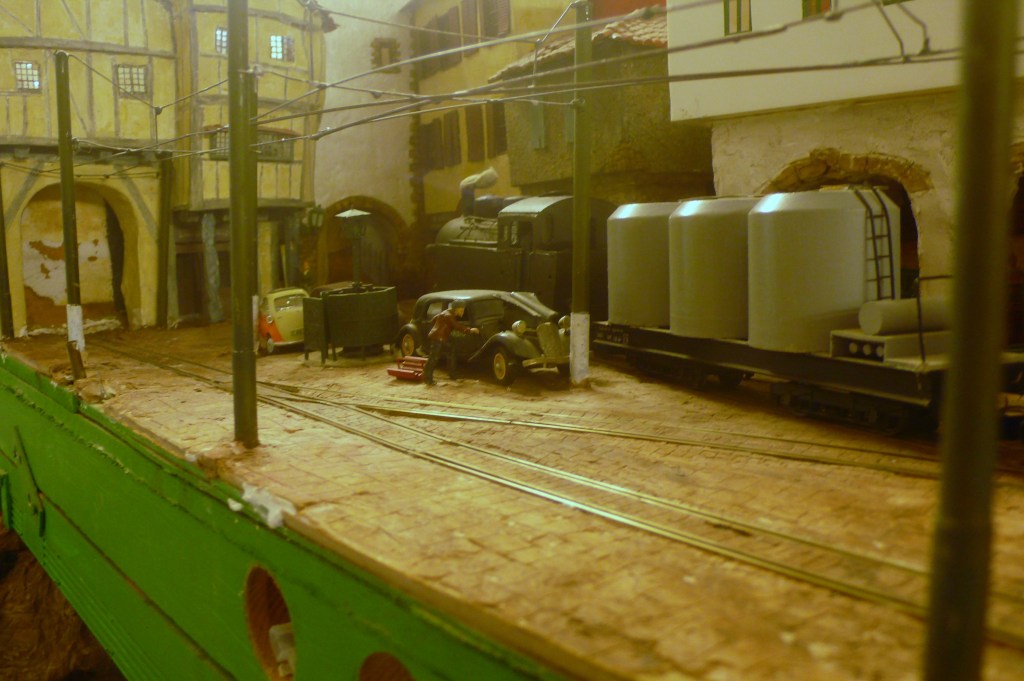
14-200. The High Reaches goods finally arrives at Fenditavalat, some time after 22.00. The city authorities, in effect the Scolari or University Senate, do not like too much shunting to take place at this time of night but the train needs to have the cement silos worked down to Rivabordo so there is no option. It certainly won’t upset the students as the cafes are teeming with night life and the table football league, and associated betting, is in full swing. Nevertheless the work will be done as quickly as possible, hopefully without running over any inebriated students!
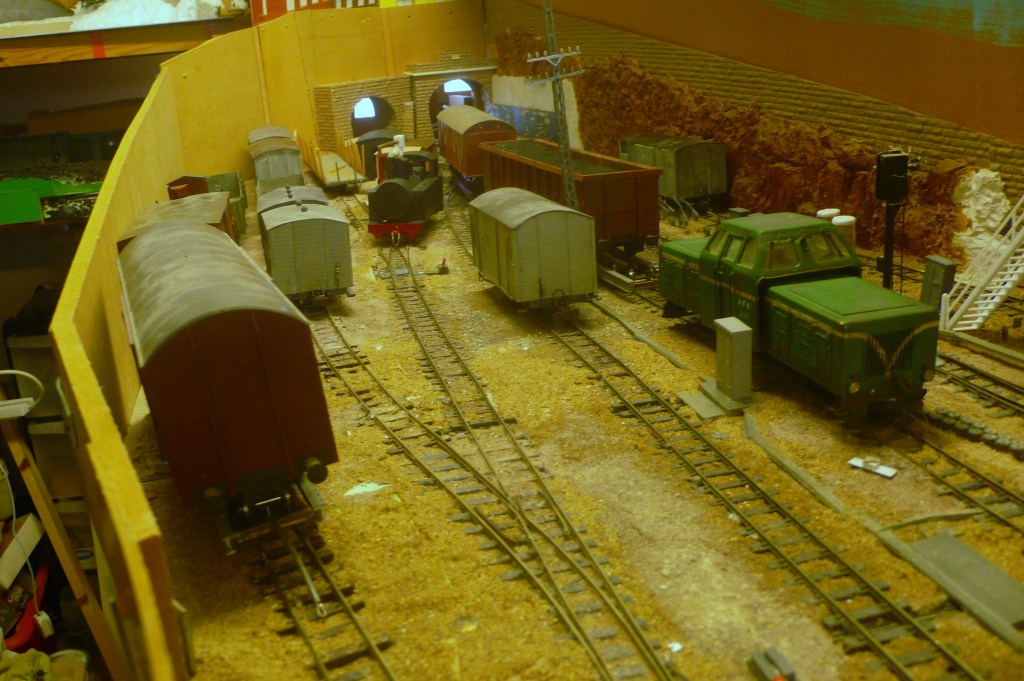
14-201. The evening goods pulls into Lacono. The eagle eyed will note that the bogie open has received the base for a coal load. The 4-6-0T is still shuffling vans and questions are starting to be asked about the whereabouts of the pilot.
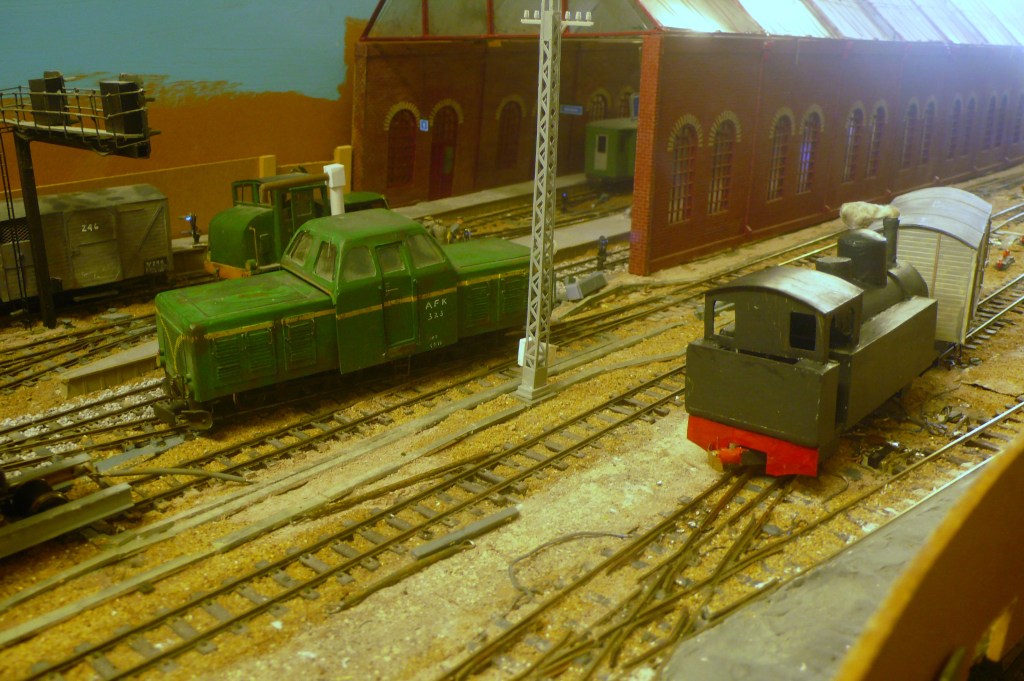
14-202. The changing of the guard. The pilot, in the background, has returned. The crew have judged it nicely. They had a 20 minute unscheduled break in the Danulbo, long enough, but not long enough for a serious inquiry to be necessary. The ailing train loco is going to the shed for minor attention and the 4-6-0T will put the van at the goods shed and then follow suit.

14-203. The Urteno pilot/banker is busy tonight. Authorised by Control to run as trip 9601 it pulls the maximum authorised load, 80 tons without a van, up the vulpafaŭkangulo. The bogie hoppers are “equivalent to 30 tons”. It looks as if there will be the need for another trip after this one to clear the coal empties. The prospect of overtime looms, to much rubbing of hands.
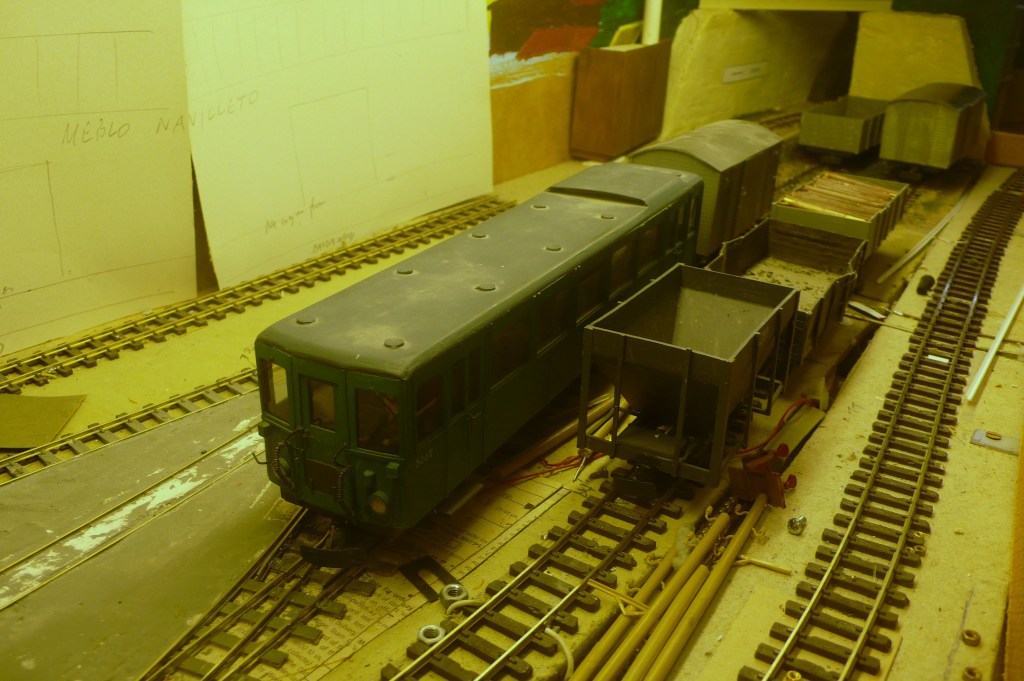
14-204. With the colliery trip out of the way the Urteno-Eromarbordo railcar backs down onto a van of beer in the coal sidings. It was discovered many years ago, well before photographic recording began, that this was the easiest way to get wagons from the brewery to the coast. Two empty coal wagons stand on the middle road waiting to return to the colliery and the pilot will eventually return to Lacono with the open wagon of cord wood. This is one of many areas on the layout that could do with development, especially as “stuff” from the workbench gets put here. One day!
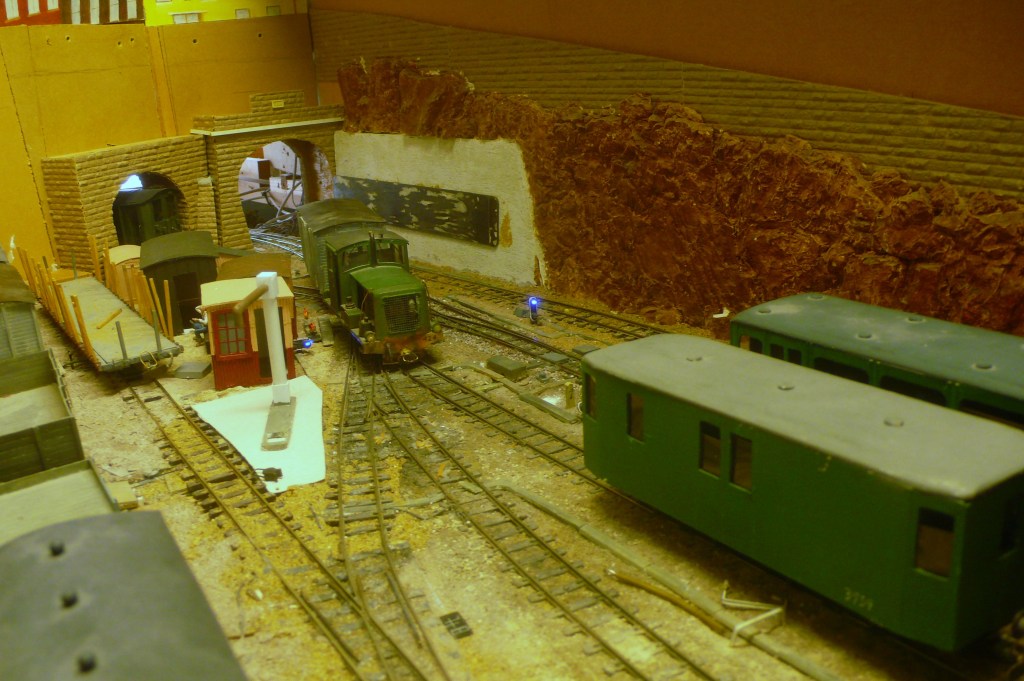
14-205. The evening is wearing on and the incessant shunting at Gasafabrikatastrato continues, now with the pilot back on duty. The last down passenger, the Urteno-Eromarbordo railcar, drops down to the dodd, hidden behind the brakevan, to wait as the pilot casually runs off the main into the yard. The relief crew have finally got away. In the tunnel, fresh from Aspargo, stands the I-D-I which will run forward with the evening goods to Urteno whilst the “croc” is looked at. This is its third diagram today but freight diesels are interchangeable unlike certain prima donnas.
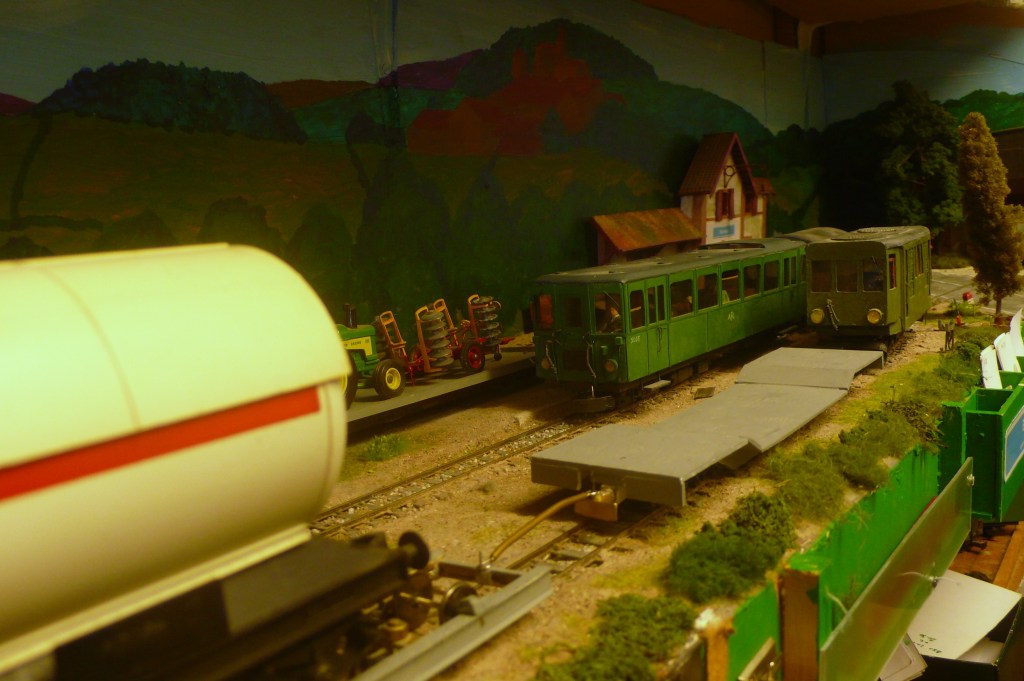
14-206. Some while later the railcar runs into Boursson to cross the paper train. The trialist flat is making a better impression this time around. Reminds me of the “Good old days” when A. Newman was a common name in Rugby League programmes! The “chlorine” tanker (a Lima petrol tanker in reality) is behind it.
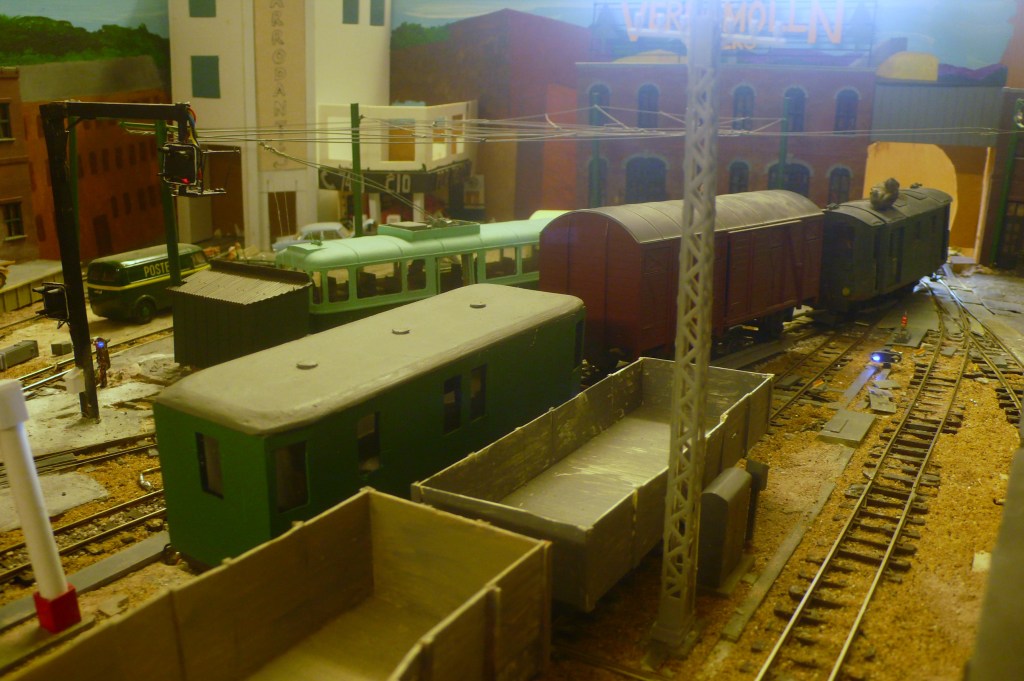
14-207. Having had an engine change, and left all its wagons behind, the Urteno train leaves Lacono for its destination with an empty SG van for the furniture factory.
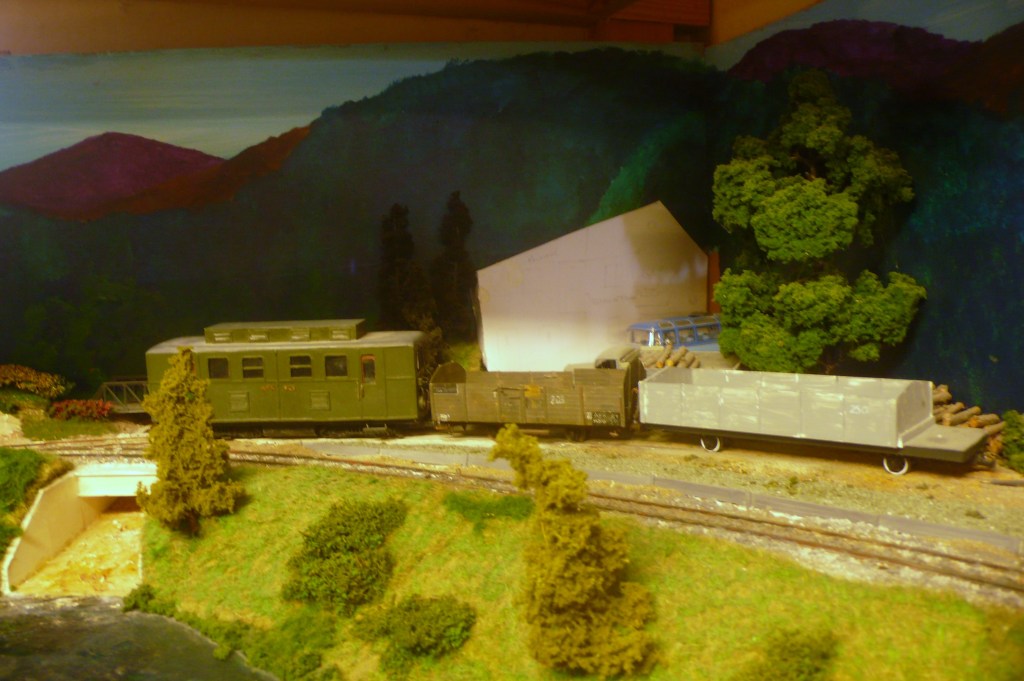
14-208. The pilot/banker has left the empty coal wagons at Ithilarak load out point and is returning down the vulpafaŭkangulo. It is reversing into Varden siding to pick up the now empty ballast wagon (at the rear in this picture). This is a self unloading wagon based on a RhB design. The deck pivoted and the sides swung loose as it was unloaded. This needs to go up the bank but the first problem is getting it out of this remote siding which is tricky to work. It cannot swap places with the open because shunting is restricted by the Rule Book on account of the steep grade.
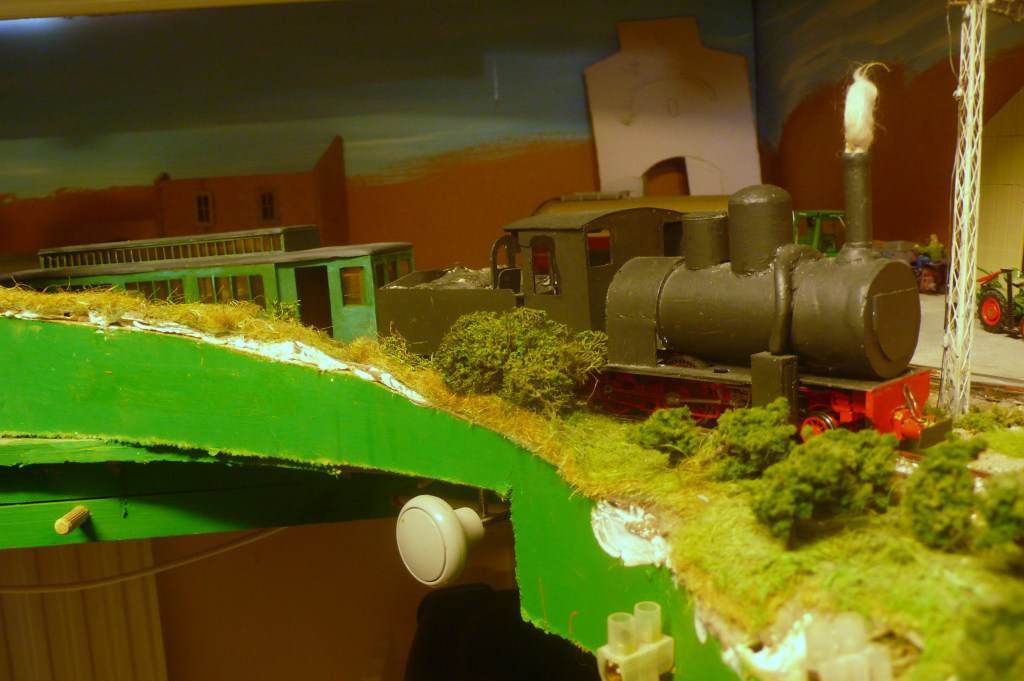
14-209. The seaside special waits at Breĉo de Glissent for the Eromarbordo railcar to arrive. The special is running in front of the delayed up railcar and will pick up what little custom there is at this time of night. A few of the scolari, from Lacono and Urteno, decide that there might be time to visit the renowned Orabarscho, the Golden Perch, and then catch the railcar. This brings back memories of late running trains at Beverley in the seventies. After listening to evensong at the Minster and visiting “Nelly’s”, a well known pub lit by gas mantles, I was advised by the station staff to go to the Telegraph as the last train was late. Good job I did not take this advice as it rolled in five minutes later.
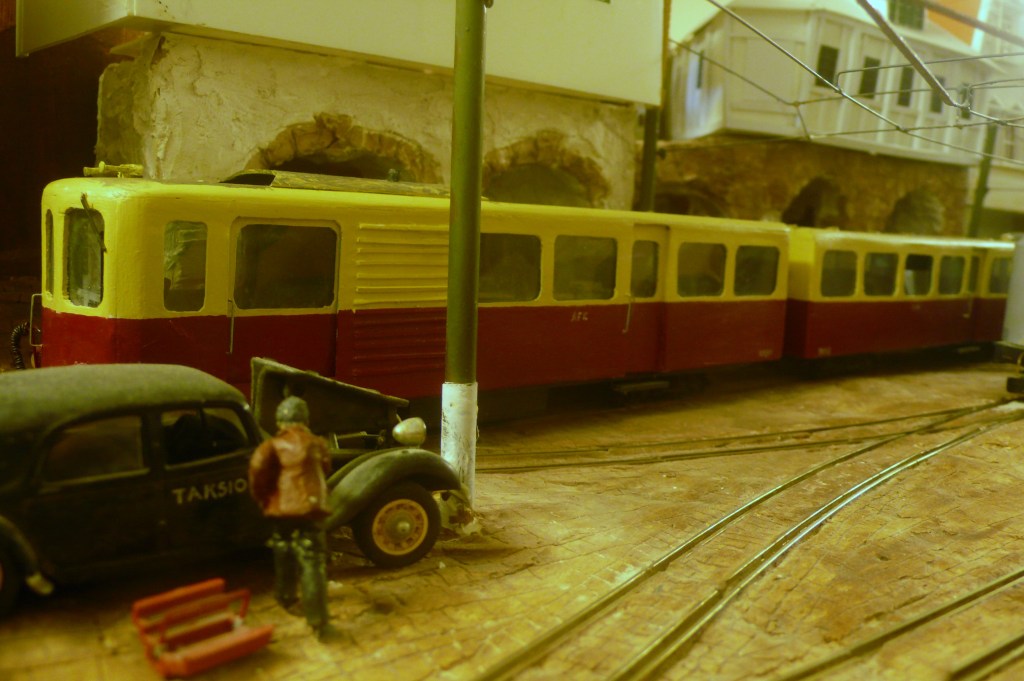
14-210. The last up railcar arrives at Fenditavalat just before 23.00, and rather later than advertised. It was held on the outskirts of the city because of shunting by the freight train. You might remember that this was held at Urteno for the mixto, which had to be kept on time. This is one ripple from the Talking Mouse at Beruna allowing Narnian connections to run late. Although he did not cause this particular problem, it could have been solved had Lacono Control been punctually advised of the hour delay.
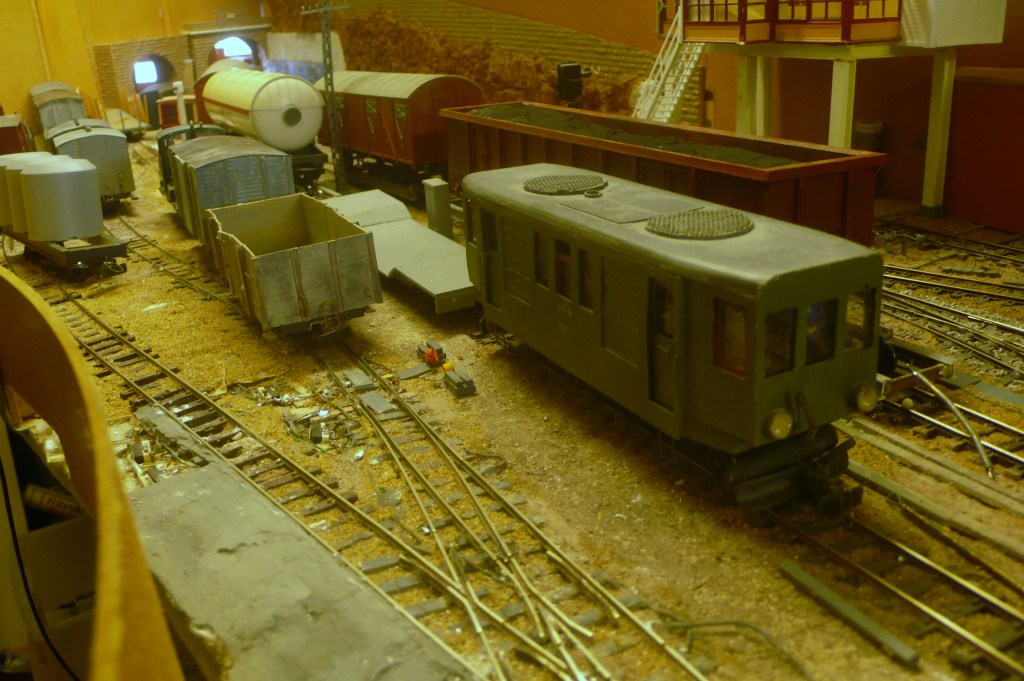
14-211. The paper train rolls into Gasafabrikatastrato 90 minutes early. The well wagon has behaved itself this time around and will go straight back to Relforka as there is not much likelihood of Lacono offering a suitable loading. The shunter is still going. It, or a substitute, have been in action for eighteen hours continuously and there is still plenty to do. The cement silo to the left has accidentally been left there and should be in a box below the lower level of the layout! It is amazing what you do not notice when taking photos.
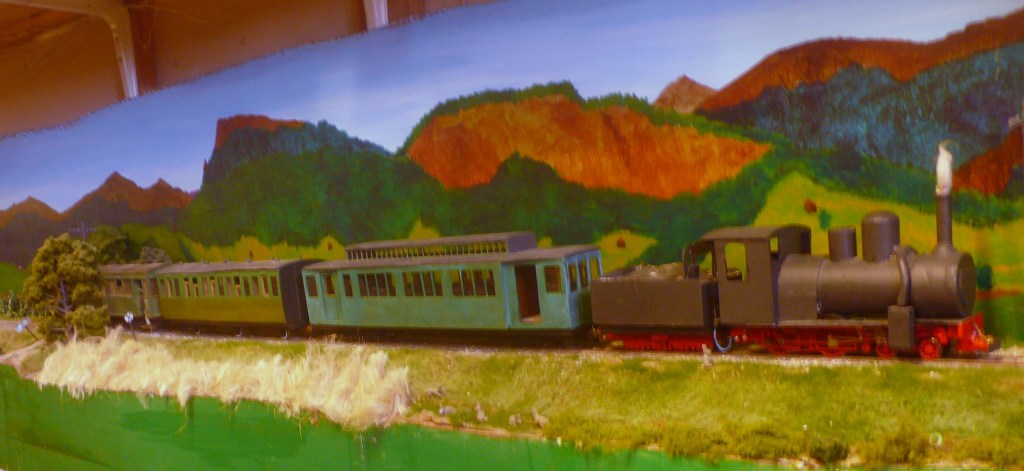
14-212. The excursion crosses the KTT, although as it is after darkness has fallen it is debatable what would have been seen out here in the fields. The first carriage is the infamous beer coach whereby beer is sold from a counter in the near vestibule. It is currently patronised by the scolari, no surprise there then! The six wheeler behind is fairly sedate but a bloke is standing on the lower footstep of the carriage behind, whist quaffing from a bottle. The front bogie of the 4-4-0 could probably do with lengthening but it is unlikely to get it. The beer coach was based on a German tramway vehicle, as I recall, hence the large vestibules. Another coach, with high rounded windows, from the same source, was marked up but never progressed. There are more than enough carriages nowadays so that is one that got away.
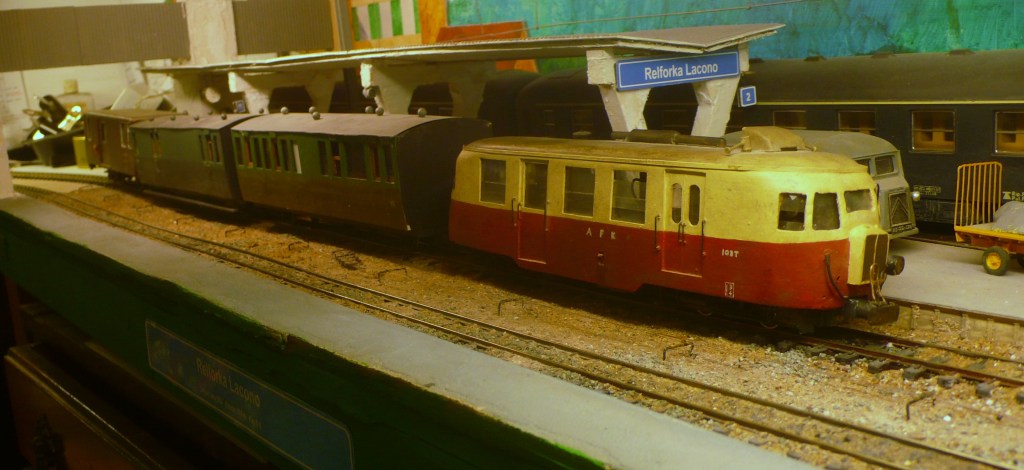
14-213. The Billard revs up and prepares to depart Relforka 70 minutes behind time thanks to the Royal Narnian Railways dilatory ways. There are more than a few passengers making the trip to Lacono as this train forms the last leg of a connection that left Sarip at 13.55 with the through coaches for Beruna. This arrived slightly late but the railcar guarantees to make connections to Lacono from Narnia and has to wait for the Beruna connection. The Postal traffic ensures that the train pays its way.
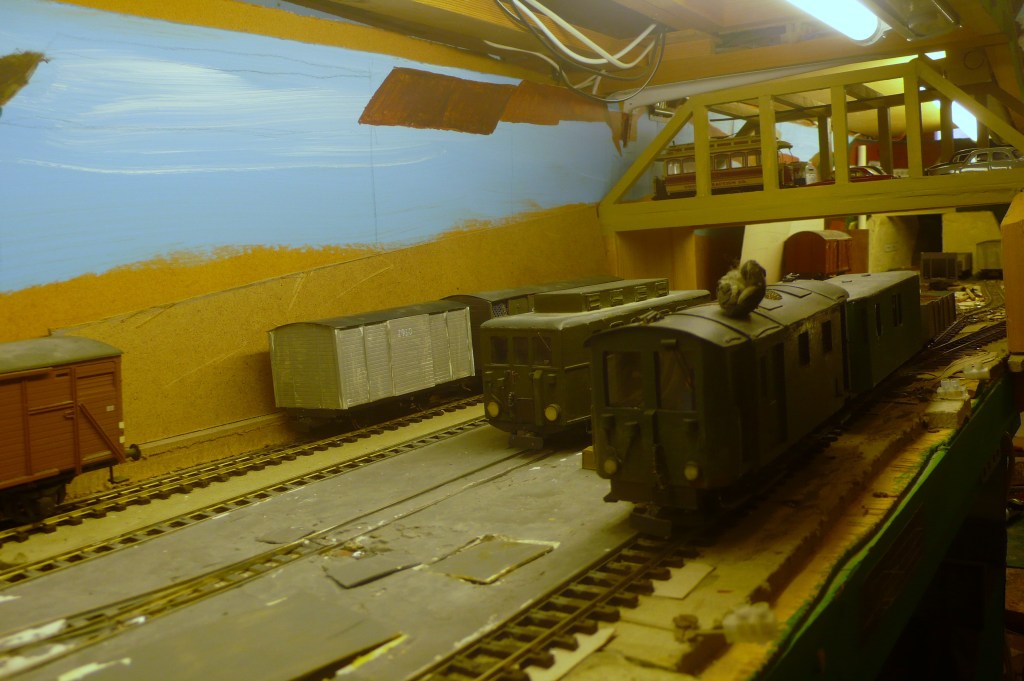
14-214. The pilot has returned to Urteno with the two opens just as the URT-RFK train is about to depart. This has picked up the wagon of logs for the paper mill. The SG van, on the transporter, has been left at the furniture factory in the background.
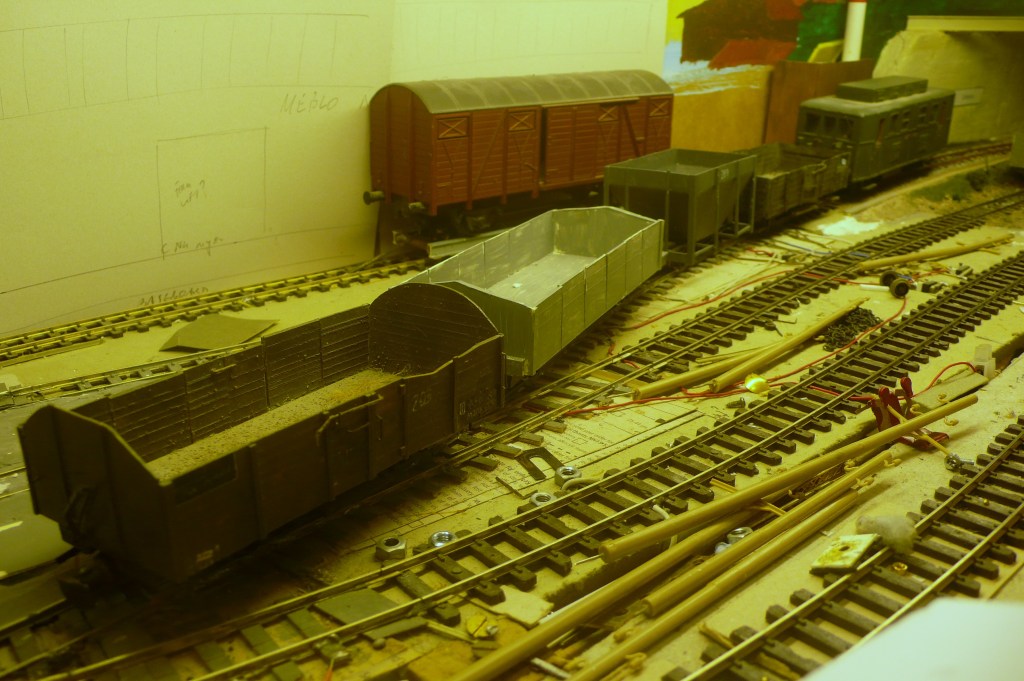
14-215. With the clock showing 23.10 the pilot/banker, now running as train 9603, makes the second trip up the bank this evening. The front two empty coal wagons are no good to anyone if they are left standing in the sidings at Urteno and the empty gravel wagon needs to return to Ospicio without overloading trains on the bank. The rear empty will be left in the siding at Varden as the banker returns. The Coal Sidings are the emptiest that they have been for some time which should please Miraro, the morning shunter, although whether this will cause problems remains to be seen.
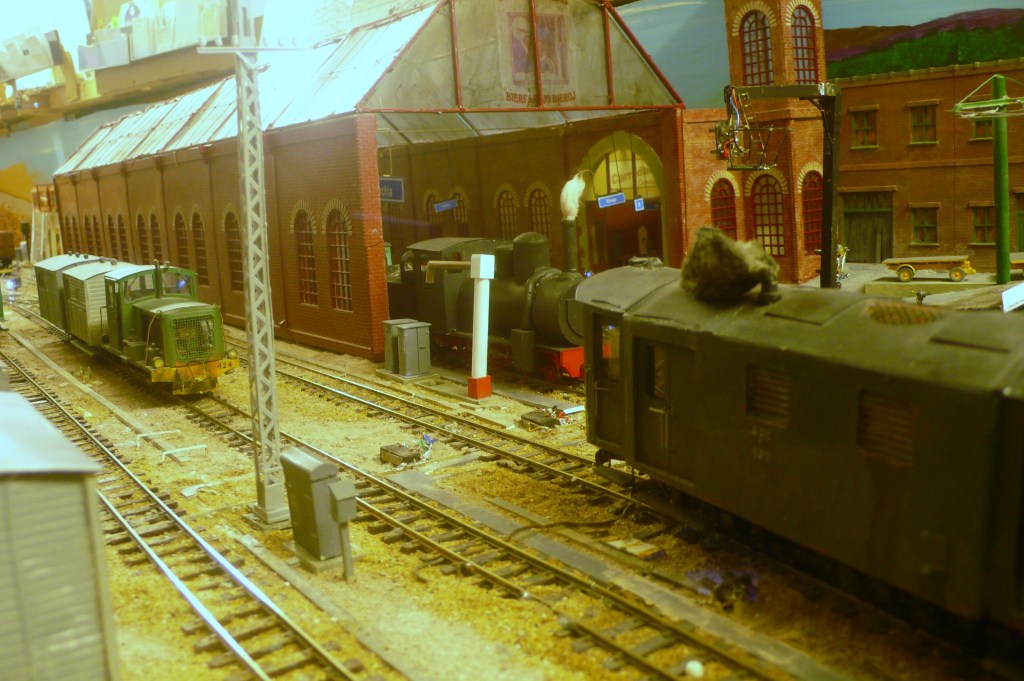
14-216. The ancient unkempt I-D-I frees the single line to give the excursion train the road. The excursion will double for the railcar tonight for those going onto the nightshift at the hospital. The train might be a bit untidy but there is a wide choice of seats available by now.
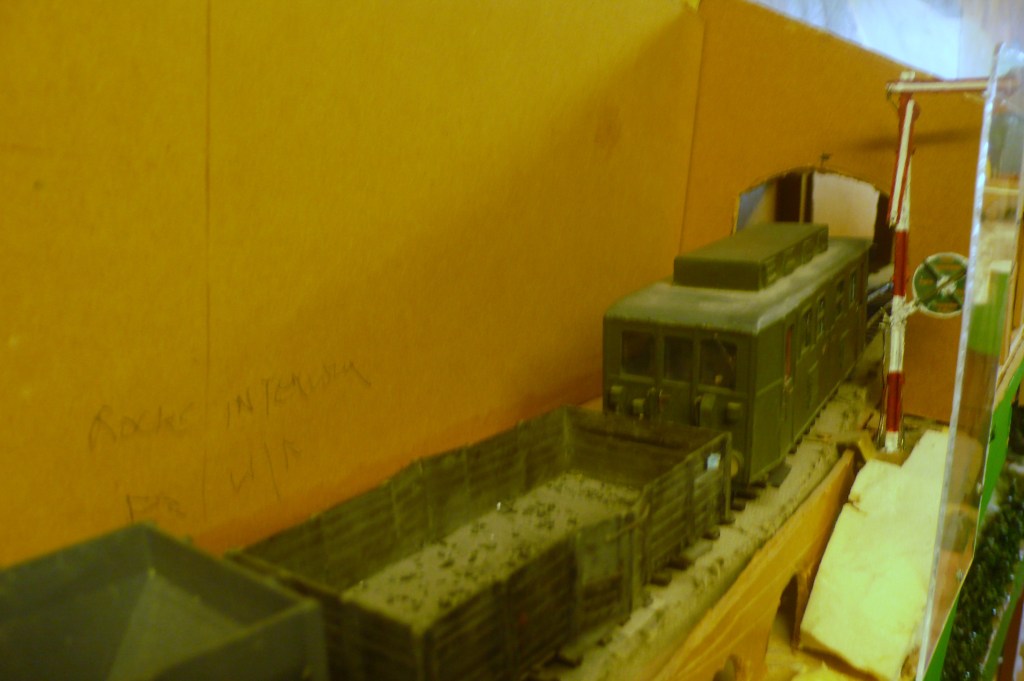
14-217. The second colliery trip working of the evening is obliged to pass Ithilarak’s home signal at danger, as per The Instructions, because the station is closed. A dead stop is prohibited here because of the gradient so the loco slows to walking pace, blows the horn and proceeds, ready to stop on sight of danger.

14-218. The excursion reaches Urteno at 23.30, as it is timed to do. The trams are still running so that workers can get to the hospital and the scolari revellers can get home.
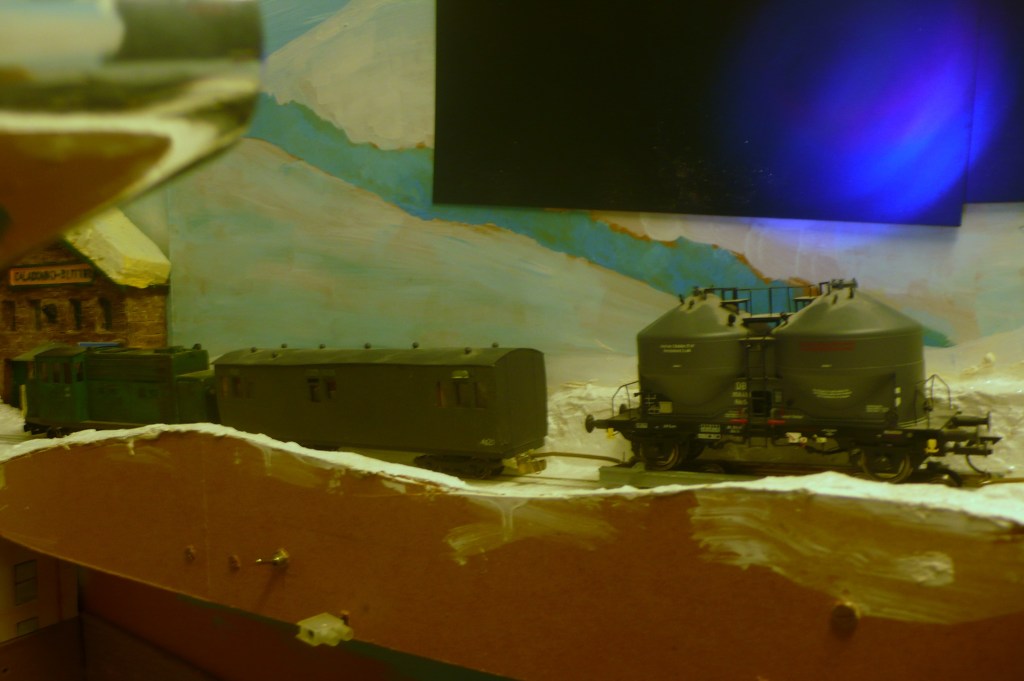
14-219. Over the hills and far away the cement train runs into the Narnian enclave. The aurora borealis can clearly be seen tonight. This is temporarily mocked up whilst I decide whether to proceed any further. I don’t suppose that many modellers attempt to simulate the Northern Lights! It might just be possible to finish this portion of the backscene as it might be seen at night, possibly with the moon and stars visible, although none of the stock has lighting in it. At the moment this is just an idea that may not go anywhere. The kaleidoscopic lighting device can be seen at the left and the right hand held the camera, hence the judder. There is a full range of red green and purple.
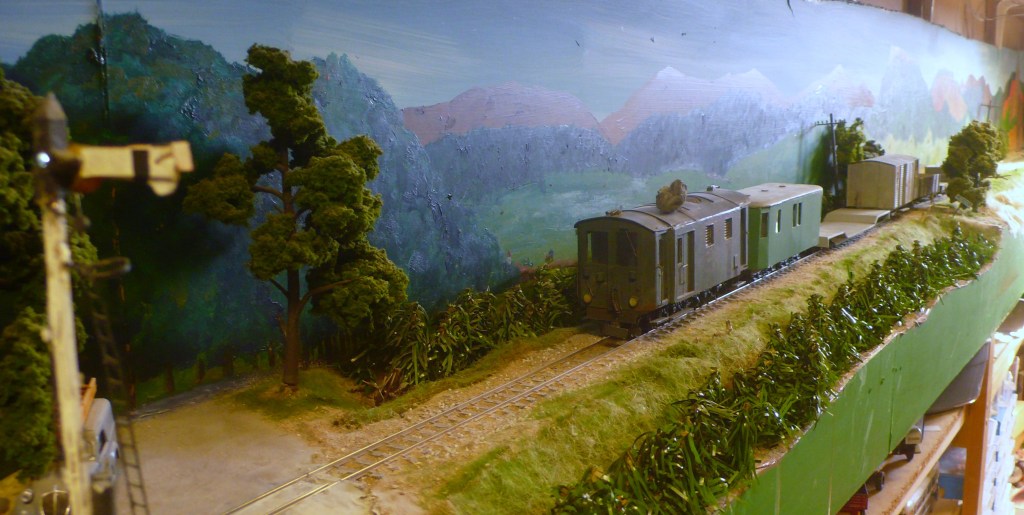
14-220. The return working of the Urteno goods looms out of the mists and darkness of the KTT maize fields as it leaves the private right of way to join the RN424 for the Ero crossing. After a long blast on the horn it will pass the enirasignalo which is standing at danger. The loco remains on the train as the crocodile was left at Lacono. Locos would not be changed just for the sake of it. The train is doing the job it was designed for ~ bringing empty NG wagons back to Relforka yard. The crocodile was taken to the workbench and put in order. One of the current collectors was touching the plastic wheel spoke inserts rather than a tyre. I do not understand why Roco designed the sixteen wheel mechanism to only pick up off eight wheels but it is likely to remain as it is, especially as I broke it during construction and bodged a repair.

14-221. The ecs from the seaside trip was allowed out of Urteno because the railcar was so late. Unfortunately the station at Lacono is blocked by the stock that the railcar is dropping and by the railcar itself and the empty stock is forced to run into the yard.
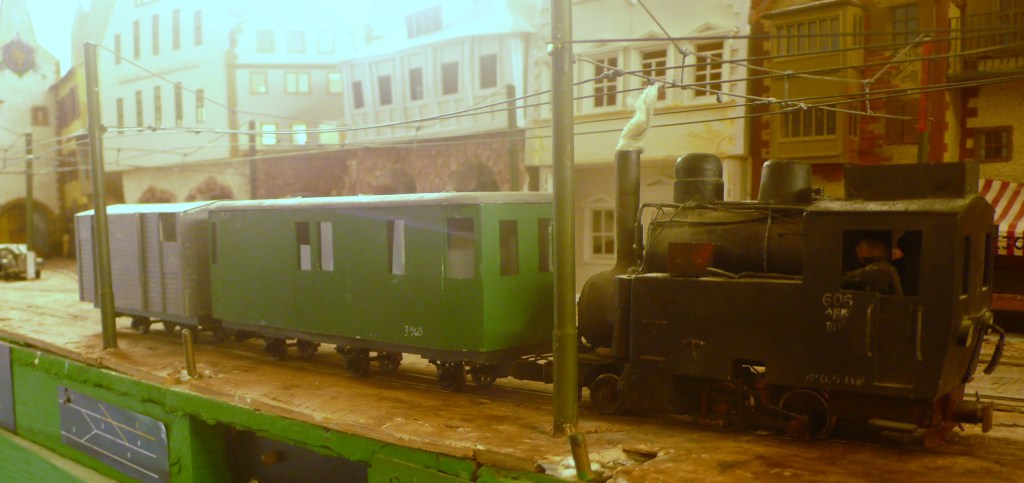
14-222. The ripples of the late running are still apparent at Fenditavalat at 23.30. In the final shunt of the day the pilot rounds up the brake and the road van running through to Krelm before departing for Rivabordo.
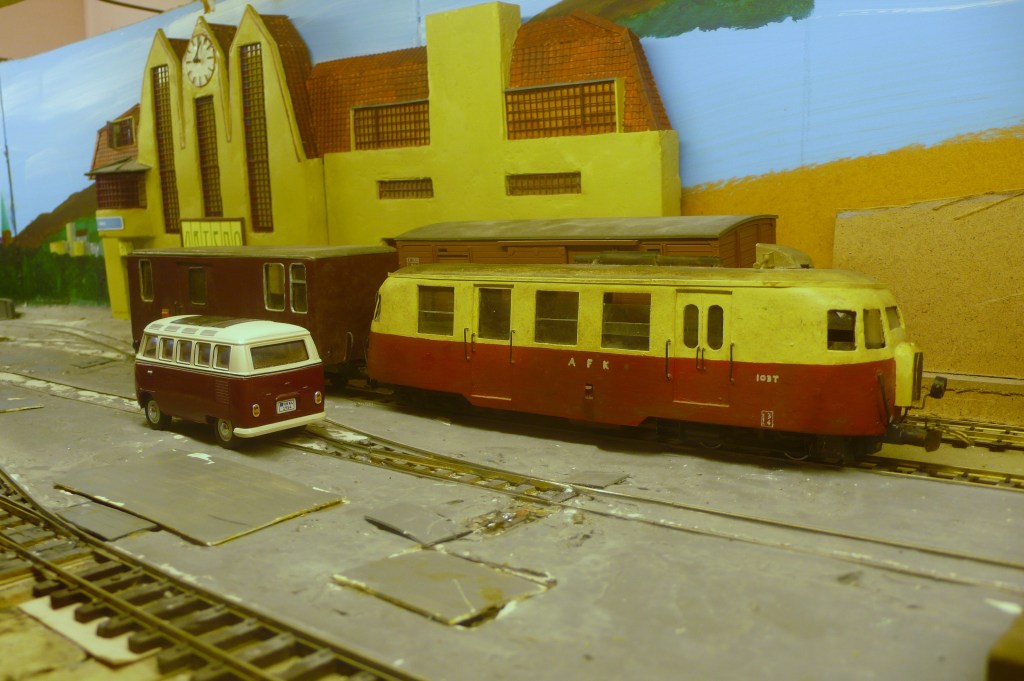
14-223. Ripples within ripples. The railcar finally reaches Urteno at midnight. The ferry and last bus left ages ago but the AFK is obliged to provide ongoing connections should they be needed. Lacono has rung through to confirm that they are. The minibus will run round the head of the lake to take passengers to the east shore.
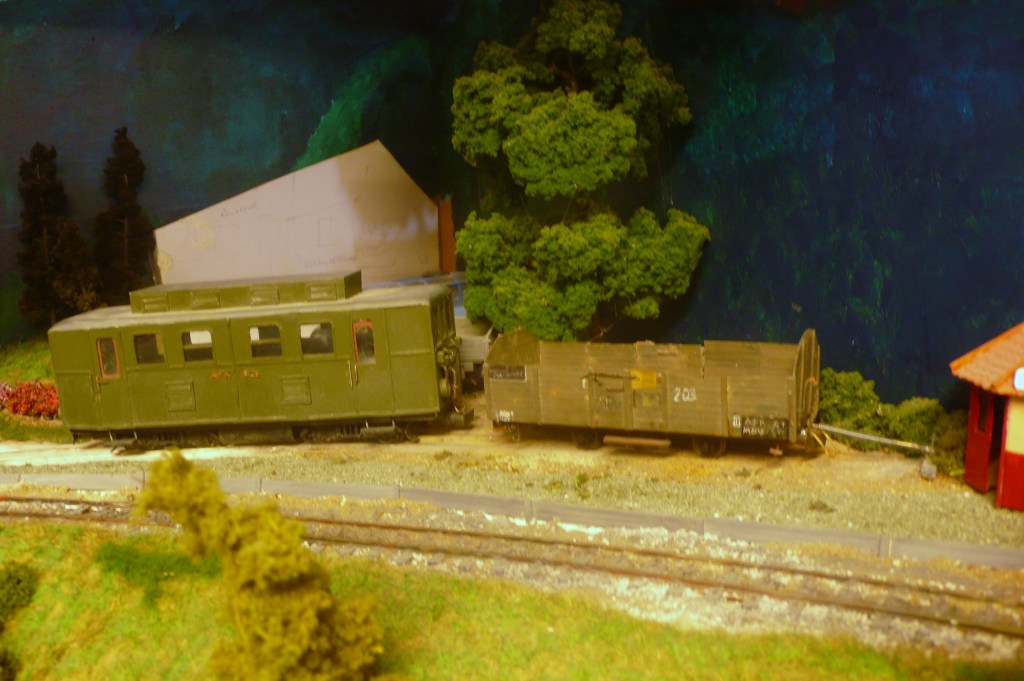
14-224. The Urteno pilot shunts Varden siding at half past midnight. The wagon is secured in the siding by the bar attached to the stop blocks. If it is not secured, even on the model, it will run out onto the mainline. The pilot, which you might remember started the day as the Lacono spare loco, is usually home and hosed by this time of night.
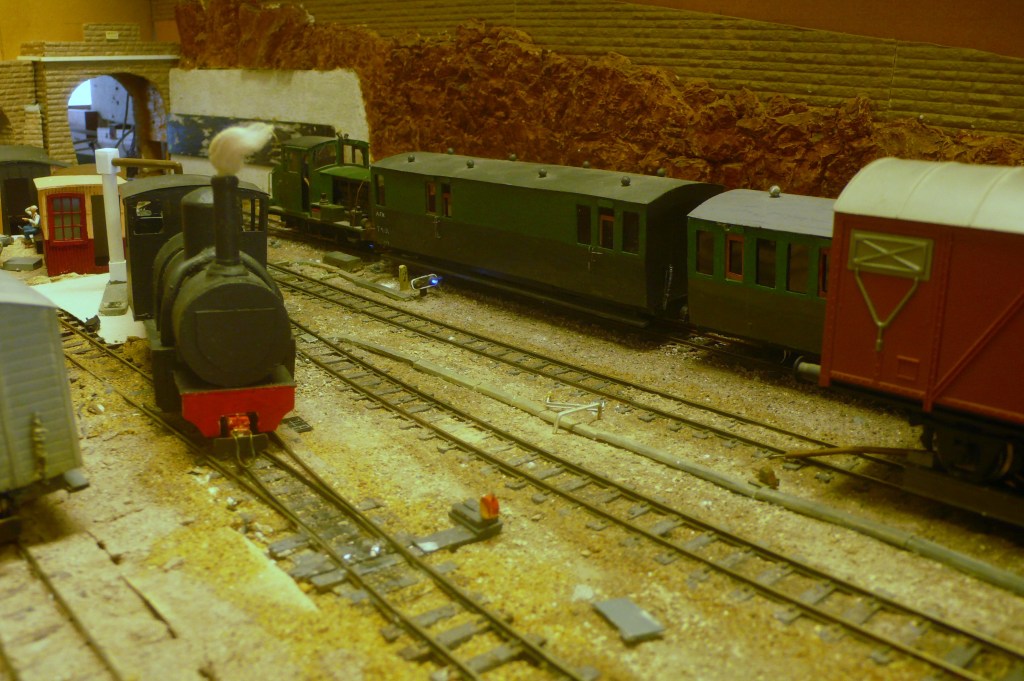
14-225. The 4-4-0 takes on water in Gasafabrikatastrato yard. The loco has been purloined to help shunt the yard. It is easiest for the crew to comply because it will help them get away earlier. In the background the pilot is shuffling the extra coach and the mail tender left behind by the railcar.

14-226. There is little road traffic in Lacono after midnight so the rules are stretched to leave a raft of wagons temporarily blocking the Karushnastrato crossing. The pilot, just visible beside the floodlight pylon, has just arrived to remove them. Any pedestrians can easily circumvent the barriers. The rear wagon, although incomplete, seems to be missing a few end struts.
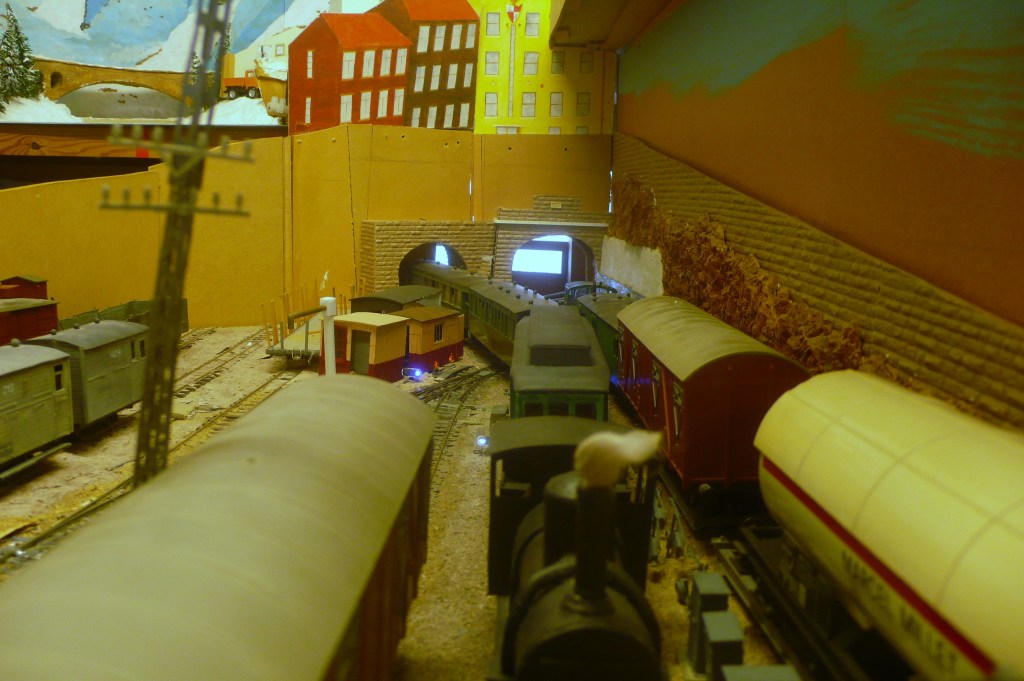
14-227. The signalman’s view at LaC cabin. The 4-4-0 is propelling the empty coaching stock towards Aspargo depot whilst the “spare” road holds wagons for the paper mill. It must be a bit disconcerting to sit on top of a chlorine tanker! Rather more disconcerting is the fact that it rams the box! The transporters were adjusted, a couple of sessions back, to incorporate a crude three point suspension system to improve their track holding. This slightly raised them, only by 1mm or so, but a couple of places have tighter clearances than I realised. The box needs a slight lift to prevent a recurrence.
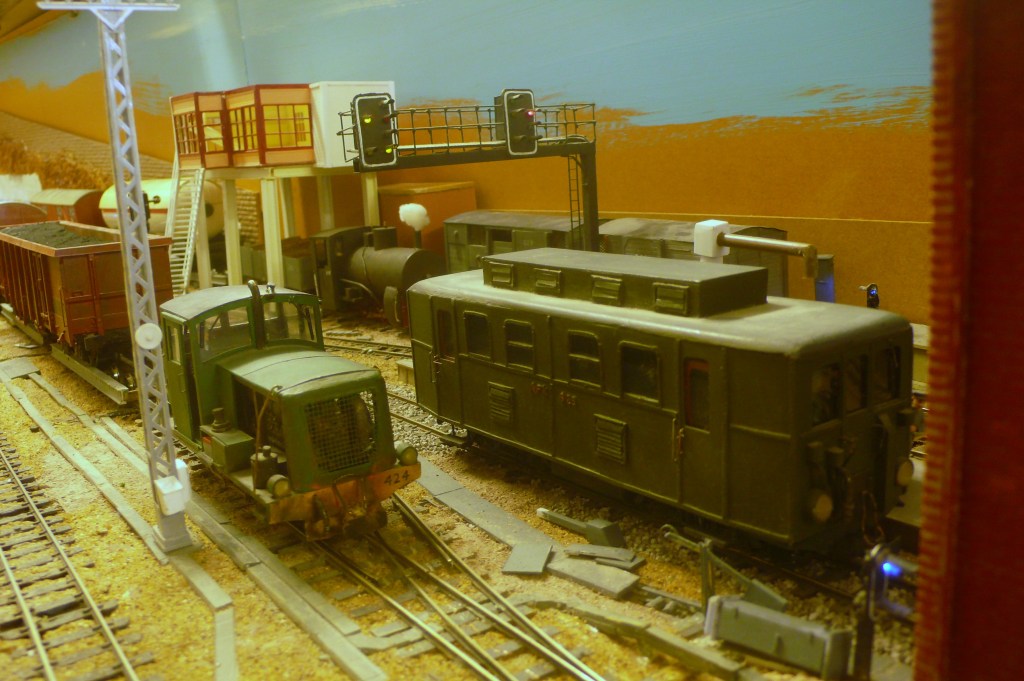
14-228. By now it is 01.00 and the fireless has arrived to pick up the mill loads. The Urteno banker/pilot is returning to Aspargo, as indicated by the diagonal yellow aspect, and the shunter is dealing with the gas coal.
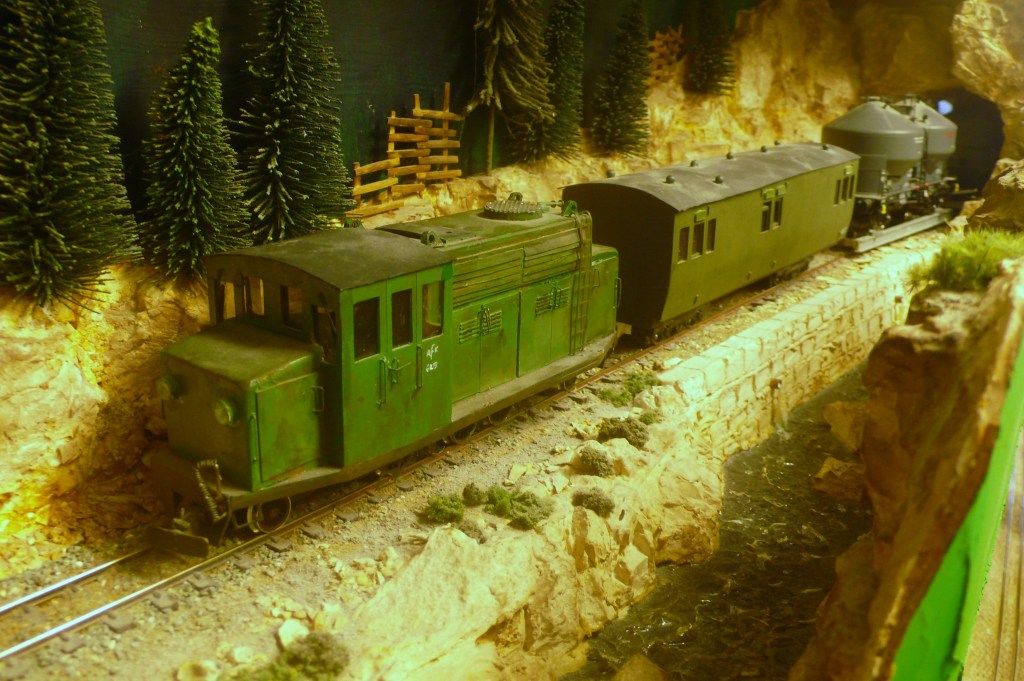
14-229. The cement train is still running down the Aepto Gorge when it is decided to end the session. The train will remain in suspended animation. The silos have caught a couple of overline features as well so these will need paring before the next session.
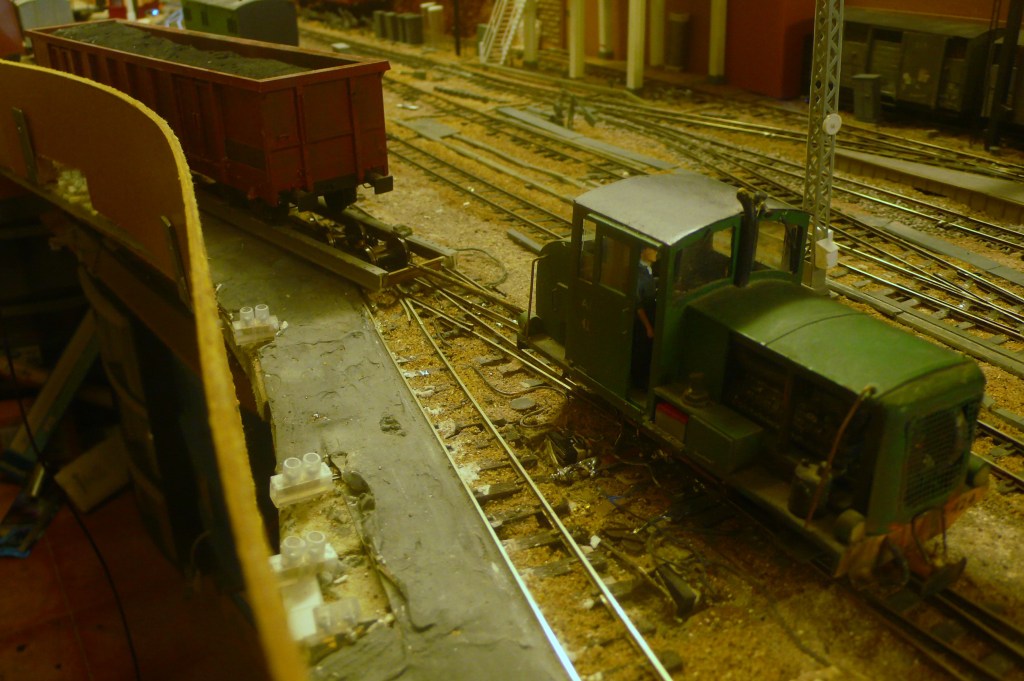
14-230. The Lacono pilot has moved the wagon of gas coal at its unloading point. Gasafabrikatastrato is closed to vehicle traffic and a temporary conveyor belt reaches across the road to deposit the coal in the gas works’ bunkers. The time is 01.30 and the session is declared closed despite there being unfinished business. This will be dealt with “tomorrow”.
The session started in late April and finished in mid September, taking a total of approximately 5 months to run through. There was a lot of traffic on the day but this is becoming the new norm. A lot of time was “lost” due to good weather and other interests such as cricket. The shutdown will see some remedial work, hopefully some new developments and a little attention paid to my other model railways. I don’t want a long shut down but that sounds all too familiar! Time will tell.
 Altonian Complementary Railways